

Summary
28 items · 45–90 minutes
Why the First Hour in Your New Apartment Matters Most
The moment you receive your keys is also the moment the clock starts on your security deposit. Any damage you fail to document before moving in can legally be attributed to you when you eventually move out — costing you hundreds or even thousands of dollars.
A structured walkthrough creates a timestamped record that protects both you and your landlord. It establishes a shared baseline of the unit's condition, eliminating the guesswork that typically drives deposit disputes. If you haven't already read through your lease carefully, our guide for first-time renters explains what security deposit terms and landlord expectations actually mean before you commit.
Bring a smartphone for photos and video, a notepad, and ideally a second person as a witness. Ask your landlord or property manager to walk through with you — their presence strengthens the record. If they can't attend, request that they sign the completed checklist afterward.
Smartphone with camera
Take dated photos and video of every pre-existing defect for your records.
Written move-in inspection form
Provides a formal, shareable record that both you and the landlord can sign.
Phone charger or plug-in device
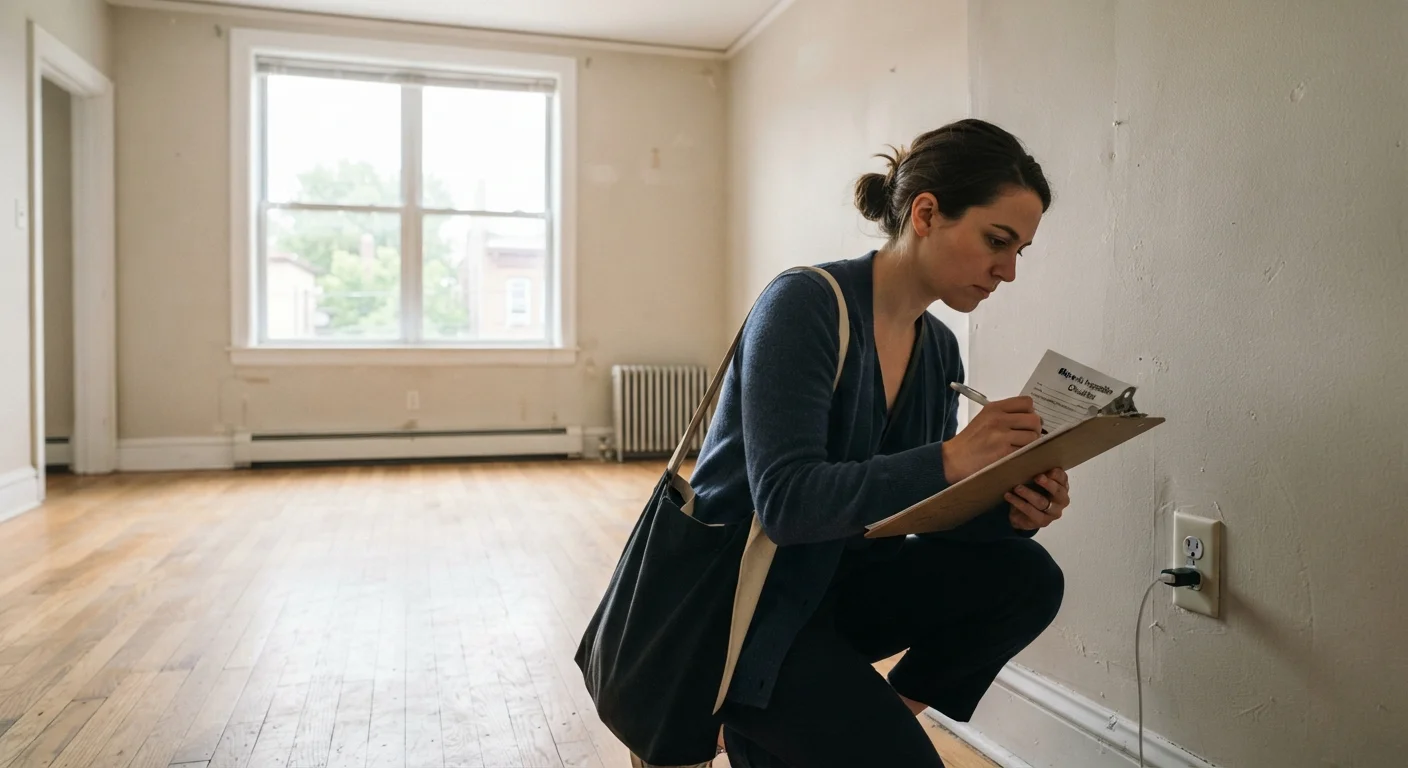
Use to test every electrical outlet in the unit quickly and without specialized tools.
Flashlight or phone torch
Illuminate dark closets, cabinet interiors, and corners where damage is easy to miss.
Notepad and pen
Record detailed observations that photos alone may not fully capture.
Room-by-Room Inspection Checklist
Work through each area of the apartment methodically. Mark every item as OK, Needs Attention, or Pre-Existing Damage, and photograph anything that isn't in perfect condition. Date-stamp all photos.
Preparation
Walls, Ceilings & Floors
Kitchen & Appliances
Bathrooms
Electrical, Heating & Cooling
Safety & Security
Submit Your Report the Same Day
A move-in inspection only protects you if it is documented and submitted before you move your belongings in — or at the very latest, on the first day of occupancy. Waiting even a few days weakens your legal standing, because the landlord can argue damage occurred after you took possession. Email your completed report with photos attached on day one and keep the sent message as proof of delivery.
After the Walkthrough: What to Do With Your Documentation
Once you've completed every section of the checklist, compile your notes and photos into a single document. Email it to your landlord the same day with a clear subject line such as Move-In Inspection Report — — . Email creates an automatic timestamp and a delivery record.
Request written acknowledgment. If your landlord disputes any item, note the disagreement in writing immediately rather than letting it become a verbal he-said/she-said situation later.
Verbal Agreements About Damage Don't Hold Up
If a landlord says 'don't worry about that scratch' or 'we'll fix that before you move in,' get it in writing. Verbal promises are almost impossible to enforce if a dispute arises at move-out. A brief email confirmation from the landlord acknowledging the pre-existing condition is far more valuable than a handshake.
Missing the Inspection Window Can Be Costly
Some states give tenants a specific window — often 24 to 72 hours after move-in — to submit a written inspection report. Missing this deadline may reduce your legal protections when disputing deposit deductions. Check your lease and your state's landlord-tenant statutes to confirm the applicable timeframe.
Store your inspection report somewhere you can retrieve it at move-out — cloud storage, a dedicated email folder, or both. Understanding your broader legal protections as a tenant is equally important; our article on renter's rights landlords must honor covers habitability standards and notice requirements worth knowing. For a complete picture of the entire rental journey, see The Renter's Complete Handbook.
This article provides general informational guidance for renters and does not constitute legal or financial advice. Deposit rules, required disclosures, and landlord obligations vary by state and locality. Consult a local tenant's rights organization or attorney for guidance specific to your situation.
The content on this site is for informational purposes only and is not a substitute for professional advice. Always consult a qualified professional for guidance specific to your situation.