

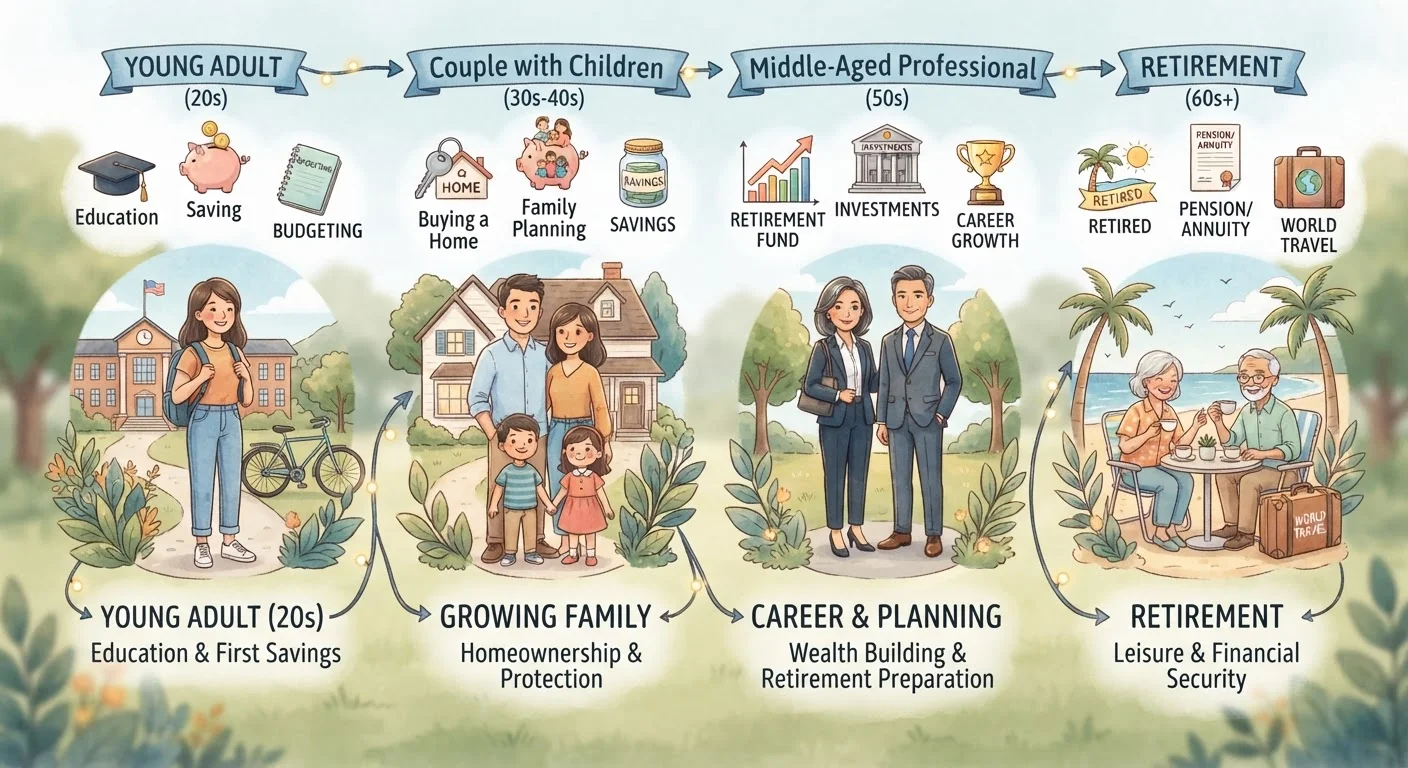
Why Life Stage Matters More Than Age Alone
Life insurance is fundamentally about replacing what would be lost — income, care, financial stability — if you were no longer here. That means coverage needs are driven less by a number on your birthday cake and more by who depends on you, what you owe, and what you want your legacy to look like.
If you're new to the concept, our overview of how life insurance actually works covers the foundational mechanics worth understanding first. The short version: a life insurance policy pays a death benefit to your named beneficiaries when you die, in exchange for premiums paid during the policy's term.
What that benefit should cover — and how much it should be — changes meaningfully as your circumstances evolve. The sections below walk through the most common life stages and the coverage questions each one tends to raise.
This Is General Information, Not Personal Advice
The guidance in this article reflects general patterns in how life insurance needs evolve — it is not tailored to any individual situation. Coverage requirements depend on your income, debts, dependents, health, and financial goals. A licensed insurance agent or financial adviser can help you assess what makes sense for your specific circumstances.
Early Adulthood: Single, Renting, and Building a Career
If you're in your twenties, renting an apartment, and have no dependents, you may genuinely need very little life insurance — or none at all. The core purpose of coverage is to protect people who rely on your income. If no one does, the financial case is limited.
That said, there are two scenarios where purchasing a modest policy early makes sense. First, if you have co-signed student loans or private debt that a parent or co-signer would inherit, coverage can protect them. Second, life insurance premiums are heavily influenced by age and health — locking in a lower rate while young and healthy can mean significant savings over a long term policy.
Marriage, Mortgages, and Growing Families
This life stage typically brings the sharpest increase in coverage needs. When a spouse, partner, or child depends on your income, the financial gap your death would leave becomes concrete and significant. A mortgage, childcare costs, and future education expenses all factor in.
Most financial planning guidance suggests working parents consider coverage equal to several multiples of their annual income — though the right amount depends on your specific situation. Our guide to evaluating coverage amounts walks through the key variables.
Term life insurance — which covers a fixed period, such as 20 or 30 years — is frequently chosen at this stage because it aligns with the years of highest financial obligation. For a comparison of term and permanent options, see term life vs. whole life.
Mid-Life: Kids in College, Debts Shrinking
By the time children are in college or leaving home, financial obligations often start to ease. The mortgage balance has dropped, retirement accounts have grown, and the household may be operating on two solid incomes again. This is a natural point to reassess whether existing coverage still fits.
Some people in this stage find they're over-insured — paying premiums on a large death benefit when the underlying need has diminished. Others discover gaps: a spouse who paused a career to raise children, for instance, may have fewer retirement assets, and coverage may still serve a protective function.
Pre-Retirement and Beyond: Estate Goals Take Center Stage
Once the mortgage is paid off and children are financially independent, the income-replacement rationale for life insurance largely fades. But coverage doesn't become irrelevant — it shifts purpose.
At this stage, life insurance often plays a role in estate planning: covering estate taxes, equalizing inheritances among heirs, or leaving a charitable gift. How life insurance connects to estate planning is a nuanced topic worth exploring if you're in this phase.
Permanent policies — like whole life — are more commonly discussed at this stage because they don't expire. However, they carry higher costs and trade-offs that deserve scrutiny. See our honest look at whole life trade-offs for a clear-eyed view.
“Life insurance isn't a product you buy once and forget. It's a financial tool that needs to be revisited whenever your life circumstances change meaningfully — because what you needed at 30 is rarely what you need at 50.”
— Insurance Basics Editorial Team, Editorial Staff, Insurance Basics
This article provides general information about life insurance concepts and is not personalized financial or insurance advice. Coverage needs, policy terms, and eligibility vary by individual and provider. Consult a licensed insurance professional or financial adviser for guidance specific to your situation.
The content on this site is for informational purposes only and is not a substitute for professional advice. Always consult a qualified professional for guidance specific to your situation.