

Our Verdict
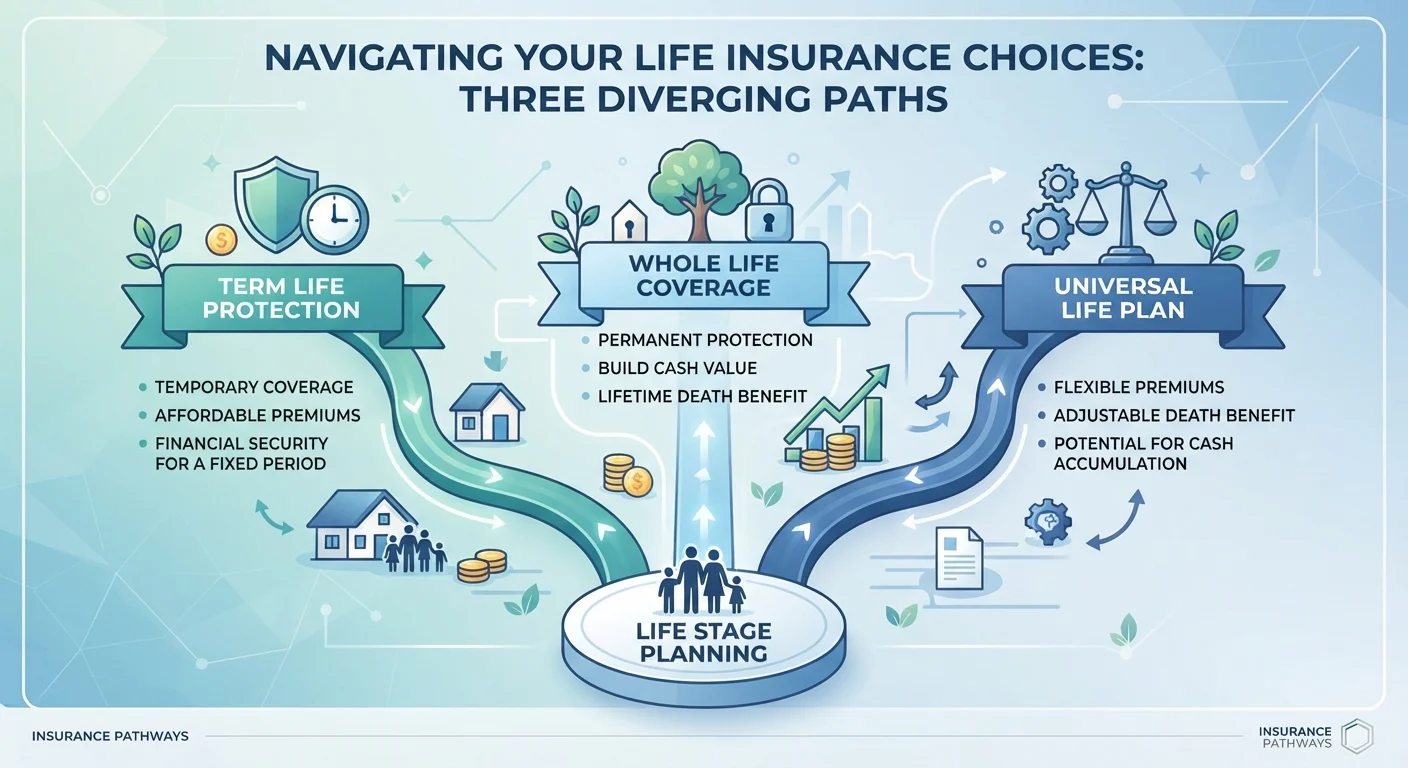
Term, whole, and universal life insurance each serve a distinct purpose. Term is built for defined-period protection at lower cost; whole life offers permanence and guaranteed cash value growth; universal life adds flexibility at the cost of complexity. None is objectively superior — the right structure depends on your income, obligations, and long-term financial picture.
| Best for | Recommended |
|---|---|
| Those who want straightforward, affordable coverage for a specific time horizon | Term Life Insurance |
| Those who want guaranteed lifetime coverage and predictable cash value accumulation | Whole Life Insurance |
| Those who want permanent coverage with the ability to adjust premiums or death benefits over time | Universal Life Insurance |
Why the Differences Between Policy Types Matter
Life insurance is not a single product — it's a category that includes several structurally different policy types. Choosing among them without understanding the core distinctions can mean paying more than necessary, or holding coverage that doesn't align with what you actually need.
If you're new to how life insurance works at a fundamental level, the mechanics of life insurance explained offers a solid foundation before diving into the comparison below. This article focuses specifically on the three most common structures: term, whole, and universal life.
This article is for general informational purposes only and does not constitute personalised insurance, financial, or legal advice. Coverage terms, costs, and availability vary by insurer and state. Consult a licensed insurance professional before making any coverage decisions.
Term Life Insurance: Coverage With a Built-In Expiration
Term life insurance provides a death benefit — a payout to your designated beneficiaries — if you die within a specified policy period, commonly 10, 20, or 30 years. If the term ends and you're still living, coverage simply expires with no payout and, in most cases, no return of premiums paid.
Because it carries no investment or savings component, term life is typically the most transparent policy type. Premiums are generally fixed for the duration of the term and tend to be lower than permanent alternatives at comparable coverage amounts.
Term policies suit people who need coverage tied to a specific financial obligation — a mortgage, years until children are financially independent, or a period during which one income supports a household. Once those obligations diminish, the need for large coverage may too.
Compare the Same Coverage Amount
When evaluating policy types side by side, use the same death benefit amount and your own age and health profile as the baseline. A lower premium for term isn't a direct saving unless it's measured against equivalent coverage. Ask an insurer or independent agent for quotes across policy types at the same face value to see the real cost difference.
For a deeper look at how term and whole life compare structurally, see term vs. whole life coverage goals.
Whole Life Insurance: Permanent Coverage With Guaranteed Cash Value
Whole life insurance is a form of permanent life insurance — it does not expire as long as premiums are paid. It includes two components: a death benefit paid to beneficiaries, and a cash value account that grows over time at a guaranteed rate set by the insurer.
Premiums for whole life policies are fixed, predictable, and considerably higher than term premiums for the same face value. In exchange, policyholders receive lifetime coverage and access to cash value they can borrow against or, in some cases, withdraw — though doing so can reduce the death benefit.
Whole life is often considered by those who want coverage that doesn't lapse as they age, or who want an insurance-linked savings element as part of a broader financial plan. It's worth understanding the real trade-offs involved — an honest look at whole life trade-offs covers these in detail.
| Term Life | Whole Life | Universal Life | |
|---|---|---|---|
| Coverage Duration | Fixed term (e.g., 10–30 years) | Lifetime (permanent) | Lifetime (permanent) |
| Premiums | Fixed, generally lower | Fixed, generally higher | Flexible within limits |
| Cash Value | None | Guaranteed growth rate | Interest-rate or market-linked |
| Death Benefit | Fixed face amount | Fixed face amount | Often adjustable |
| Complexity | Low | Moderate | Higher |
| Lapse Risk | Low if premiums paid | Low if premiums paid | Higher if underfunded |
Universal Life Insurance: Flexibility at the Cost of Complexity
Universal life insurance is also a permanent policy, but it introduces a degree of flexibility that whole life does not offer. Policyholders can — within limits — adjust their premium payments and, in some versions, the death benefit amount over time.
Like whole life, universal life accumulates cash value. However, instead of a guaranteed growth rate, interest is typically credited based on current market rates or a minimum floor set by the insurer. Some universal life variants, such as indexed or variable universal life, tie cash value growth to market indices or investment sub-accounts, introducing additional complexity and risk.
This flexibility can be valuable, but it also requires more active management. If premiums are reduced too much or cash value underperforms, the policy can lapse — leaving the policyholder without coverage. Understanding terms like cost of insurance, surrender charges, and net amount at risk is important before committing. The life insurance glossary is a useful reference for these concepts.
Universal Life Policies Can Lapse Unexpectedly
Because universal life policies allow flexible premium payments, it's possible to underfund a policy — particularly if interest rates fall or the cost of insurance rises with age. A lapsed policy means losing coverage and potentially losing accumulated cash value. If you hold or are considering a universal life policy, review annual policy illustrations carefully and consult a licensed agent to ensure the policy remains on track.
Choosing the Right Structure for Your Situation
There is no universally correct policy type. The decision turns on several factors that vary by individual:
- Duration of need: Is your coverage need temporary (a mortgage, dependent children) or lifelong (estate planning, permanent income replacement)?
- Budget: What premium level is sustainable over years or decades?
- Savings goals: Do you want your insurance to include a savings or cash-value component, or keep those goals separate?
- Tolerance for complexity: Are you prepared to monitor a policy with variable components, or do you prefer fixed, predictable terms?
These aren't questions with right or wrong answers — they're variables that a licensed insurance agent or financial professional can help you work through relative to your own circumstances. If you're just beginning to explore this topic, a ground-up overview of life insurance provides a helpful starting framework.
~54%
American adults with some form of life insurance
According to LIMRA's 2023 Insurance Barometer Study, slightly more than half of U.S. adults report owning life insurance in some form.
20+ years
Most common term length purchased
LIMRA data consistently shows 20-year terms as one of the most frequently selected options among term life buyers in the United States.
The content on this site is for informational purposes only and is not a substitute for professional advice. Always consult a qualified professional for guidance specific to your situation.