

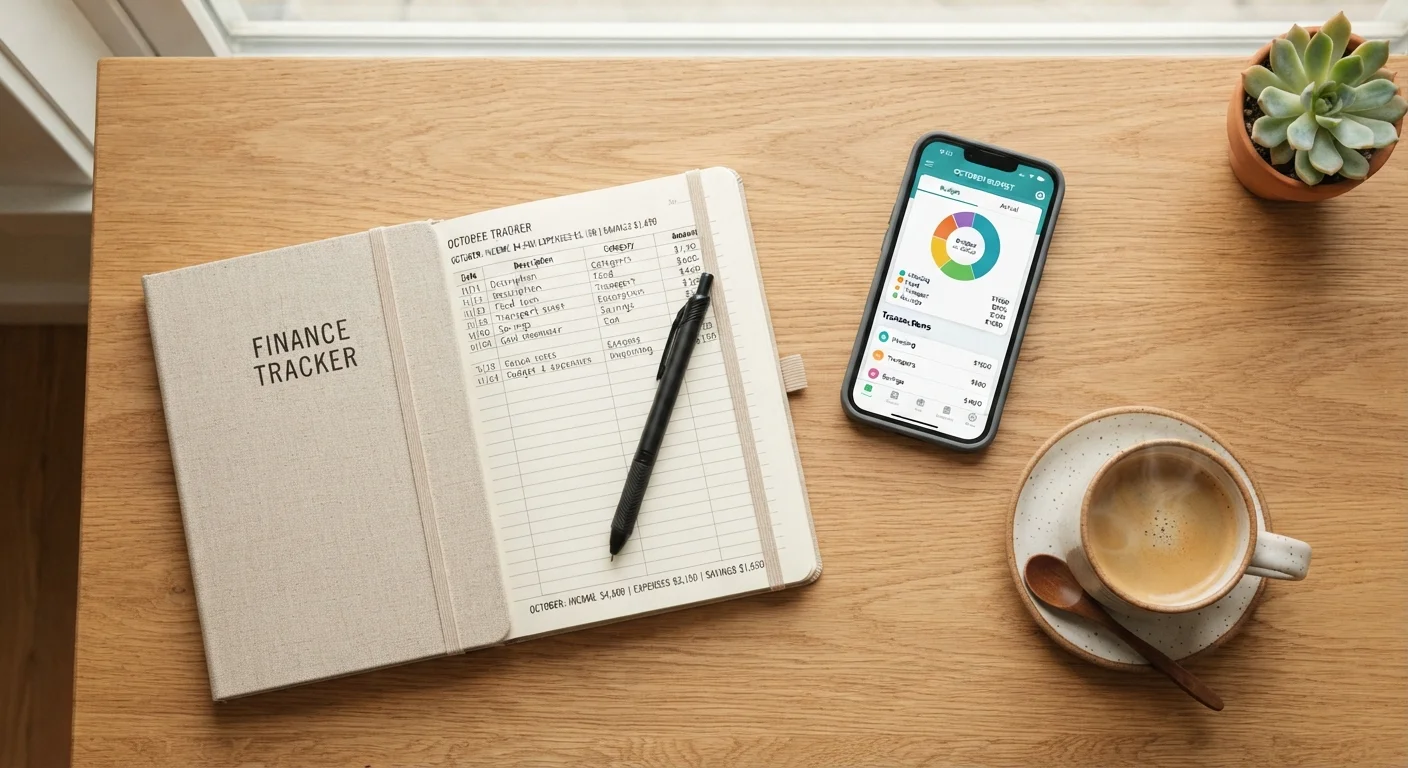
Why Most Spending Trackers Fail (And How to Avoid That)
Most people who try to track their spending give up within two to three weeks. The reasons are predictable: the system is too complex to maintain, the method doesn't match how they naturally behave, or the data doesn't feel actionable. The result is a half-filled notebook or a disconnected app that becomes background noise.
Effective tracking doesn't require logging every penny or spending hours in a spreadsheet. It requires capturing enough information, consistently, to reveal the patterns that actually matter. For most people, that means knowing where roughly 80–90% of their money goes — not a forensic accounting of every transaction.
Avoid Tracking Overload
Tracking every cent in obsessive detail often backfires — it becomes exhausting and people quit entirely. Aim for a system that captures the meaningful patterns, not microscopic precision. A few blind spots are acceptable if the big picture stays clear.
Before you start, you'll need a few basics in place:
What you will need
The Three Methods — and What You'll Need
Choosing the right approach upfront saves a lot of frustration. Here's a plain-language breakdown of your options, along with the tools each requires:
Bank or credit card statements
Provides a complete transaction history to review and categorize.
Notebook and pen
Used for manual tracking of daily spending in a simple log.
Spreadsheet application
Enables custom category tracking and running totals with formulas.
Expense-tracking app
Automates transaction imports and categorization from linked accounts.
Manual tracking works well for people who spend mostly in cash or want a mindful, deliberate practice. App-based tracking suits those who spend primarily on cards and prefer automation. The hybrid method — exporting bank data into a spreadsheet — offers flexibility without requiring full automation. There's no universally correct answer. See what resonates, then commit for at least 30 days before switching.
Step-by-Step: Building Your Tracking System
Follow these steps to set up a tracking system you'll actually maintain. The process takes 15–30 minutes to establish; ongoing maintenance is typically 10 minutes a week.
Pull together your recent transactions
Log into your bank and credit card accounts and download or print the last 30 days of statements. If you use cash frequently, estimate those purchases separately. This gives you raw material to work with — the actual record of where money has gone, not where you assumed it went.
Choose a tracking method that matches your habits
Three approaches work for most people: manual logging (writing purchases in a notebook as they happen), app-based tracking (linking accounts to an expense app that imports transactions automatically), and a hybrid approach (manually reviewing and categorizing bank exports in a spreadsheet). See our comparison of paper, spreadsheets, and apps to weigh what each demands in time and skill.
The best method isn't the most sophisticated one — it's the one you'll actually use beyond week two.
Set up meaningful spending categories
Group transactions into categories that reflect your life: housing, groceries, dining out, transportation, subscriptions, personal care, and so on. Avoid overly granular categories (separate lines for every fast-food chain) and categories so broad they hide important detail (a single "food" bucket for groceries, restaurants, and coffee).
Pay particular attention to irregular expenses — annual subscriptions, car registration, seasonal costs. These are the categories that most commonly blow up monthly budgets. Our guide on spending categories most budgets get wrong covers these in detail.
Record and categorize every transaction
Go through your statements line by line and assign each transaction to a category. For app users, review the auto-categorizations — apps frequently miscategorize merchants, and an unchecked miscategorization quietly distorts your picture over time. For manual or spreadsheet trackers, enter each transaction as it happens or batch them once daily.
Do a weekly 10-minute review
Once a week, total up each category and compare it to your expected spending. You're looking for two things: categories running unexpectedly high, and patterns you didn't notice before. This weekly rhythm prevents end-of-month shock and gives you time to adjust behavior before the damage is done.
[tip_callout]Refine your system after the first month
After 30 days, assess honestly: Did you actually use your chosen method? Were any categories consistently too vague or too detailed? Did you miss entire types of spending — like small recurring habits that quietly drain savings? Adjust categories and method accordingly. A tracking system should evolve with you, not stay frozen on day one's design.
Once you have a reliable picture of spending, you're positioned to build on it — whether that means tackling debt, building savings (see the Saving & Debt hub), or eventually exploring investing essentials.
Once tracking becomes routine, the next challenge is making habits that hold. Our article on budgeting habits that hold up over time covers what the evidence says about long-term consistency.
This Is Education, Not Financial Advice
The information in this article is general in nature and intended for educational purposes only. It is not personalized financial advice. For guidance specific to your situation, consider consulting a licensed financial professional.
This article is for general informational and educational purposes only. It does not constitute personalized financial advice. Consult a qualified financial professional for guidance tailored to your specific circumstances.
The content on this site is for informational purposes only and is not a substitute for professional advice. Always consult a qualified professional for guidance specific to your situation.