

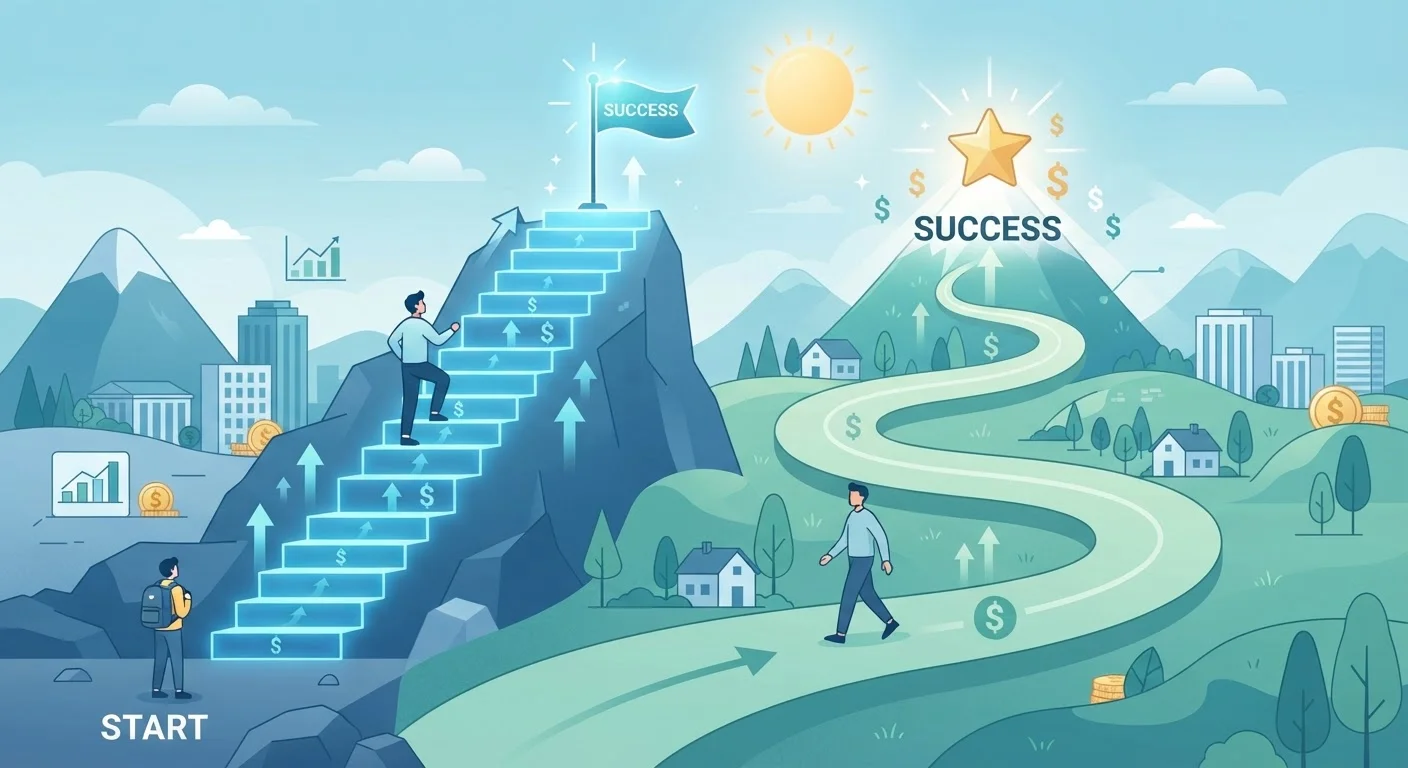
Option A
Debt Avalanche
The mathematically efficient, interest-minimizing approach.
Best for: People who want to pay the least total interest and are comfortable with slower early progress.
Option B
Debt Snowball
The psychologically rewarding, momentum-driven method.
Best for: People who need early wins to stay motivated and are willing to pay slightly more interest over time.
How Each Method Works
Both strategies share the same mechanical foundation: pay the minimum on every debt, then direct any extra money toward one target account until it's gone — then roll that freed-up payment into the next target. The difference is entirely in how you rank those targets.
Debt Avalanche: Sort your debts by interest rate, highest to lowest. Your extra money goes to the account with the steepest rate first, regardless of its balance size. Once that's paid off, you move to the next-highest rate.
Debt Snowball: Sort your debts by balance, smallest to largest. Your extra money goes to the account with the lowest balance first, regardless of its interest rate. Each paid-off account adds its minimum payment to the amount attacking the next balance — hence the "snowball" analogy.
For a concrete comparison of the two across common criteria, see the table below.
| Criterion | Debt Avalanche | Debt Snowball |
|---|---|---|
| Payoff order | Highest interest rate first | Smallest balance first |
| Total interest paid | Lower (mathematically optimal) | Typically slightly higher |
| Time to first payoff | Can take longer if top-rate debt is large | Faster — smallest balance clears quickly |
| Motivational impact | Slower early wins | Frequent early wins |
| Complexity | Low — sort by APR | Low — sort by balance |
| Best when... | Interest rates vary widely | Rates are similar; motivation is key |
Ready to put either method into practice? A realistic debt payoff plan can help you list your balances, map a sequence, and build a schedule you can actually follow.
The Math vs. The Psychology
The avalanche method wins on pure numbers. Because high-interest debt compounds faster, neutralizing it first reduces the total interest you'll pay across all accounts. The gap can be meaningful — potentially hundreds of dollars or more depending on balances and rates.
But math isn't the whole story. Several behavioral economics studies have found that people who use the snowball method are more likely to complete their debt payoff — partly because paying off an account entirely, even a small one, delivers a concrete sense of progress that sustains effort. A study published in the Journal of Marketing Research found that focusing on eliminating individual accounts (rather than reducing total balances) was associated with greater motivation and follow-through.
~$1,000+
Potential interest savings with avalanche method
Estimated savings vary widely by balance size and rate spread; consumer finance analysts often illustrate four-figure differences on typical credit card debt scenarios.
80%
Americans carrying some form of debt
According to Pew Research Center data, roughly eight in ten U.S. adults carry debt of some kind, from mortgages to credit cards to student loans.
The practical takeaway: the "best" method is the one you'll stick with. An avalanche plan abandoned after four months beats nothing — but a snowball plan you follow for three years beats a half-finished avalanche.
For more evidence-backed habits that can accelerate either approach, see strategies that consistently help people pay down debt faster.
Choosing Between Them — and What Else to Consider
A few practical questions can point you toward the right fit:
- Do your interest rates vary significantly? If one debt charges 24% APR and another charges 7%, the avalanche's advantage is real and worth capturing. If all your rates cluster within a few percentage points of each other, the financial difference between methods shrinks.
- How many accounts do you have? Someone with eight small debts may find the snowball's quick account eliminations highly motivating. Someone with two large debts may not notice much difference in pace between methods.
- What's your track record? Be honest. If prior plans have stalled, prioritize the method that keeps you engaged over the one that looks better on a spreadsheet.
It's also worth knowing these aren't the only tools available. Debt consolidation can sometimes simplify repayment or reduce interest costs, though it carries its own trade-offs. And pairing either method with sound budgeting basics — tracking spending, finding room for extra payments — is what makes the numbers work in real life.
Both Methods Require Extra Payments
Neither the avalanche nor the snowball works on minimum payments alone — minimums largely cover interest charges, not principal. The strategy only accelerates payoff when you consistently direct additional funds beyond the minimums toward your target account. Even a modest extra $50–$100 per month can meaningfully shorten your timeline, though individual results will vary based on balances and rates.
Once your debt is under control, redirecting that freed-up cash toward savings and investments matters just as much. The Investing Essentials hub covers foundational concepts to help you take that next step confidently.
This article is for general informational purposes only and does not constitute personalized financial or legal advice. Consult a qualified financial professional for guidance tailored to your specific situation.
The content on this site is for informational purposes only and is not a substitute for professional advice. Always consult a qualified professional for guidance specific to your situation.