

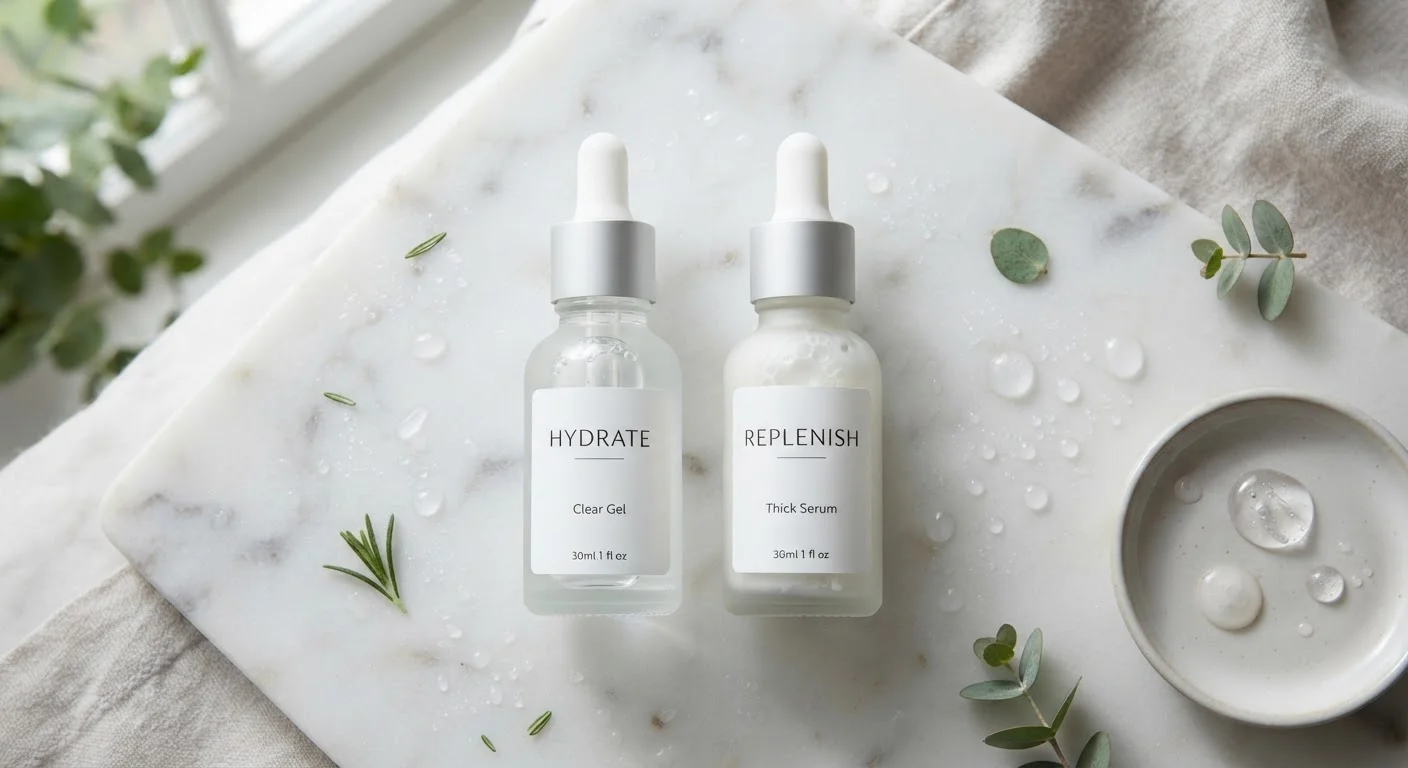
Option A
Hyaluronic Acid
The high-tech hydrator with serious staying power.
Best for: Those seeking deep, layered hydration with a lightweight, serum-friendly texture.
Option B
Glycerin
The budget-friendly workhorse humectant with a long track record.
Best for: Anyone wanting reliable, affordable moisture that plays well with every skin type and product format.
What Is a Humectant, and Why Does It Matter?
Before pitting these two ingredients against each other, it helps to understand what they have in common. Both hyaluronic acid and glycerin are humectants — ingredients that attract and bind water molecules to the skin's surface. Think of them as tiny sponges that pull moisture either from the environment around you or from deeper layers of the skin into the outermost layer (the stratum corneum).
Humectants are foundational in any hydrating skincare routine because they address a root cause of dull, tight, or flaky skin: lack of water in the outer skin barrier. They're distinct from emollients (which soften skin) and occlusives (which seal moisture in). Ideally, a well-rounded moisturizer uses all three in combination.
Humectants Need Moisture to Work
In very low-humidity environments, humectants have less environmental moisture to draw from, which can reduce their effectiveness. This is why layering a humectant serum under a sealing moisturizer is especially important during winter months or in dry climates. Applying humectants to damp — not dripping wet — skin is a simple way to improve results.
Hyaluronic Acid: What the Science Actually Says
Hyaluronic acid (HA) is a naturally occurring polysaccharide — a type of sugar molecule — found throughout the human body, particularly in connective tissue, eyes, and skin. In skincare formulas, it's typically synthesized through fermentation rather than derived from animal sources.
One of HA's most celebrated properties is its theoretical capacity to hold a significant amount of water relative to its weight, which is why it's marketed so heavily as a hydration powerhouse. In practice, topical HA primarily hydrates the surface and upper layers of the skin.
Modern HA serums often use multiple molecular weights to target different skin depths: high-molecular-weight HA sits on the surface, providing a plumping, smoothing effect; low-molecular-weight HA penetrates more deeply into the skin. This layered approach is a key advantage over single-weight formulations.
64%
Water content of healthy skin
The stratum corneum typically requires adequate water content — often cited around 10–30% — to function properly, while the deeper dermis contains significantly more, underlining why surface hydration matters.
100+ years
Glycerin's history in skincare
Glycerin has appeared in cosmetic and pharmaceutical formulations since at least the late 19th century, making it one of the most time-tested ingredients in modern skincare.
3 sizes
Common HA molecular weight tiers
Many hyaluronic acid serums are formulated with high, medium, and low molecular weight variants to address hydration at multiple skin depths simultaneously.
Glycerin: The Underrated Classic
Glycerin (also called glycerol) has been used in skincare formulations for well over a century — and for good reason. It's a simple, small molecule derived from plant oils or synthetic sources, and it's one of the most well-researched humectants in cosmetic chemistry.
Because of its small size, glycerin integrates easily into the skin's outer layers. Research published in dermatology literature has noted glycerin's ability to support the skin's natural barrier function alongside its humectant properties — a dual benefit that's easy to overlook when all the attention is on shinier, more heavily marketed ingredients.
Glycerin does have one known drawback: in very high concentrations applied without dilution, it can feel tacky on the skin. Most commercial formulations balance this by using glycerin at carefully calibrated percentages within a broader product formula.
| Criterion | Hyaluronic Acid | Glycerin |
|---|---|---|
| Molecular complexity | Large polysaccharide, multiple weight options | Small, simple molecule |
| Texture on skin | Lightweight, watery | Slightly thicker, can feel tacky in high concentrations |
| Typical product formats | Serums, essences, ampoules | Cleansers, toners, moisturizers, serums |
| Cost in formulations | Generally higher cost | Generally lower cost |
| History of use | Popularized in skincare from the 1990s onward | Used in cosmetics for over a century |
| Best climate for use | Works in most climates; seal with occlusive in dry air | Works in most climates; seal with occlusive in dry air |
| Skin-barrier support | Primarily hydration focused | Hydration plus some barrier-supportive properties |
How to Use Both Ingredients Together
Here's the good news: you don't actually have to choose. Hyaluronic acid and glycerin complement each other well, and many serums and moisturizers already contain both. When layering products, apply humectant-rich serums to slightly damp skin — this gives both HA and glycerin more water molecules to bind, maximizing their effect.
Always follow humectants with an emollient or occlusive (like a moisturizer or facial oil) to lock that attracted moisture in. Skipping this step — especially in dry or cold climates — can actually backfire, causing humectants to draw moisture out of the deeper skin layers rather than from the air around you.
For sensitive or reactive skin types, glycerin-heavy formulas are often easier to tolerate, as hyaluronic acid products can occasionally contain additional actives or preservatives that cause sensitivity. As always, patch-testing any new product is a sensible habit.
The content on this site is for informational purposes only and is not a substitute for professional advice. Always consult a qualified professional for guidance specific to your situation.