

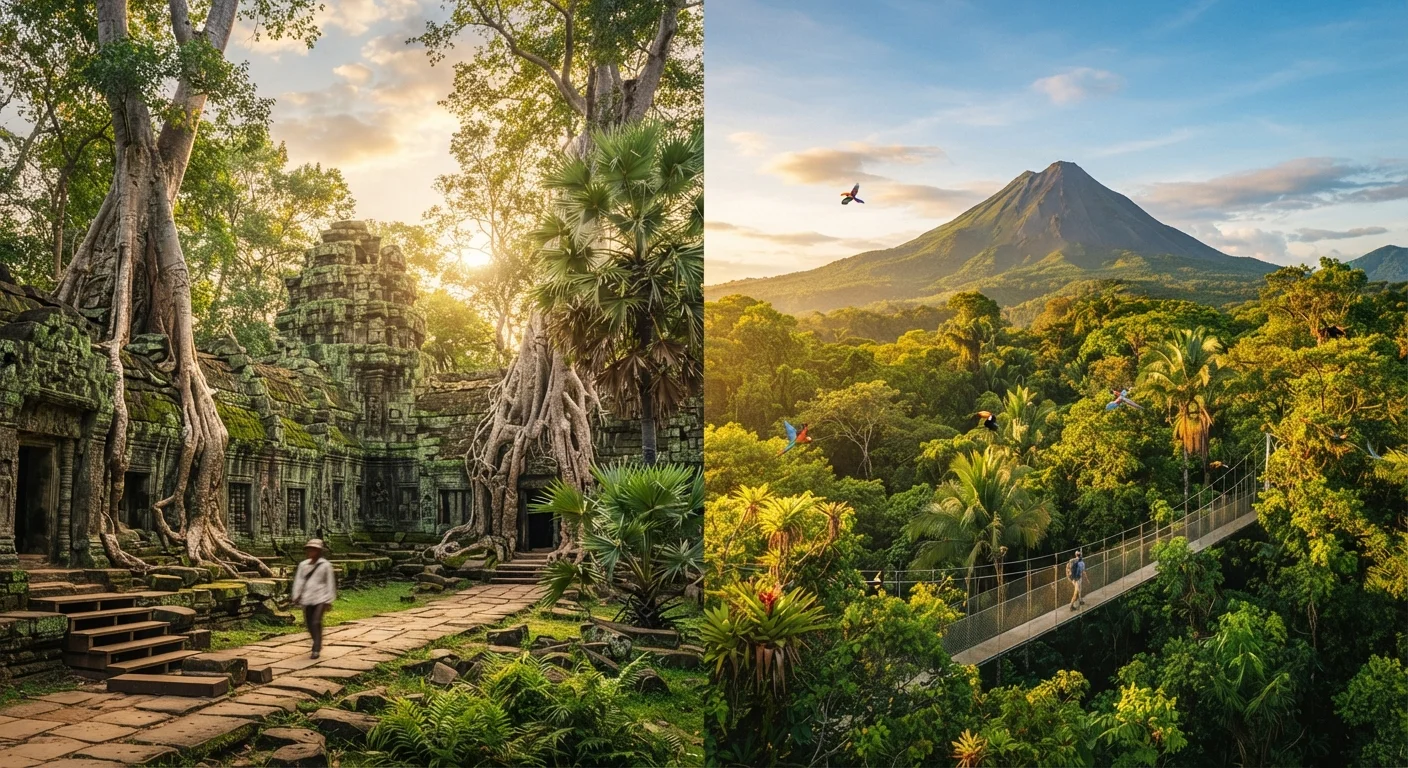
Option A
Southeast Asia
The immersive, culturally rich long-haul adventure.
Best for: Travelers drawn to ancient temples, diverse cuisines, and a well-worn backpacker infrastructure that makes navigating new territory feel surprisingly manageable.
Option B
Central America
The accessible, nature-forward gateway from the Americas.
Best for: Travelers who want dramatic landscapes, ecological adventure, and shorter flight times from the United States without a full long-haul commitment.
Setting the Scene: What Each Region Offers
Choosing between Southeast Asia and Central America as a first international destination is less about which is objectively better and more about which aligns with the kind of traveler you are right now. Both regions are popular with Americans venturing abroad for the first time — and for good reason. Each delivers a compelling mix of landscapes, culture, and value. But they deliver it very differently.
Southeast Asia spans countries like Thailand, Vietnam, Cambodia, Indonesia, and Laos, offering an extraordinary layering of Buddhist temples, colonial history, street food culture, and coastlines ranging from the Gulf of Thailand to the South China Sea. The region has a mature backpacker infrastructure built over decades, meaning hostels, guesthouses, and tour operators are abundant and accustomed to international visitors.
Central America — including Costa Rica, Belize, Guatemala, Panama, and Honduras — punches above its weight in terms of ecological diversity. Volcanoes, cloud forests, coral reefs, and Mayan ruins exist within relatively short drives of one another. The region has a smaller geographic footprint than Southeast Asia, which can make multi-country itineraries feel less daunting. Before committing to either, it's worth reviewing this destination research checklist to make sure you've covered the essentials.
Cost, Logistics, and Getting There
| Criterion | Southeast Asia | Central America |
|---|---|---|
| Flight time from US | 15–22+ hours | 3–8 hours |
| Visa requirements | Varies by country; many visa-on-arrival | Most countries visa-free for US citizens |
| Primary language | Multiple; English in tourist areas | Spanish (Belize: English) |
| Budget travel potential | Very high in most countries | High, varies significantly by country |
| Cultural immersion depth | Extensive — temples, traditions, diverse cuisines | Strong — Mayan heritage, ecological culture |
| Eco-adventure options | Available; island and jungle focused | Exceptional; volcanoes, rainforests, reefs |
| Ideal trip length | 3+ weeks recommended | 1–3 weeks manageable |
| Tourist infrastructure | Highly developed in key countries | Well-developed in Costa Rica, Belize, Panama |
Flight time is one of the most practical differentiators. From the US East Coast, direct or one-stop flights to countries like Costa Rica or Belize can run as few as three to six hours. Southeast Asia, by contrast, typically requires 15 to 22 hours of travel time, often with a layover in a hub like Tokyo, Seoul, or Doha. That time investment shapes how long your trip needs to be to feel worthwhile.
In-country costs in Southeast Asia have a reputation for being exceptionally low, though this varies considerably between, say, budget-friendly Cambodia and the more developed Singapore or Bali. Central America also offers affordable travel, particularly in Guatemala and Nicaragua, though Costa Rica — one of the most visited countries in the region — trends notably pricier than its neighbors. Neither region is uniformly cheap, and your actual budget will depend heavily on accommodation choices, transportation style, and whether you're joining organized tours or moving independently.
Logistics within each region differ meaningfully. Southeast Asia has extensive bus, train, and budget airline networks connecting countries, but navigating cross-border travel for the first time can feel complex. Central America's smaller size means overland travel between countries is common and well-trodden, though border crossing procedures vary and should be researched carefully in advance.
Safety, Health, and Practical Considerations
~1.5M
Americans visiting Costa Rica annually
Costa Rica is consistently one of the most visited destinations in the Americas for US travelers, according to ICT (Costa Rica Tourism Board) data.
~11M
US arrivals to Southeast Asia yearly
Thailand, Vietnam, and Indonesia each rank among the top Southeast Asian destinations for American tourists, per national tourism authority reports.
160+
Countries requiring no US passport visa for entry
The US passport provides visa-free or visa-on-arrival access to the majority of Central American and most popular Southeast Asian nations, per Henley Passport Index data.
Safety is one of the most common concerns for first-time international travelers, and it deserves honest treatment rather than sweeping reassurances. Both regions contain countries with very different safety profiles. In Southeast Asia, Thailand, Vietnam, and Bali are widely considered safe and traveler-friendly, while some other areas in the region carry different risk levels. In Central America, Costa Rica, Belize, and Panama are generally considered more stable for tourism, while some other countries carry active US State Department travel advisories. Always check current government travel advisories before booking — conditions change, and advisories reflect real, up-to-date assessments.
Health precautions are relevant in both regions. Vaccinations, malaria prophylaxis in certain areas, and food and water hygiene are all considerations worth discussing with a travel medicine provider well before departure. The specific requirements differ by country and even by region within a country, so personalized guidance matters here.
If you're weighing how to structure your booking process, a travel agency with regional expertise can be a genuine asset — particularly for first-timers managing complex itineraries. This guide to working with a travel agency walks through what to expect from the process. It's also worth knowing that both regions have distinct high and low seasons; traveling off-peak can offer savings but also comes with real trade-offs in either destination.
Always Check Official Travel Advisories
The US Department of State publishes country-specific travel advisories at travel.state.gov, rated from Level 1 (Exercise Normal Precaution) to Level 4 (Do Not Travel). Both Southeast Asia and Central America include countries across that spectrum. Advisory levels can shift with little notice due to political events, natural disasters, or public health developments — checking the current status before booking and again before departure is strongly recommended.
Culture, Language, and the Traveler Experience
Culture is perhaps the most personal dimension of this comparison. Southeast Asia offers an immersive depth that is difficult to match — centuries-old temple complexes, living religious traditions, and cuisines that vary dramatically from country to country. Language barriers exist, but English is widely spoken in tourist areas across Thailand, Vietnam, and Bali. That said, the cultural distance from everyday American life is significant, which for many first-timers is precisely the appeal.
Central America shares more linguistic and cultural familiarity for many American travelers. Spanish is the primary language across most of the region (with Belize as the English-speaking exception), and the cultural exchange between the US and Central America means that navigating systems, menus, and interactions can feel more intuitive. The region's connection to Mayan heritage, particularly in Guatemala and the Yucatán-adjacent areas, also provides rich historical depth for travelers who want more than just beach and jungle.
Ultimately, neither region offers a single, monolithic experience. Multi-country itineraries in both areas give travelers the chance to mix urban and rural, adventure and relaxation — much like the choice explored in city breaks versus road trips. The question isn't which region is better — it's which one fits the trip you're ready to take right now.
This article provides general travel information for educational purposes only. Entry requirements, safety conditions, health recommendations, and travel costs change frequently. Always verify current visa rules, travel advisories, and health guidance through official government and healthcare sources before booking or traveling.
The content on this site is for informational purposes only and is not a substitute for professional advice. Always consult a qualified professional for guidance specific to your situation.