

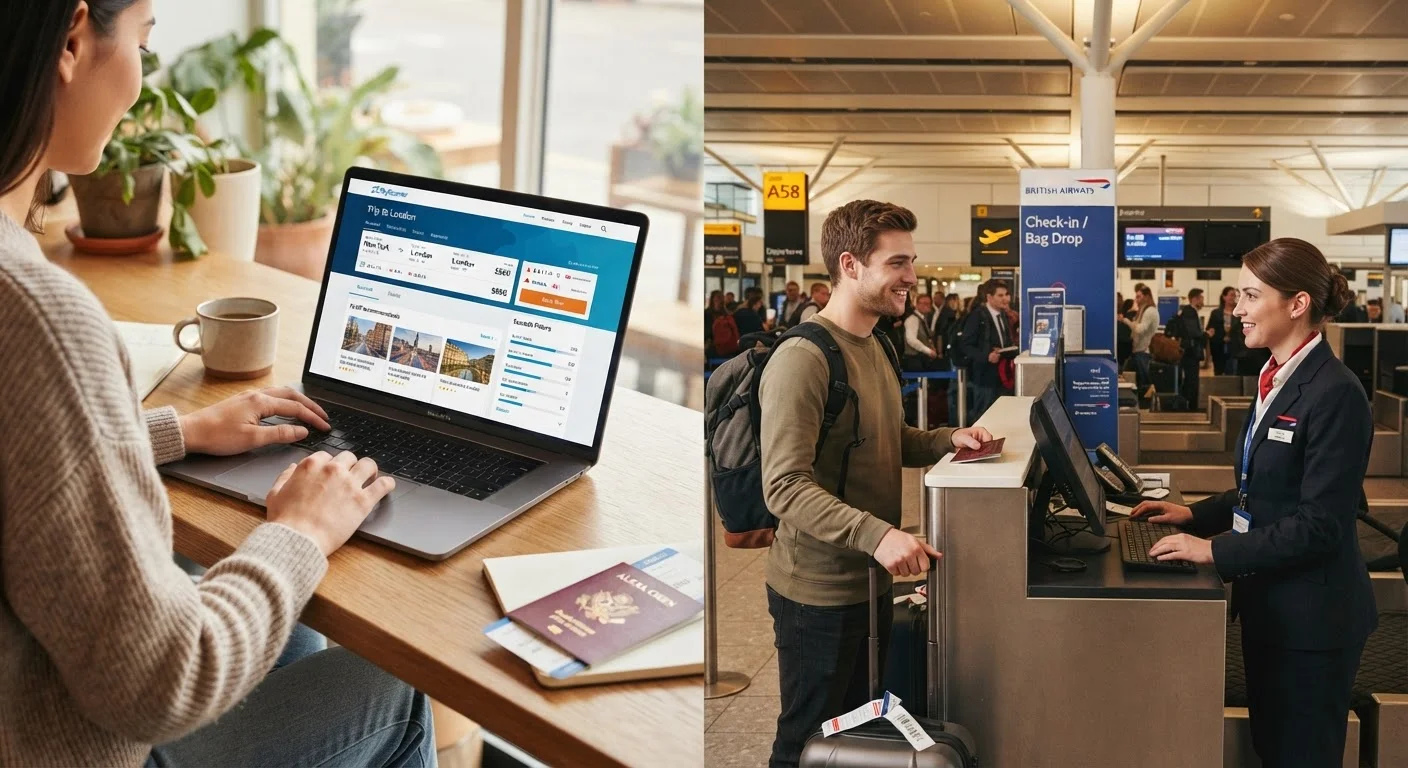
Option A
Online Travel Agencies (OTAs)
The all-in-one comparison and convenience layer.
Best for: Travelers who want to compare multiple airlines or hotels side-by-side in a single session.
Option B
Booking Directly
The straight-to-the-source approach with fewer intermediaries.
Best for: Travelers who prioritize loyalty perks, flexible changes, and direct customer service.
Two Ways to Book, One Big Decision
Every traveler eventually faces the same fork in the road: pull up an online travel agency (OTA) like Expedia, Kayak, or Priceline, or head straight to the airline's or hotel's own website. Both paths lead to a confirmed reservation, but the experience — and sometimes the outcome — can differ in ways that aren't obvious at first glance.
Understanding what each approach actually gives you is more useful than hunting for a universal "right answer," because the smarter choice genuinely depends on your trip type, travel habits, and priorities. See our overview of how travel agencies and booking services work for background on the landscape before diving in.
| Criterion | Online Travel Agency (OTA) | Booking Directly |
|---|---|---|
| Price comparison | Instant multi-provider comparison | Single provider; manual research needed |
| Loyalty points & status | Often ineligible or reduced | Full credit typically awarded |
| Cancellation flexibility | Subject to OTA and provider policies | Managed directly with provider |
| Customer support during disruption | Intermediary layer may slow resolution | Direct access to airline or hotel |
| Room/seat upgrades | Rarely included | More commonly available |
| Bundling (flight + hotel) | Easy; sometimes discounted | Requires separate bookings |
| Base price | Often same as direct (rate parity) | Often same as OTA (rate parity) |
What OTAs Do Well — and Where They Fall Short
Online travel agencies built their business on aggregation. Within seconds, you can see dozens of flight combinations or hotel options sorted by price, duration, or rating. That comparative visibility is genuinely valuable, particularly when you're flexible on airline or property and just want to understand the market.
OTAs also make bundling easy. Packaging a flight and hotel together through a single platform can occasionally reduce the total cost, though it's always worth checking each component separately to confirm the bundle is actually saving you money.
Where OTAs show friction is during disruption. If your flight is canceled or your hotel room doesn't match what was advertised, the OTA — not the airline or hotel — is technically your point of contact. That intermediary layer can slow resolution. The airline may tell you to call the OTA; the OTA may tell you to call the airline. Travelers who've navigated a weather disruption through a third-party booking often describe it as a frustrating loop.
~48%
U.S. travelers using OTAs to research trips
Phocuswright research has consistently found that roughly half of U.S. leisure travelers use OTAs during the planning phase, even when they ultimately book elsewhere.
3–5%
Typical OTA commission rate charged to hotels
Hotel industry analyses generally estimate OTA commissions in the 15–25% range for properties, costs that influence how hotels structure their direct booking incentives.
For a deeper look at how this plays out specifically with hotel reservations, the comparison of direct hotel booking versus third-party sites covers the trade-offs in more detail.
The Case for Going Directly to the Source
Airlines and hotel chains have strong incentives to reward direct bookers. Loyalty program miles and points, room category upgrades, early check-in, and complimentary amenities are frequently reserved for guests who bypass third-party channels. If you accumulate status with a specific carrier or hotel brand, direct booking is almost always necessary to receive those benefits — OTA reservations are often ineligible.
Flexibility is another meaningful advantage. Most airlines and major hotel chains have streamlined their own cancellation and modification tools, and making changes directly is typically faster than routing a request through an OTA's support system. During irregular operations — storms, strikes, or aircraft swaps — airlines can proactively rebook direct customers more efficiently.
The trade-off is time. Booking directly means visiting multiple sites to compare options, which requires more legwork upfront. Some travelers use an OTA to research options and then complete the reservation on the provider's own site — a reasonable middle-ground approach.
If your itinerary grows genuinely complex, neither OTAs nor direct booking may be the most efficient path. The comparison of human travel agents versus self-service platforms outlines when a person in your corner adds real value.
A Note on Price Parity Agreements
Many airlines and hotel chains require OTAs to display the same base rate they offer on their own websites — a practice known as rate parity. As a result, the headline price you see on an OTA is often identical to what you'd pay directly. Where the two channels diverge is in benefits, flexibility, and support quality rather than the raw dollar amount. Always check both before assuming one is cheaper.
Price: Closer Than You Think
A common assumption is that OTAs offer meaningfully lower prices. In practice, many airlines and hotel chains operate under rate parity agreements, meaning the base fare or room rate is identical across channels. The real differences tend to show up in what surrounds the price: loyalty credit eligibility, bundled extras, fee structures for changes, and the quality of support when things go wrong.
That said, OTAs do occasionally surface flash sales or opaque pricing models (where you don't know the exact property until after booking) that undercut standard rates. These can represent genuine savings for flexible travelers who don't need a specific property or flight time. Understanding terminology like "consolidator fares" can help here — the glossary of key booking and agency terms is a useful reference.
For travelers planning accommodations, the broader hotels and accommodations resource hub covers how to evaluate properties and what to look for before committing to a reservation. And if you want to think through the full picture of when agency-style services help — and when they don't — the end-to-end guide to travel agency decisions offers a comprehensive framework.
The content on this site is for informational purposes only and is not a substitute for professional advice. Always consult a qualified professional for guidance specific to your situation.