

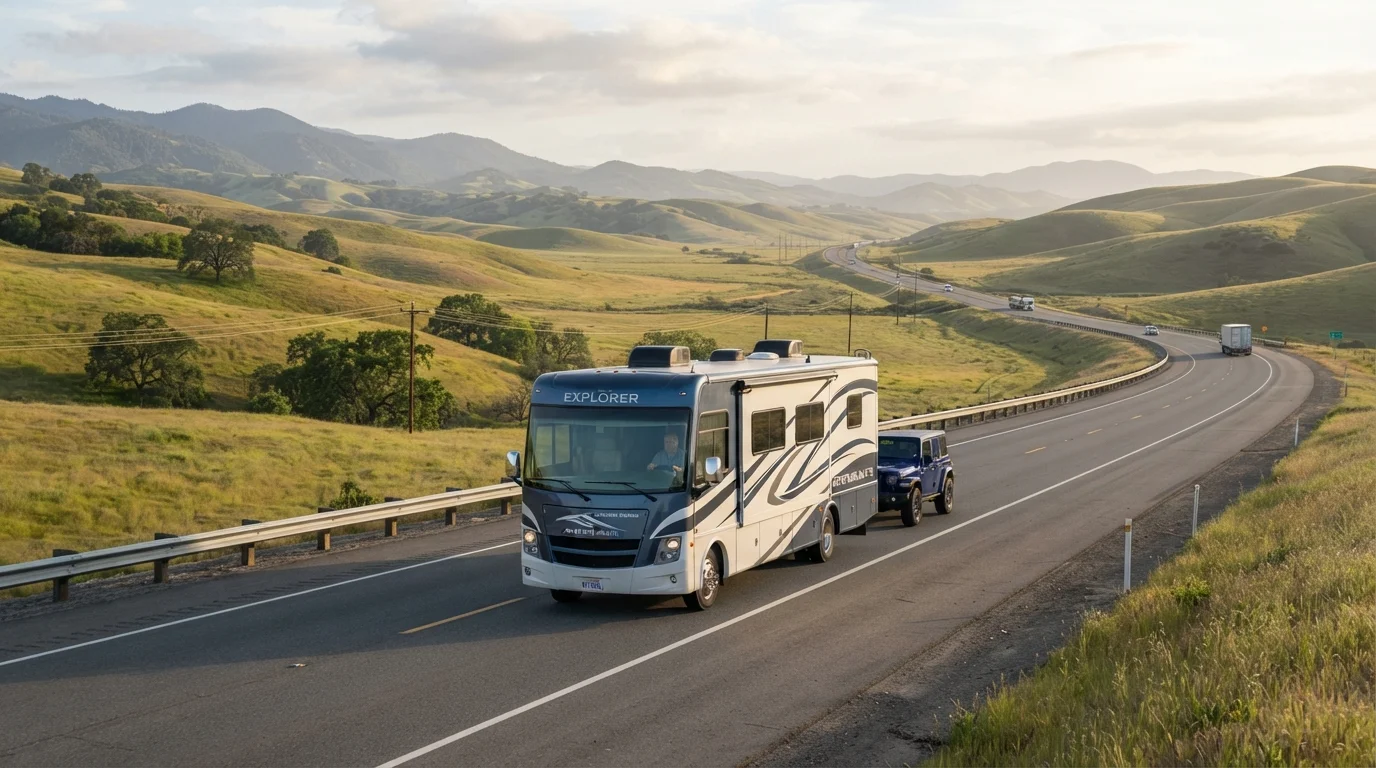
Why Fuel Economy Myths Catch New RV Owners Off Guard
Buying an RV is an exciting decision, but the financial realities of operating one can come as a shock — particularly at the fuel pump. New owners frequently arrive with fuel economy expectations shaped by manufacturer brochures, online forums, or assumptions carried over from everyday vehicle ownership. Those expectations are often wrong in ways that meaningfully affect trip budgets.
RV fuel economy is influenced by a constellation of variables: vehicle class and weight, engine type, load, road grade, wind, and driving speed. Unlike a passenger car where EPA estimates are tightly regulated and moderately predictive, RV figures are far more variable and far less standardized. Understanding where the myths come from — and what the data actually shows — is the first step toward realistic trip planning. For a broader look at costs that catch owners off guard, see the full picture of RV ownership expenses.
Myth
The MPG figure listed in the manufacturer's brochure is what I'll actually get on the road.
Fact
Manufacturer estimates are often derived under idealized conditions and regularly exceed what owners observe during typical travel.
Unlike passenger vehicles, which undergo standardized EPA fuel economy testing, RVs are not subject to the same regulatory testing requirements. Manufacturers may publish figures based on controlled, light-load runs on flat terrain — conditions that bear little resemblance to a loaded cross-country trip with hills, headwinds, and highway speeds. Class A gas motorhomes that list 8–10 MPG on paper frequently return 6–8 MPG in real-world driving. Owners should treat published figures as a ceiling, not an expectation, and budget conservatively.
Myth
Driving at highway speed (70–75 mph) won't make much difference in fuel consumption for a big RV.
Fact
Reducing speed from 70 to 60 mph can meaningfully improve fuel economy in large RVs, sometimes by 10–20% depending on the vehicle.
Aerodynamic drag scales with the square of velocity, and the flat, tall front profile of most motorhomes makes them especially sensitive to speed. The drag penalty for a Class A going 70 mph versus 60 mph is substantially larger than for a low-slung sedan. Many experienced RV travelers voluntarily cap their cruising speed at 60–65 mph on open interstates specifically to recover fuel efficiency, particularly when covering long distances where the savings accumulate significantly.
Myth
A diesel RV will always get dramatically better fuel economy than a comparable gas model.
Fact
Diesel engines typically offer better torque and can be more efficient, but the real-world MPG advantage over gas is often narrower than expected.
Diesel powerplants do generally produce better fuel efficiency per gallon — and their torque advantage on grades is real — but the gap in MPG between diesel and gas motorhomes in the same weight class is often modest in day-to-day operation. Diesel fuel also carries a cost premium over regular gasoline that partially offsets any efficiency gain. The stronger case for diesel usually rests on longevity and towing capability rather than fuel savings alone. Prospective buyers should run the numbers on their specific models rather than assume a large economy advantage.
Myth
Using the RV's generator or air conditioning has little effect on overall fuel consumption.
Fact
Running the generator and HVAC systems adds measurable fuel load, particularly during extended idling or slow campground travel.
Integrated generators draw directly from the vehicle's fuel tank, and running one for several hours per day — common during hot-weather travel when air conditioning is in use — can add a meaningful fraction to daily fuel costs. On a long trip, that auxiliary fuel draw accumulates. Some owners are surprised to find their generator alone accounts for a noticeable portion of total fuel expenditure, especially on trips with limited shore power access. Planning for this usage rather than treating it as negligible helps produce more accurate travel budgets.
Myth
Payload and cargo weight don't significantly impact fuel economy as long as I stay under the GVWR.
Fact
Operating legally within weight limits and operating fuel-efficiently are different things — payload weight meaningfully increases fuel consumption.
The Gross Vehicle Weight Rating (GVWR) defines a legal and structural safety threshold, not an efficiency target. An RV loaded to its GVWR will consume substantially more fuel than the same vehicle traveling lightly packed, because the drivetrain must work harder and braking events cost more energy to recover from on grades. Owners who habitually carry full freshwater tanks, extensive tools, stored inventory, and towed vehicles often report noticeably lower MPG than those who travel lean. Evaluating what's truly necessary for each trip can yield meaningful fuel savings over time.
Speed, Weight, and Other Variables That Actually Move the Needle
Beyond the myths themselves, it helps to understand the physics at work. Aerodynamic drag increases with the square of speed — meaning a Class A motorhome traveling at 70 mph faces roughly 36% more drag than the same vehicle at 60 mph. That translates directly into fuel burn, and the penalty is steeper for tall, boxy RVs than for streamlined passenger cars.
6–8 MPG
Typical real-world range for Class A gas motorhomes
Owner-reported averages from RV forums and travel logs consistently fall below the higher figures sometimes cited in manufacturer materials.
10–20%
Potential fuel economy gain from reducing speed 10 mph
Aerodynamic drag increases with the square of speed, making speed reduction one of the highest-impact fuel-saving strategies for boxy RVs.
~0.5 GPH
Approximate generator fuel consumption at moderate load
A generator running several hours per day can add gallons to a trip's total fuel cost, a factor often omitted from pre-trip budgeting.
Weight is equally consequential. Every 1,000 pounds of added payload places additional demand on the drivetrain, especially on grades. Full freshwater tanks, stored gear, passengers, and towed vehicles all compound fuel consumption in ways spec sheets never capture. Drivers who travel lightly and moderate their highway speed consistently report real-world figures closer to the optimistic end of the range; those who load heavily and cruise at 70–75 mph often land at the bottom — or below it.
If you're still weighing whether RV ownership makes financial sense for your travel style, comparing renting versus owning can sharpen that decision. And many of the same critical-thinking habits that apply to car maintenance myths — questioning conventional wisdom and consulting primary sources — apply here too. See debunking common car maintenance myths for a parallel look at how misinformation shapes vehicle decisions.
Budget With Real Numbers, Not Brochure Figures
New RV owners who plan fuel budgets around manufacturer estimates frequently encounter shortfalls on their first major trip. Before committing to a long itinerary, research owner-reported MPG figures for your specific make, model, and engine combination from RV communities and travel logs. Build in a buffer of at least 15–20% below the published estimate to avoid being caught short at the pump on a remote route.
The content on this site is for informational purposes only and is not a substitute for professional advice. Always consult a qualified professional for guidance specific to your situation.