

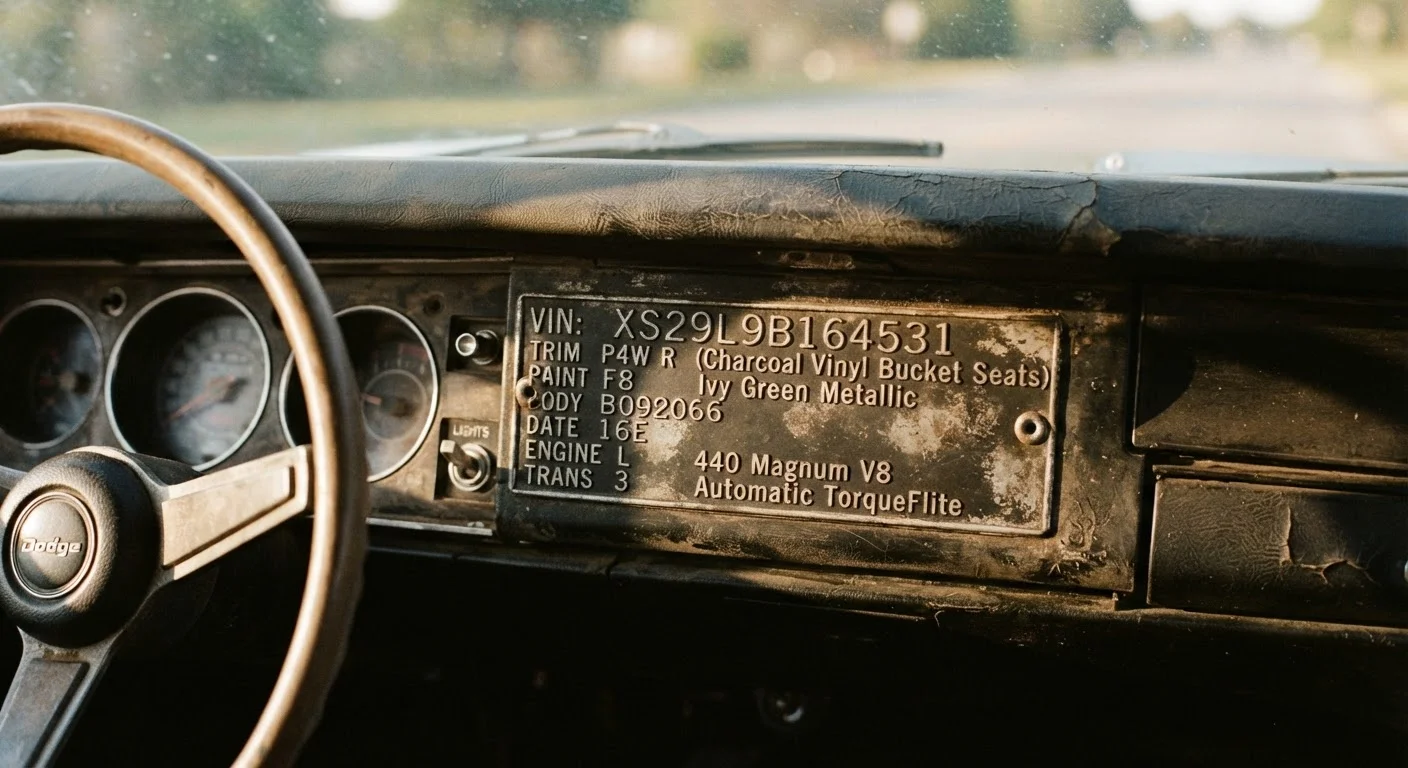
Why VIN and Build Sheet Research Matters
When evaluating a classic vehicle, documentation is everything. A car's appearance can be changed; its stamped identification cannot be legitimately altered. The factory VIN and build sheet together form a paper trail that tells you what the manufacturer actually produced — not what a seller claims, and not what a restoration made it look like.
This matters for several reasons. Authenticity affects insurance valuations, judged concours scores, and resale prices. A well-documented car with its original high-performance engine confirmed by the VIN and supported by a matching build sheet commands a meaningfully different market position than a visually identical car without documentation. Understanding how these vehicles are categorized by insurers and registries also depends on accurate identification.
Beyond value, there's a deeper reward: understanding exactly what your vehicle was on the day it left the factory is one of the most satisfying aspects of the classic car hobby.
What you will need
Step-by-Step: Decoding Your Classic Car's Identity
The process below applies broadly to American classics from the 1950s through the late 1970s. Foreign-market vehicles and some specialty manufacturers used different systems, so always verify with a marque-specific resource.
Locate all VIN and identification plates on the vehicle
Classic cars often carry multiple identification stamps in different locations. The primary VIN plate is typically riveted to the driver-side dashboard, visible through the windshield. Additional stampings appear on the firewall, door jamb, front frame rail, and engine block pad. On many American muscle cars from the 1960s and early 1970s, a partial VIN is also stamped directly into the block or transmission to indicate factory matching.
Photograph each location before handling anything. Compare the stampings across locations — consistent digits confirm the numbers haven't been altered.
Understand what the VIN structure reveals
Before 1981, U.S. automakers used their own proprietary VIN formats — there was no federally mandated 17-character standard. General Motors, Ford, Chrysler, and AMC each used different lengths and positional meanings. A typical GM muscle car VIN from the late 1960s might be 13 characters, while a contemporary Ford could be 11.
Despite the variation, most classic-era VINs encode the same broad categories of information:
- Division or make — often the first character
- Model or body style — one or two characters indicating coupe, convertible, sedan, etc.
- Engine code — a single character identifying the factory-installed engine displacement and configuration
- Model year — typically a single letter or digit
- Assembly plant — a letter identifying the factory where the car was built
- Production sequence number — the final digits, indicating the car's place in the assembly run
The engine code position is particularly meaningful: it can confirm whether a car left the factory with a high-performance engine or a base unit — a distinction that significantly affects collector value. See our guide to matching numbers for how this interacts with originality claims.
Find the trim tag and cowl data plate
Separate from the VIN, most American classics from the 1960s and 1970s carry a trim tag (also called a body tag or cowl plate) — typically a small aluminum or cardboard placard riveted inside the driver's door jamb or on the firewall. This tag encodes paint color, interior trim, build date, and sometimes the body style and transmission type using manufacturer-specific abbreviations.
Cross-referencing the trim tag's color codes with factory paint charts can confirm whether a car's current finish matches its original color — a key point for judged shows and insurance valuations.
Search for the factory build sheet
A build sheet (sometimes called a broadcast sheet) is a paper document printed at the factory that traveled with the car down the assembly line. It lists every option, color, and component ordered for that specific vehicle. Unlike the VIN, which is a compressed code, the build sheet is essentially a human-readable factory receipt.
Common hiding spots include:
- Beneath the rear seat cushion
- Under the front seat carpet or padding
- Inside door panels (behind the panel itself)
- Under the headliner at the rear
- Tucked behind the dashboard
Workers sometimes used multiple copies and stuffed them wherever was convenient during assembly, so it's worth checking more than one location.
Decode the build sheet line by line
Build sheets use factory abbreviation codes that differ by manufacturer and model year. Once you have the sheet in hand, you'll need a marque-specific guide to interpret the codes. Most entries correspond to RPO (Regular Production Option) codes or equivalent factory option identifiers. Look for:
- Engine and transmission codes
- Exterior paint and vinyl top codes
- Interior color and material
- Axle ratio
- Power accessories (windows, steering, brakes)
- Factory-installed audio or convenience packages
- Build date and shift (morning or afternoon assembly)
Compare what the build sheet lists against what the car currently has. Discrepancies don't always mean fraud — options were sometimes dealer-swapped — but they are worth investigating before purchase or appraisal.
Cross-reference with a marque registry or documentation service
After decoding the VIN and build sheet independently, submit your findings to a marque-specific registry or documentation service. Many marque clubs maintain production records, window sticker databases, and Protect-O-Plate archives (for GM vehicles) or equivalent records that can confirm your interpretations or flag anomalies.
A documented registry listing — sometimes called a tank sticker or factory invoice replica — adds a layer of third-party verification that carries weight with appraisers, insurers, and buyers. For context on how documentation affects market value and what collectors look for, our article on matching numbers myths covers the subject in depth.
Keep Copies of Every Document
Photograph the VIN plate, trim tag, firewall stampings, and build sheet before any restoration or disassembly work begins. Store digital copies in a cloud service and keep physical copies with the car's title. Original documentation that is lost during a restoration cannot be recreated and can significantly affect the car's provenance record.
Once you've decoded your car's identity, consider pairing your findings with a vehicle history report if one is available — the two sources complement each other well when evaluating a potential purchase. The classic car community also offers excellent peer knowledge; clubs and registries are invaluable for marque-specific decoding help.
The content on this site is for informational purposes only and is not a substitute for professional advice. Always consult a qualified professional for guidance specific to your situation.