

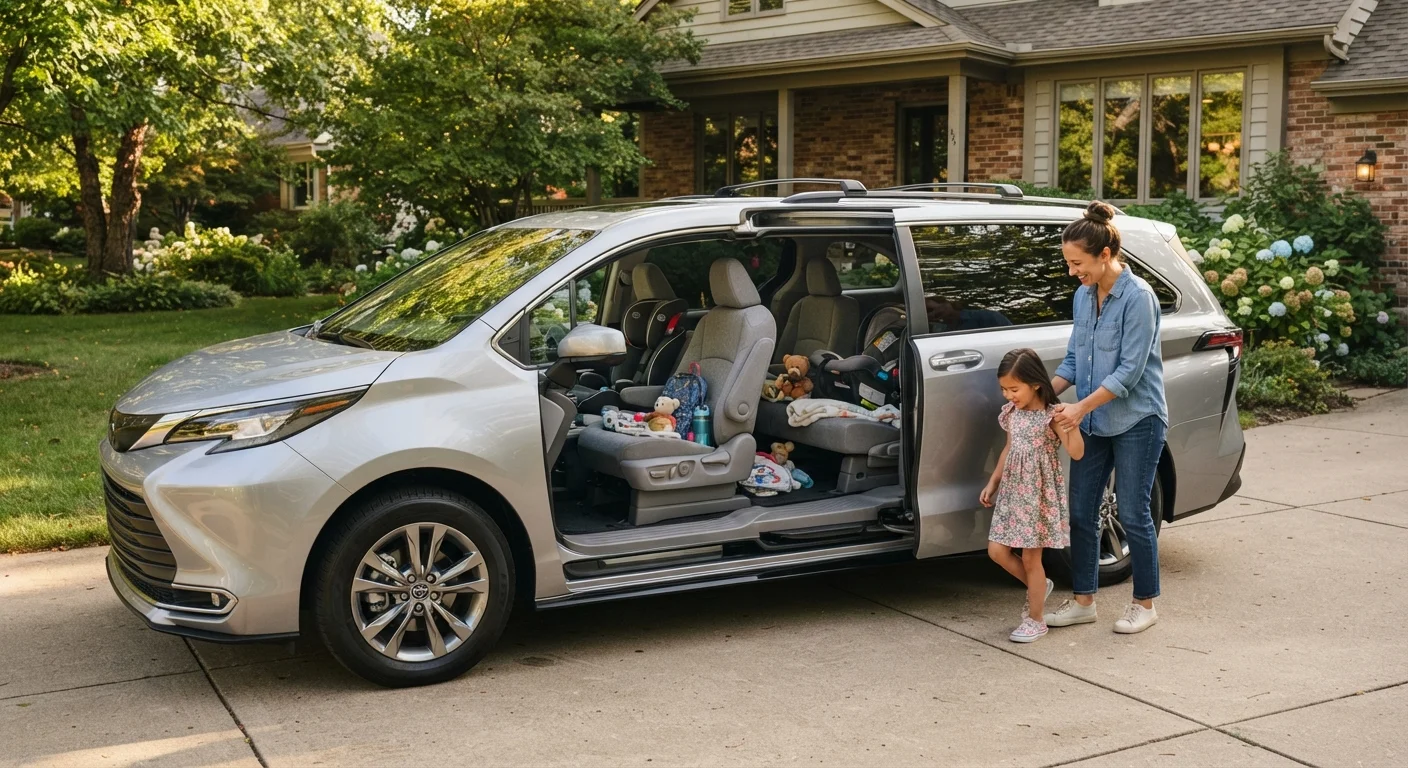
Why Minivans Have a Reputation Problem
Few vehicles inspire as much reflexive resistance as the minivan. Mention one at a family gathering, and someone will usually crack a joke about surrendering their identity. Yet automotive data and owner surveys consistently tell a different story — one where the minivan quietly outperforms its competitors on nearly every practical metric families actually care about.
The gap between minivan perception and minivan reality is wide enough to cost families real money and real comfort. Shoppers who rule them out early often end up paying more for a three-row SUV that delivers less usable space. Understanding where these myths come from — and what the evidence actually shows — is useful groundwork for any family navigating the vehicle shopping process.
Myth
Minivans are gas-guzzlers compared to SUVs.
Fact
Modern minivans typically achieve fuel economy ratings comparable to or better than most three-row SUVs of similar passenger capacity.
A common assumption is that a minivan's boxy shape and size translate directly into poor fuel economy. In practice, most current minivans are rated in the mid-to-upper 20s mpg combined — figures that frequently match or exceed comparably sized three-row SUVs, which carry more weight and often use larger engines to manage that bulk. The aerodynamic penalty of a tall SUV body is often greater than that of a well-optimized van profile.
Myth
Minivans can't handle bad weather because they don't offer all-wheel drive.
Fact
At least one current minivan model offers available all-wheel drive, and front-wheel-drive minivans with winter tires perform well in most snowy conditions.
The belief that minivans are limited to fair-weather use oversimplifies both the all-wheel-drive landscape and winter driving physics. Tire selection has a larger impact on winter traction than drivetrain configuration in most everyday scenarios. Front-wheel-drive vehicles — which pull rather than push — also handle slippery surfaces more predictably than rear-wheel-drive alternatives. Families in regions with serious winters should evaluate tire options carefully rather than treating drivetrain type as a dealbreaker.
Myth
Minivans are cramped for tall adults.
Fact
Minivans generally offer more headroom, legroom in all rows, and easier ingress and egress than most three-row SUVs.
Because minivans are designed from the outset around interior volume rather than exterior styling, they typically offer class-leading headroom and legroom across all three rows. The low floor height — made possible by the absence of a traditional body-on-frame platform — also makes getting in and out significantly easier for adults, children, and passengers with limited mobility. Sliding rear doors eliminate the awkward angles that rear doors on SUVs create in tight parking spaces.
Myth
Minivans have poor resale value and are expensive to own long-term.
Fact
Minivan resale values are generally competitive within the family vehicle segment, and their lower purchase prices often reduce the total cost of ownership.
This myth has two parts, and both need unpacking. First, well-maintained minivans from established manufacturers have historically held value reasonably well compared to similarly priced family vehicles. Second, the upfront purchase price of a minivan is typically lower than that of a comparable three-row SUV — meaning that even if depreciation rates were identical, the total dollar loss over ownership would often favor the minivan. As with any vehicle, condition, mileage, and regional demand affect resale; no outcome is guaranteed.
Myth
Minivans are only for families with young children.
Fact
Minivans serve a wide range of use cases, including adult road trips, hobby hauling, pet transport, and accessibility needs.
The cultural image of a minivan loaded with car seats has obscured how versatile the platform actually is. The combination of a flat load floor, high ceiling, and configurable seating makes minivans well-suited for transporting large items, accommodating passengers who use mobility aids, or serving as a base for weekend adventures. Some owners remove rear seats entirely to create a cargo-focused vehicle. The van category more broadly — covered in our overview of the commercial van segment — reflects just how adaptable this body style can be.
What the Numbers Actually Show
Much of the minivan's reputation problem is rooted in social signaling rather than substance. When researchers and automotive journalists measure interior volume, ease of entry and exit, cargo flexibility, and cost per seat-mile, minivans repeatedly land at or near the top of the family vehicle category.
~165 cu ft
Maximum cargo volume in a typical minivan
Automotive testing data consistently shows minivans offering substantially more maximum cargo space than most three-row SUVs when all rear seats are folded or removed.
~28 mpg
Typical combined fuel economy for modern minivans
EPA ratings for current minivan models generally fall in the mid-to-upper 20s combined, matching or exceeding many comparable three-row SUVs.
12–15 inches
Typical minivan load floor height
The low floor height of most minivans — compared to 20-plus inches in many SUVs — makes loading cargo and seating passengers considerably easier.
For families who do a lot of highway driving, road trips, or car-pool duty, these differences are felt every day — not just on paper. If you're also evaluating three-row SUVs, it's worth understanding the real-world usability trade-offs that three-row SUV designs often involve before assuming more metal means more room.
Don't Skip the Ownership Cost Comparison
Purchase price is only one part of the total cost picture. Insurance premiums, fuel costs, scheduled maintenance, and tire replacement costs all vary by vehicle type. Before finalizing any vehicle decision, run the full ownership cost math for your specific driving patterns rather than relying on sticker price alone. A licensed financial adviser or independent automotive cost calculator can help frame the numbers accurately.
Minivans aren't the right fit for every household — buyers who regularly tow heavy loads, drive unpaved roads, or need all-wheel drive for severe winter conditions may find other vehicle types more suitable. But for the majority of family use cases centered on passengers, cargo, and commuting, the data deserves an honest look. See our framework for matching a vehicle type to your actual life for a broader perspective on the decision.
The content on this site is for informational purposes only and is not a substitute for professional advice. Always consult a qualified professional for guidance specific to your situation.