

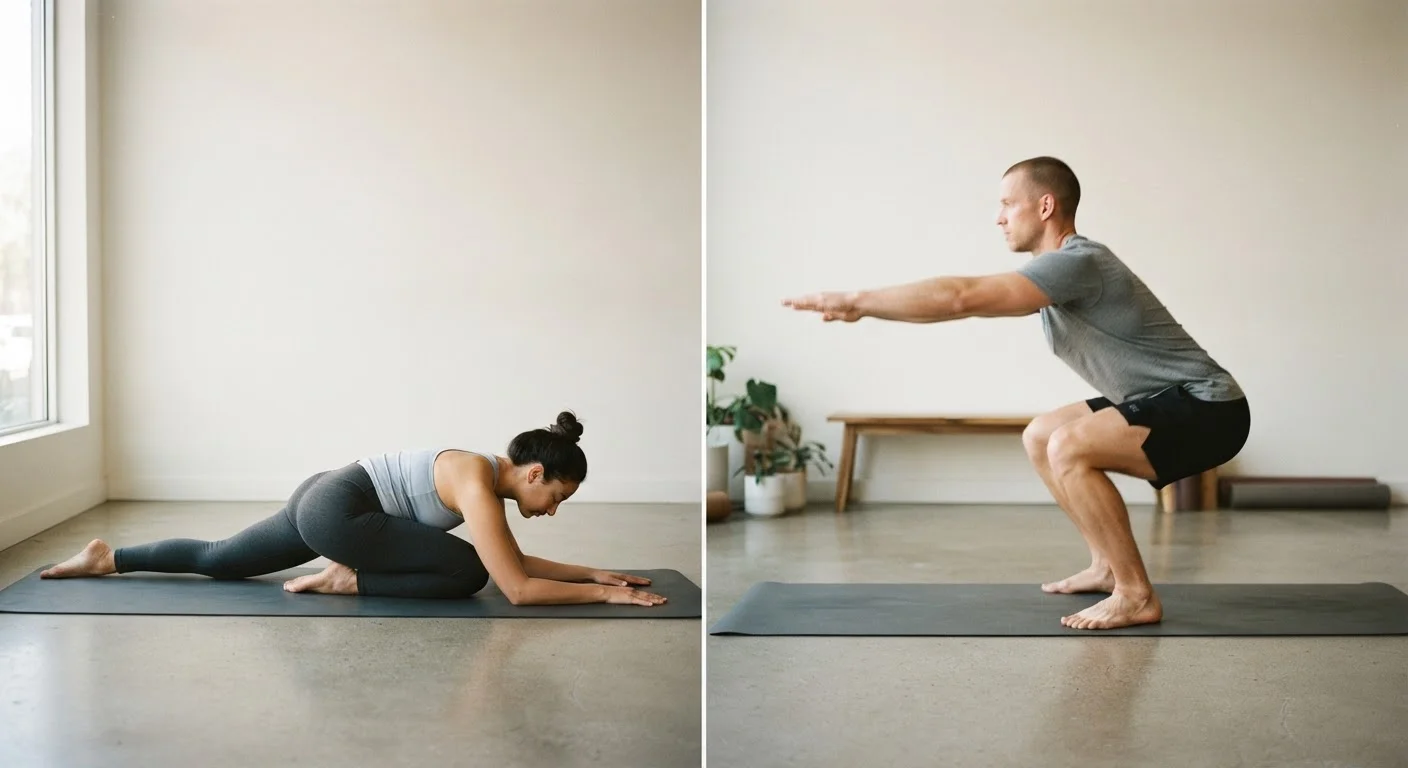
Option A
Flexibility
The passive range your muscles can achieve.
Best for: Improving tissue length, reducing muscle tightness, and supporting recovery after activity.
Option B
Mobility
The active control you have through your range of motion.
Best for: Enhancing functional movement, joint health, athletic performance, and injury prevention.
The Core Distinction: Passive Length vs. Active Control
Flexibility describes how far a muscle or muscle group can be lengthened — typically measured in a passive state, where an external force (gravity, a strap, a partner) moves the limb. Think of a seated hamstring stretch: you're measuring how far the muscle allows movement, not how well you control that range.
Mobility, by contrast, is your ability to actively move a joint through its available range with control and coordination. It incorporates muscle strength, neuromuscular coordination, and joint health — not just tissue length. A gymnast might display extraordinary passive flexibility but limited functional mobility if they lack the muscular activation to control those positions. The reverse is less common but equally instructive: someone with moderate flexibility can have excellent mobility if their nervous system efficiently coordinates movement through that range.
This distinction matters practically. You might be able to push your leg into a 90-degree hip flexion with your hands — but can your hip actively lift that high during a walking stride? That gap between passive and active range is where mobility work lives. As the relationship between static stretching and dynamic warm-ups illustrates, the type of movement preparation you choose shapes what your body can actually do during activity.
How Each Quality Is Trained
Because flexibility and mobility are different qualities, they call for different training approaches.
Building flexibility primarily involves static stretching — holding a lengthened position for 30 to 60 seconds or more — as well as techniques like proprioceptive neuromuscular facilitation (PNF), where contracting and then relaxing a muscle before a stretch can increase passive range. Consistency matters more than intensity; short daily sessions tend to outperform infrequent long ones.
Building mobility requires active effort. Common approaches include:
- Controlled articular rotations (CARs) — slow, deliberate joint circles performed under muscular tension to explore and maintain the full extent of joint range
- Strength-through-range exercises — movements like deep squats or hip 90/90 transitions that load the body at end ranges
- Dynamic movement flows — linking positions together to train transitions, not just static endpoints
Both also respond well to sustained practice tied to mindful body awareness. The same focus that distinguishes mindfulness from meditation — presence vs. technique — applies here: flexibility asks you to relax into length, while mobility asks you to engage through it.
| Criterion | Flexibility | Mobility |
|---|---|---|
| Definition | Passive range a muscle allows | Active control through joint range |
| Primary tissue targeted | Muscles and connective tissue | Joints, muscles, nervous system |
| State during training | Passive or relaxed | Active and engaged |
| Key training method | Static and PNF stretching | CARs, loaded end-range work |
| Functional carry-over | Moderate — range without control | High — range plus usable movement |
| Ideal session timing | Post-workout or standalone | Warm-up or dedicated session |
| Who benefits most | Those with chronically tight muscles | Those seeking functional movement quality |
Why Most People Need Both — In Different Measures
Few people need to choose one exclusively. Flexibility and mobility are complementary: greater tissue length gives mobility training more range to work with, and mobility work helps translate passive flexibility into functional capacity.
~80%
Adults reporting lower back pain at some point
According to the National Institute of Neurological Disorders and Stroke, low back pain is one of the most common reasons Americans seek medical care, often linked to poor mobility and movement patterns.
30–60 sec
Recommended static stretch hold duration
Research published in physical therapy literature generally supports holding stretches for 30 to 60 seconds to produce meaningful gains in passive muscle length over time.
2–3×/week
Minimum mobility practice frequency for adaptation
Exercise science guidelines broadly indicate that two to three dedicated sessions per week are needed for consistent improvements in joint mobility and movement control.
That said, most adults in sedentary lifestyles tend to present with tight tissues but poor joint control — which means stretching alone may widen passive range without improving how well they can use it. Functional movement research broadly suggests prioritising mobility training while using flexibility work as a supportive tool, particularly for the hips, thoracic spine, and ankles — areas that commonly limit movement quality.
Individuals with hypermobility (unusually high passive range) often need the opposite balance: less stretching, more stability and controlled strengthening to build neuromuscular command over their existing range. This is a case where personalised guidance from a physical therapist or qualified movement professional is especially valuable.
This article is for general informational purposes and does not constitute medical or clinical advice. If you are managing a specific injury, condition, or movement limitation, consult a qualified healthcare or rehabilitation professional before modifying your exercise routine.
The content on this site is for informational purposes only and is not a substitute for professional advice. Always consult a qualified professional for guidance specific to your situation.