

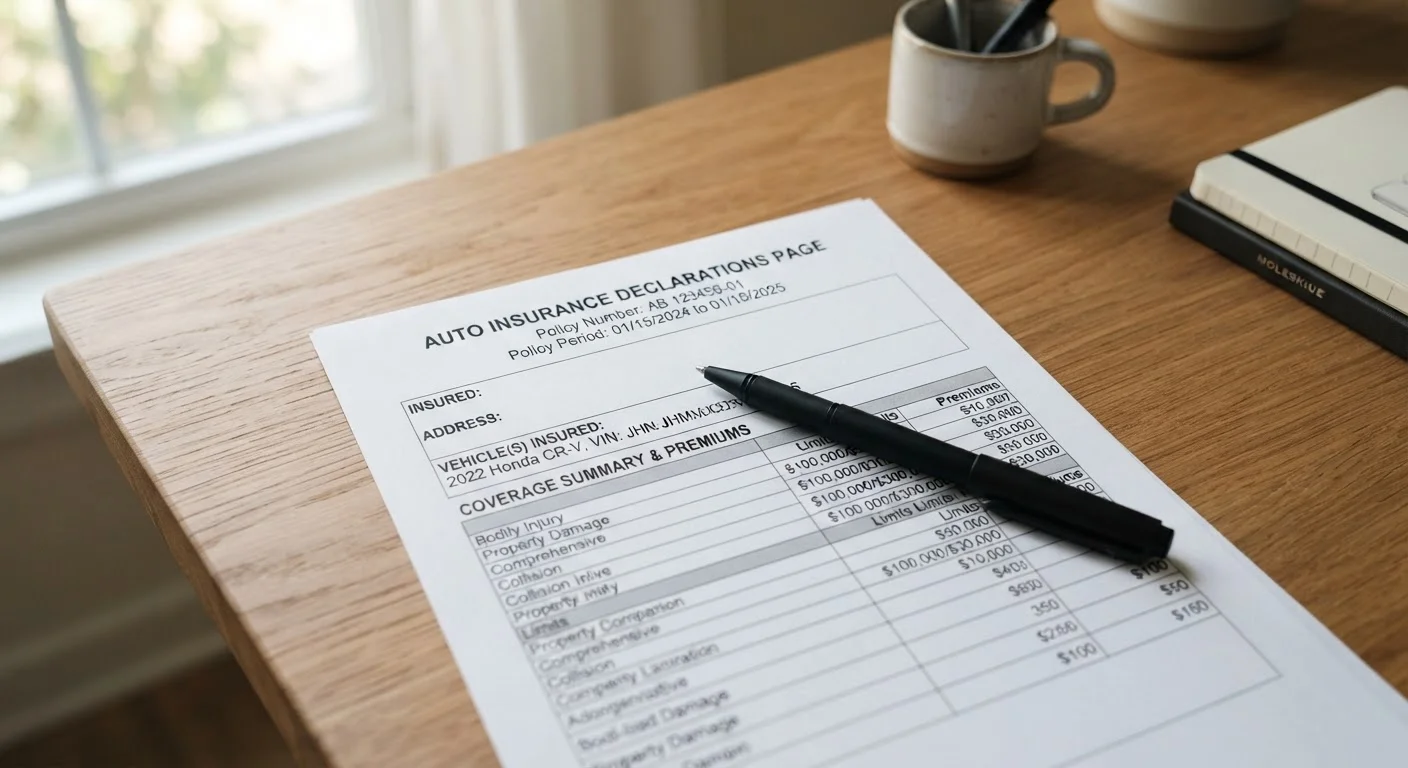
What the Declarations Page Actually Is
The auto insurance declarations page — often called the dec page — is a condensed summary of your policy issued by your insurer. Think of it as the index to a longer contract: it tells you who is covered, what vehicles are insured, which coverages are in place, what the limits and deductibles are, and how long the policy runs. The full policy document — typically dozens of pages of legal language — provides the fine print behind each item on the dec page.
Most drivers interact with the declarations page more often than any other part of their policy. It arrives at renewal, after mid-term changes, and after a new policy is issued. Knowing how to read it accurately is one of the simplest and most practical things you can do to stay on top of your coverage. For a broader look at how coverage types fit together, Auto Insurance Coverage Types, Explained is a useful starting point.
What you will need
How to Read Your Declarations Page Step by Step
Follow these steps each time you receive a new or updated declarations page. The process takes less than twenty minutes and can prevent costly surprises at claim time.
Declarations Page ("Dec Page")
The primary document you will be reviewing — it summarizes all coverages, limits, deductibles, and policy details.
Vehicle Registration or Title
Used to cross-check your vehicle's VIN, year, make, and model against what appears on the declarations page.
Driver's License
Used to verify that your name and any listed drivers are spelled correctly and fully listed.
Prior Policy Declarations Page
Allows you to compare coverage limits and deductibles year over year to catch unintended changes.
Locate your declarations page
Your insurer sends a declarations page at the start of each policy period — typically every six or twelve months. You can usually find it in your insurer's online account portal, as a PDF attachment in your policy confirmation email, or in the paper packet mailed to your address of record. If you cannot locate it, call your insurer or agent and ask them to resend it. Keep a digital copy somewhere accessible.
Verify the named insured and listed drivers
At the top of the page you will see the named insured — the primary policyholder. Confirm your full legal name is spelled correctly and your current mailing address is accurate. Next, check that every driver in your household who regularly uses the vehicle is listed. An unlisted regular driver can complicate a claim, depending on your state and insurer's rules.
Confirm vehicle information
The declarations page will list each covered vehicle by year, make, model, and VIN. Pull out your vehicle registration and compare every field character by character. A transposed digit in the VIN is a surprisingly common error. If you added or removed a vehicle during the policy term, confirm the page reflects the current situation.
Review each coverage type and its limit
This is the heart of the declarations page. Each row represents a coverage type, the limit (the maximum your insurer will pay), and often a deductible (what you pay first). Common coverage lines include:
- Bodily Injury Liability — pays for injuries to others when you are at fault. Shown as two numbers, e.g., 100/300 (meaning $100,000 per person, $300,000 per accident).
- Property Damage Liability — pays for damage you cause to another person's property.
- Collision — pays to repair or replace your vehicle after a collision, minus your deductible.
- Comprehensive — covers non-collision losses such as theft, weather, or fire.
- Uninsured/Underinsured Motorist — protects you if the at-fault driver has little or no insurance.
- Medical Payments or Personal Injury Protection (PIP) — covers medical costs for you and passengers regardless of fault.
For a plain-language explanation of what each coverage type actually does, see Auto Insurance Coverage Types, Explained.
Note your policy period and premium
The declarations page states the exact start and end dates of your coverage period. Confirm these align with what you expect. The page also shows your total premium, sometimes broken down by vehicle or coverage line. If the premium looks different from what you were quoted or paid previously, review any endorsements (add-ons) listed further down the page — these can affect cost.
Check for endorsements and optional add-ons
Endorsements are modifications to the standard policy — additions or exclusions. Common examples include roadside assistance, rental reimbursement, gap coverage (which pays the difference between what you owe on a loan and what your car is worth after a total loss), and custom equipment coverage. Confirm any endorsements you requested are actually listed, and review any you do not recognize.
Flag errors and contact your insurer
If you find any discrepancy — wrong address, missing driver, incorrect VIN, unexpected coverage change — contact your insurer or licensed agent as soon as possible. Most corrections can be processed quickly and, where appropriate, backdated to the policy start date. Document your communication in writing (email is ideal) so you have a record. Understanding exactly what your policy covers — and where it stops — is covered in depth at What Auto Insurance Actually Covers — and Where It Stops.
Make the Declarations Page Easy to Find
Save a PDF copy of your current declarations page to a folder on your phone or a cloud service you can access from anywhere. In an emergency — such as a roadside dispute or accident — being able to pull up your coverage details instantly can save significant stress. Many insurer apps also display your dec page under the "Policy" or "Documents" section.
Once you are comfortable reading your dec page, consider building a habit of reviewing it annually — not just at renewal, but whenever a major life change occurs. The Reviewing Your Auto Insurance Policy Once a Year walks through a structured checklist for doing exactly that.
And if a claim does arise, knowing your declarations page inside and out will make the process smoother. See Filing an Auto Insurance Claim: A Step-by-Step Walkthrough for what to expect.
This article is for general informational purposes only and does not constitute personalized insurance, legal, or financial advice. Coverage terms, limits, exclusions, and regulations vary by insurer, policy, and state. Always read your actual policy documents and consult a licensed insurance agent or adviser for guidance specific to your situation.
The content on this site is for informational purposes only and is not a substitute for professional advice. Always consult a qualified professional for guidance specific to your situation.