

Why Policy Language Matters
Most drivers glance at their auto insurance card, tuck it in the glove box, and hope they never need to read further. But when a claim arises, the precise wording of your policy determines what gets paid — and what doesn't. Knowing the standard vocabulary puts you in a far stronger position to review coverage, catch errors, and ask the right questions.
This glossary covers the core terms you'll encounter in virtually any personal auto policy in the United States. For a deeper look at the specific coverages those terms describe, see Auto Insurance Coverage Types, Explained. If you're brand new to buying coverage, The First Auto Insurance Policy: A Guide for New Drivers is a good starting point.
Premium
The amount you pay for your insurance coverage — typically monthly, semi-annually, or annually. Premiums are calculated based on factors such as your driving record, vehicle type, location, and chosen coverage levels.
Deductible
The amount you pay out of pocket before your insurer pays on a covered claim. A $500 deductible on a $3,000 repair means you pay $500 and the insurer pays $2,500. Higher deductibles generally lower your premium.
Coverage limit
The maximum dollar amount your insurer will pay for a covered loss. Limits are typically expressed per person, per accident, or per occurrence (e.g., 100/300/100 for liability coverage).
Liability coverage
Pays for bodily injury or property damage you cause to others in an at-fault accident. It does not cover your own injuries or vehicle damage. Most states require a minimum amount of liability coverage to legally register a vehicle.
Collision coverage
Pays to repair or replace your vehicle after a collision with another vehicle or object, regardless of fault. Subject to your deductible.
Comprehensive coverage
Covers damage to your vehicle from non-collision events such as theft, vandalism, hail, flood, fire, or hitting an animal. Also subject to your deductible.
Uninsured/Underinsured Motorist (UM/UIM)
Covers your injuries and, in some states, property damage when the at-fault driver has no insurance or insufficient insurance to cover your losses.
Personal Injury Protection (PIP)
Covers medical expenses for you and your passengers regardless of fault. Required in no-fault states; optional or unavailable in others. May also cover lost wages and other related costs.
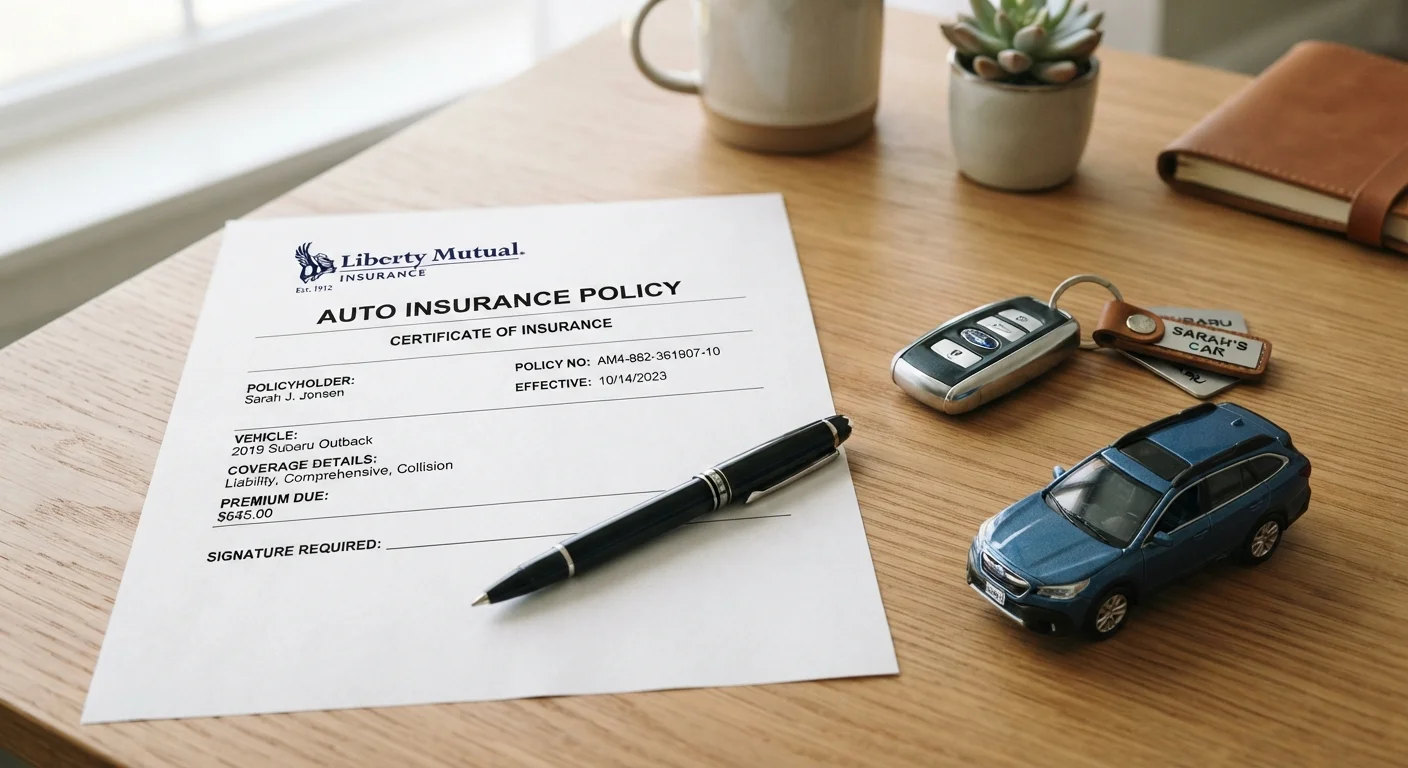
Declarations page
The summary document at the front of your policy packet. It lists the named insured, vehicle information, covered drivers, coverage types, limits, deductibles, and total premium.
Endorsement
A written amendment that modifies the terms of your base policy. Endorsements can expand or restrict coverage and take precedence over conflicting language in the standard policy form.
Named insured
The person or entity listed on the declarations page as the primary policyholder. Additional drivers in the household may also be listed, but the named insured holds the primary policy rights and obligations.
Exclusion
A specific condition, person, or circumstance that the policy does not cover. Common auto exclusions include intentional damage, using a personal vehicle for commercial purposes without proper endorsement, and mechanical breakdown.
Reading the Key Documents in Your Policy
Your auto policy isn't a single page — it's a package of documents. Knowing what each one does helps you find the right information quickly.
| Minimum liability requirement | Required in 49 of 50 states (New Hampshire is the exception, though alternatives apply) (State insurance regulators) |
| No-fault states | 12 states require Personal Injury Protection (PIP) as part of a no-fault system (Insurance Information Institute) |
| Typical deductible range | $250–$2,000 for collision and comprehensive coverage (General industry range) |
| Standard liability format | Written as three numbers (e.g., 25/50/25): per-person injury / per-accident injury / property damage, in thousands |
| Policy renewal period | Typically every 6 or 12 months; a good time to review coverage terms and limits |
Declarations page (dec page): The summary sheet at the front of your policy. It lists your name, vehicle, coverage types, limits, deductibles, and premium. Errors here — a misspelled VIN, wrong address — can create coverage problems. Our article on Reading Your Auto Insurance Declarations Page walks through every line in detail.
Policy form: The full legal contract that defines coverage terms, exclusions, and insurer obligations. It's dense, but the definitions section at the front makes the rest much easier to parse.
Endorsements (riders): Written amendments that modify the standard policy form — adding, removing, or changing coverage. An endorsement for rideshare coverage or gap protection is a common example. Always read endorsements alongside the base policy, not in isolation.
This article provides general insurance information for educational purposes only and is not personalized insurance, financial, or legal advice. Coverage terms, limits, exclusions, and regulations vary by insurer and by state. Always read your actual policy documents and consult a licensed insurance agent or adviser for guidance specific to your situation.
The content on this site is for informational purposes only and is not a substitute for professional advice. Always consult a qualified professional for guidance specific to your situation.