

What Makes Permanent Life Insurance Different
Most people's first encounter with life insurance is a term policy — coverage that lasts a set number of years and pays a death benefit if the insured dies during that period. To understand cash value, it helps to first understand what separates term from permanent coverage.
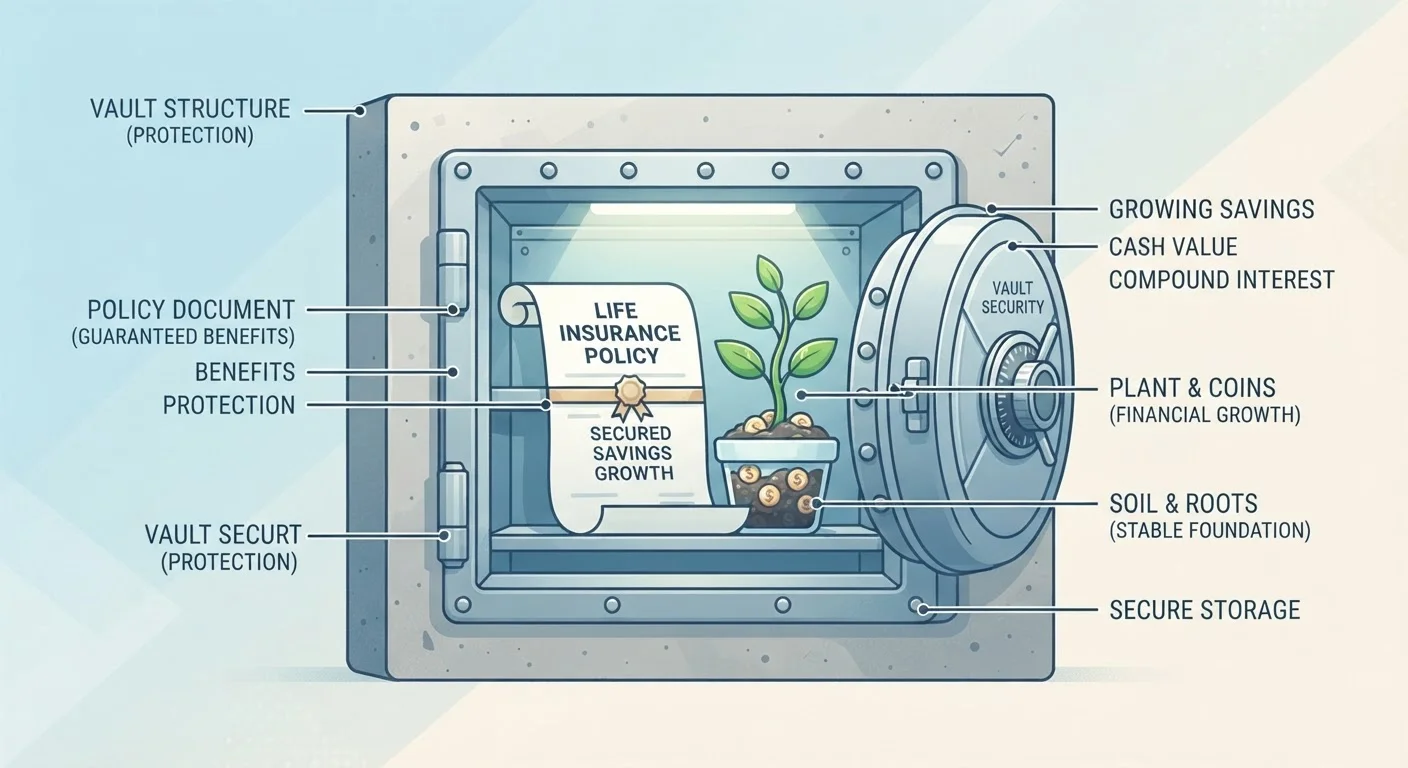
Life insurance at its core is a contract: you pay premiums, and the insurer pays a death benefit to your named beneficiaries. Term life keeps this simple. Permanent life insurance — which includes whole life and universal life — adds a second layer: a portion of each premium is directed into an internal account that builds over time. That account is your cash value.
For a fuller comparison of how these policy types are structured, see the breakdown of term, whole, and universal life insurance.
~$200B
Annual U.S. life insurance premiums collected
According to LIMRA, Americans pay hundreds of billions in life insurance premiums annually, with permanent policies representing a significant share.
10–15 years
Typical timeframe for meaningful cash value growth
Insurance educators broadly note that cash value in whole life policies tends to accumulate slowly, with substantial balances generally not appearing until well into the second decade.
Tax-deferred
Tax treatment of cash value growth
Under current U.S. tax law, gains inside a permanent life insurance policy are not subject to income tax while they remain in the policy.
How Cash Value Actually Grows
The mechanism behind cash value growth depends on the type of permanent policy you hold:
- Whole life insurance credits your cash value at a guaranteed rate set by the insurer. Some policies also pay non-guaranteed dividends that can increase your cash value further.
- Universal life insurance typically credits growth based on a current interest rate declared by the insurer, subject to a minimum floor. The rate can change over time.
- Indexed universal life (IUL) ties credited interest to the performance of a market index (such as the S&P 500), with caps on gains and a floor that protects against losses.
- Variable universal life (VUL) invests your cash value in sub-accounts similar to mutual funds. Returns are not guaranteed and the account can lose value.
In all cases, growth accumulates on a tax-deferred basis — you don't owe income tax on gains while they remain inside the policy. This is one of the features that distinguishes cash value from a standard savings account.
Check Your Policy Illustration for Growth Projections
When you purchase a permanent life insurance policy, the insurer provides a policy illustration — a document projecting how your cash value and death benefit may change over time. Ask for both guaranteed and non-guaranteed projections. The guaranteed column shows the minimum your policy is contractually obligated to deliver; the non-guaranteed column shows optimistic assumptions. Comparing both gives you a realistic range.
Accessing Your Cash Value: Options and Trade-Offs
Cash value is often described as a living benefit because you can access it before death. There are three primary ways to do so, each with meaningful consequences:
- Policy loans: You can borrow against your cash value without a credit check. The loan accrues interest, and you're not required to repay it on a schedule. However, any outstanding loan balance — principal plus interest — is deducted from the death benefit if you die before repaying it.
- Withdrawals (partial surrenders): You can withdraw funds directly, permanently reducing the cash value and, in most cases, the death benefit by the same amount. Withdrawals above your cost basis (the total premiums you've paid) may be subject to ordinary income tax.
- Full surrender: You can cancel the policy entirely and receive the cash surrender value — the accumulated cash value minus any applicable surrender charges and outstanding loans. Surrendering ends your coverage and may trigger a taxable event.
“The cash value in a life insurance policy is real money you can access, but it comes with strings attached. Understanding those strings before you pull them is what separates informed policyholders from surprised ones.”
— Insurance Basics Editorial Team, Editorial staff specializing in life insurance education
Understanding these options matters whether you're considering whole life or evaluating it against term. Comparing term and whole life structures can help clarify which approach fits your situation.
Common Misconceptions Worth Clearing Up
Cash value is one of the most misunderstood features in personal finance. A few misconceptions come up repeatedly:
"Cash value earns like a regular investment account." Growth rates in whole life are generally modest and conservative — not designed to compete with market returns. The primary purpose is insurance protection, not wealth accumulation.
"My beneficiaries receive the cash value plus the death benefit." In standard whole life policies, beneficiaries receive the death benefit only. The cash value does not pass to heirs separately. Certain riders can change this, but they increase premium costs.
"I can always access my cash value when I need it." Early in the policy — often the first several years — surrender charges can significantly reduce what you'd receive. Cash value builds slowly, and accessing it prematurely can have lasting effects on the policy's long-term performance.
For an unvarnished look at the benefits and limitations together, an honest examination of whole life trade-offs lays out what policyholders should weigh carefully. You can also find plain-language definitions in the life insurance glossary.
Policy Loans Can Lapse a Policy
If a policy loan grows large enough — due to compounding interest and insufficient premiums — the total loan balance can exceed the cash value, causing the policy to lapse. A lapsed policy means you lose coverage and may face a significant tax bill on any gains previously sheltered inside the policy. If you take a policy loan, monitor the balance regularly and confirm with your insurer what safeguards are in place.
This article is for general informational purposes only and does not constitute personalized financial, tax, or insurance advice. Policy terms, coverage, and tax treatment vary by insurer and individual circumstances. Consult a licensed insurance professional or financial adviser before making decisions about your own coverage.
Frequently Asked Questions
Yes, most permanent policies allow withdrawals from the cash value. However, withdrawals may reduce the death benefit and could trigger taxes if you withdraw more than you've paid in premiums (your cost basis). It's important to review your specific policy terms before making a withdrawal.
A policy loan lets you borrow against your cash value without permanently reducing it — as long as you repay the loan with interest. A withdrawal permanently removes funds from the account. Unpaid loans, however, will reduce the death benefit paid to your beneficiaries.
In most traditional whole life policies, the insurer pays the stated death benefit to beneficiaries — not the death benefit plus the cash value. The cash value effectively reverts to the insurer at death. Some policies offer a rider that pays both, but this typically increases premiums.
Cash value accumulates slowly in the first several years of a policy due to high upfront costs and insurer fees. Most policyholders don't see significant balances for a decade or more. Surrender charges in early years can also reduce what you'd actually receive if you cancel.
It depends on the policy type. Whole life policies generally offer a guaranteed minimum growth rate. Universal life policies tied to interest rates or market indexes carry more variability. Variable universal life policies involve investment risk and offer no growth guarantees.
The content on this site is for informational purposes only and is not a substitute for professional advice. Always consult a qualified professional for guidance specific to your situation.