

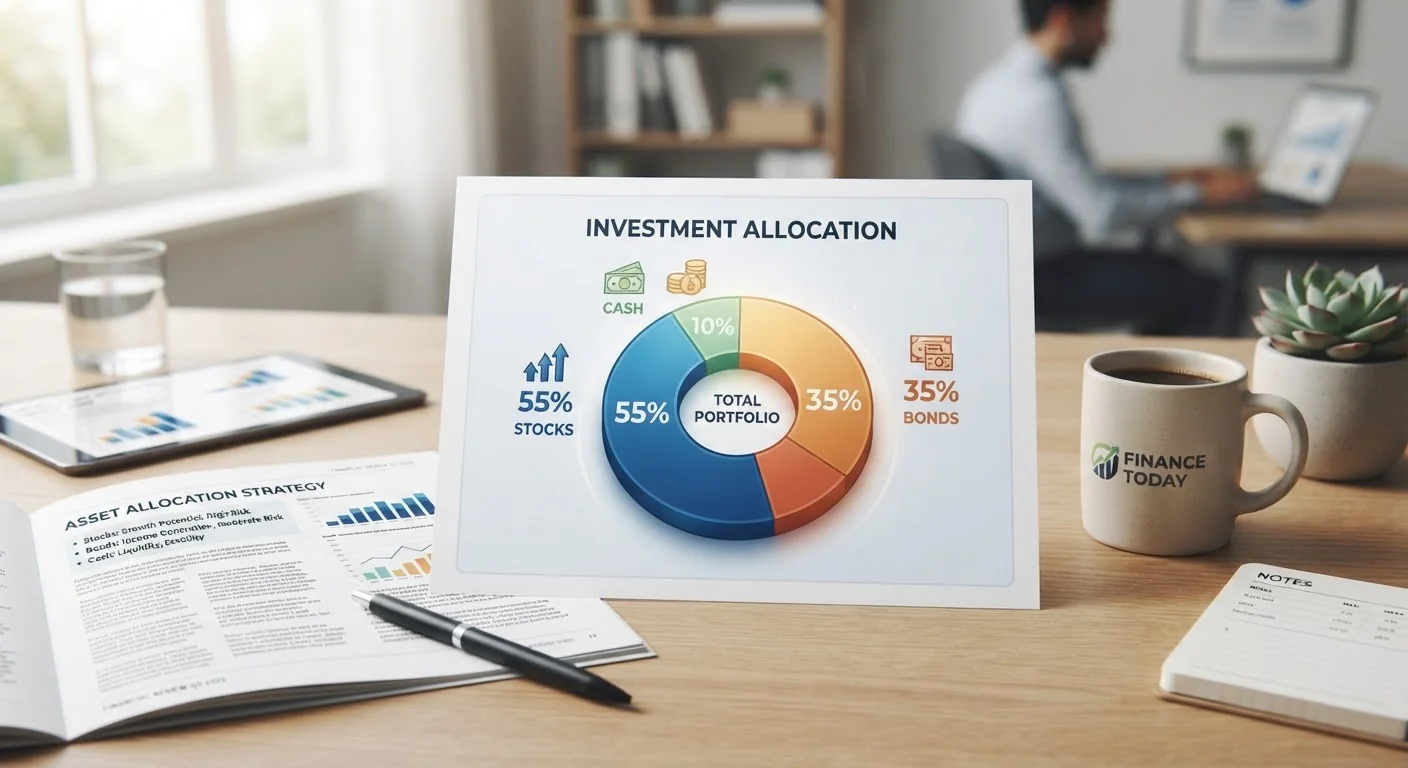
The Three Core Asset Classes
Most discussions of asset allocation center on three broad categories:
- Stocks (equities): Ownership stakes in companies. Historically, stocks have offered the highest long-term growth potential among mainstream asset classes, but they also come with the most short-term volatility.
- Bonds (fixed income): Loans you make to governments or corporations in exchange for regular interest payments. Bonds generally deliver lower returns than stocks over long periods but tend to be less volatile, which can cushion a portfolio during stock market downturns.
- Cash and cash equivalents: Savings accounts, money market funds, and short-term Treasury bills. These preserve capital and provide liquidity but offer minimal growth, especially after inflation.
Some investors also include real estate, commodities, or other alternative assets, but stocks, bonds, and cash form the foundation for most personal portfolios. If you're still building your financial vocabulary, our guide to essential investing terminology covers the key terms you'll encounter.
~90%
Portfolio variance explained by asset allocation
A widely cited study by Brinson, Hood, and Beebower found that asset allocation policy explained roughly 90% of the variation in portfolio returns over time, underscoring its central role.
3 in 10
Investors who never review their allocation
Industry surveys have consistently found that a significant share of retail investors set an initial allocation and rarely or never revisit it, risking unintended drift over time.
Why Your Mix Matters More Than You Might Think
Research in portfolio theory has consistently found that how you divide your money across asset classes — not which specific stocks or funds you pick — is a primary driver of your portfolio's long-term behavior. A portfolio weighted heavily in stocks will likely grow faster over decades but experience deeper short-term drops. A bond-heavy portfolio will feel more stable day to day but may not keep pace with inflation over a 30-year horizon.
This trade-off between risk and potential return is central to every allocation decision. The right balance isn't the one with the highest expected return in isolation — it's the one you can realistically stick with through market cycles without making panic-driven decisions.
“The most important decision a long-term investor makes is not which individual securities to own, but how to divide capital among different asset classes.”
— Burton Malkiel, Economist and author of 'A Random Walk Down Wall Street'
Asset allocation also interacts closely with diversification. While allocation sets the proportions across major asset types, diversification spreads risk within each type. The two concepts reinforce each other. See our explainer on diversification for a deeper look at how that works in practice.
What Shapes Your Ideal Allocation
Three factors typically guide allocation decisions:
- Time horizon: How many years before you need the money? Investors with decades ahead of them can generally tolerate more stock exposure because they have time to recover from downturns. Someone five years from retirement typically wants a more conservative mix.
- Risk tolerance: This is partly emotional — how would you actually respond to seeing your portfolio drop 30%? — and partly financial, meaning how much loss you could absorb without derailing your goals. New investors often overestimate their tolerance until they experience a real downturn. Our article on common risk mistakes first-time investors make explores this in more depth.
- Financial goals: A portfolio earmarked for a house down payment in three years should look nothing like a retirement account you won't touch for 30 years. Short-term goals call for stability; long-term goals can afford more growth-oriented exposure.
Use Target-Date Funds as a Starting Point
If choosing an allocation feels overwhelming, target-date funds — named for an approximate retirement year — automatically adjust the stock-to-bond mix over time, becoming more conservative as the target date approaches. They are not perfect for every investor, but they offer a low-effort way to maintain a reasonable allocation without ongoing manual rebalancing.
There is no universally correct allocation. General rules of thumb exist — such as subtracting your age from 110 to estimate a stock percentage — but they are rough guides, not prescriptions. A licensed financial adviser can help you build an allocation suited to your actual situation.
Rebalancing: Keeping Your Allocation on Track
Markets don't stand still, which means your portfolio mix will drift over time. If stocks surge for several years, you might find yourself with 80% in equities when you originally intended 60%. That unplanned shift exposes you to more risk than you chose to take on.
Rebalancing means periodically selling assets that have grown beyond their target weight and buying those that have fallen below it, returning your portfolio to its intended mix. This is a disciplined, systematic practice — not a reaction to market forecasts.
How often you rebalance is a judgment call. Some investors do it on a fixed schedule (annually, for example); others trigger rebalancing when any category drifts beyond a set threshold. Either approach can work. Keep in mind that selling assets in taxable accounts may generate capital gains taxes, so consider the tax implications before acting — this is another area where professional guidance can pay off.
This article is for general informational and educational purposes only and does not constitute personalized financial, investment, tax, or legal advice. All investing involves risk, including the potential loss of principal. Past performance does not guarantee future results. Consult a qualified financial adviser before making decisions about your own portfolio.
Frequently Asked Questions
There is no single right answer, but a common starting point is a higher stock allocation for younger investors with long time horizons and a gradually increasing bond allocation as retirement approaches. Target-date funds automate this shift. A qualified financial adviser can help you determine what fits your specific situation.
Many investors rebalance once or twice a year, or whenever their actual allocation drifts significantly — say, more than 5 percentage points — from their target. More frequent rebalancing can generate unnecessary transaction costs or tax events. Consistency matters more than perfect timing.
They are related but distinct. Asset allocation refers to how much of your portfolio goes into broad categories like stocks versus bonds. Diversification is about spreading risk within those categories — for example, holding many different stocks rather than just a few. Both concepts work together to manage overall portfolio risk.
No. Asset allocation is a risk-management strategy, not a guarantee of returns or protection from losses. All investing carries risk, including the potential loss of principal. The aim is to align your portfolio's risk profile with your goals, not to eliminate risk entirely.
Over time, market movements will cause your portfolio to drift from its original mix — for example, strong stock gains might leave you with far more equity exposure than you intended. This can mean taking on more risk than suits your goals. Periodic reviews help you stay on track.
The content on this site is for informational purposes only and is not a substitute for professional advice. Always consult a qualified professional for guidance specific to your situation.