

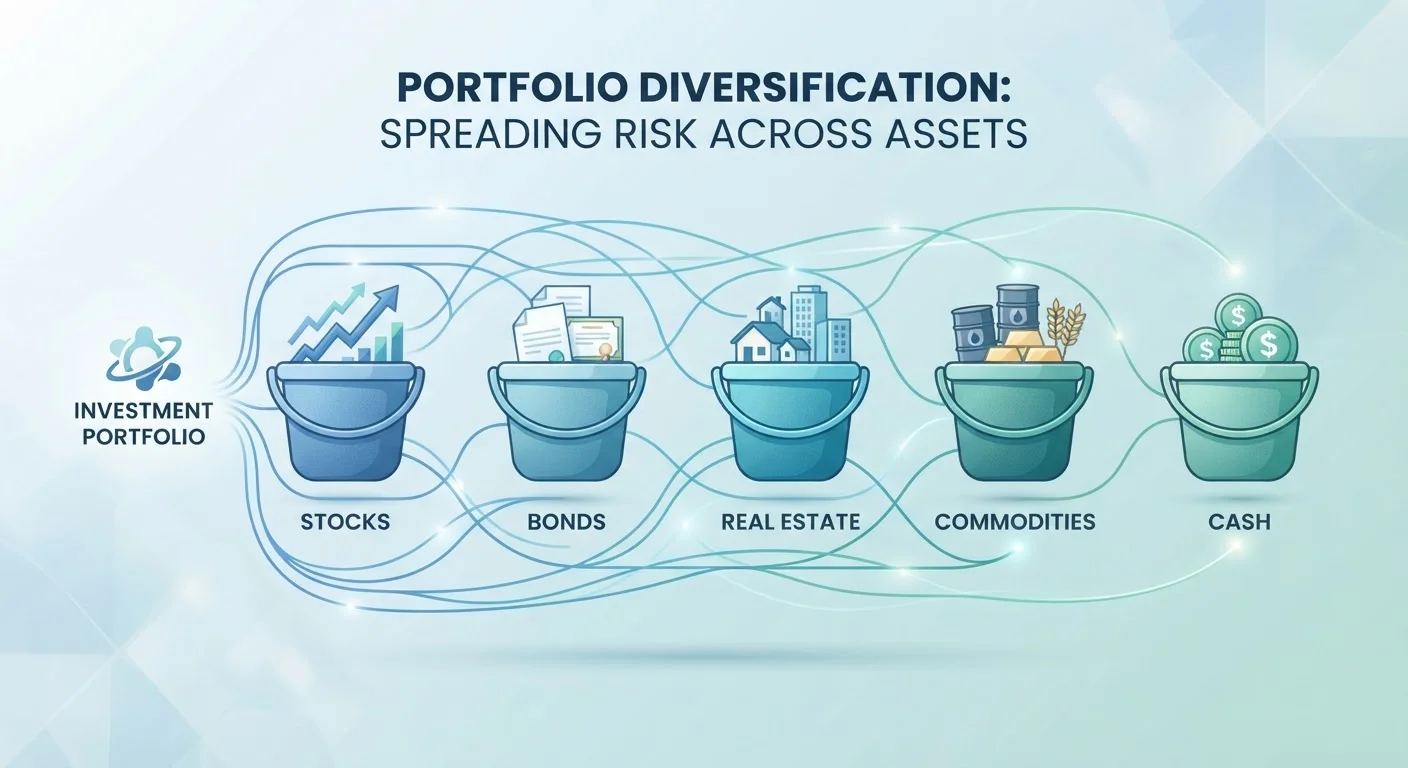
The Problem Diversification Solves
Imagine putting all your savings into shares of a single company. If that company struggles — due to poor earnings, a product recall, or a management scandal — your entire portfolio suffers the consequences. This is called concentration risk: the danger of being overexposed to the fate of one investment.
Diversification addresses this by distributing money across a range of holdings. If one investment falls sharply, it represents only a fraction of your total portfolio, limiting the damage. This is the practical logic behind the familiar phrase: don't put all your eggs in one basket.
It's worth noting that diversification is not a guarantee against loss. When broad markets decline — during a financial crisis, for example — most asset classes can fall together. What diversification manages is unsystematic risk: the risk tied to a specific company, industry, or region. For a deeper look at how new investors sometimes misunderstand this distinction, see common risk misconceptions among first-time investors.
Diversification and Market-Wide Risk
Diversification is designed to reduce company- or sector-specific risk, not market-wide risk. During broad economic downturns, most investments can decline together regardless of how well diversified a portfolio is. Understanding this distinction helps set realistic expectations for what diversification can and cannot achieve.
How Diversification Works in Practice
Diversification is effective when the investments in a portfolio are not highly correlated — meaning they don't always move in the same direction at the same time. Stocks and government bonds, for instance, have historically tended to behave differently during economic stress, with bonds sometimes rising when equity markets fall.
Investors typically diversify across several dimensions:
- Asset classes: Mixing stocks, bonds, real estate investment trusts (REITs), and cash equivalents.
- Sectors: Spreading equity exposure across industries such as technology, healthcare, consumer goods, and energy.
- Geography: Holding both domestic and international investments to reduce dependence on any single country's economy.
- Time horizon: Some investors also ladder fixed-income investments so they mature at different points, managing interest-rate exposure.
Many everyday investors achieve diversification through index funds or exchange-traded funds (ETFs), which hold baskets of securities tracking a market index. A single broad-market index fund can provide exposure to hundreds or thousands of companies simultaneously.
~15–30
Stocks needed to capture most diversification benefit
Academic research in portfolio theory, including work by Edwin Elton and Martin Gruber, has long suggested that much of the unsystematic risk reduction from diversification is achieved with a relatively modest number of uncorrelated stocks.
~90%
Of portfolio returns explained by asset allocation
A widely cited 1986 study by Brinson, Hood, and Beebower found that asset allocation — a form of broad diversification — accounted for approximately 90% of the variation in long-term portfolio returns.
What Diversification Cannot Do
It's important to be honest about diversification's limits. Spreading investments cannot eliminate systemic risk — the risk that affects the entire market at once. During the 2008 financial crisis, most asset classes fell sharply regardless of how diversified individual portfolios were.
Similarly, diversification does not improve returns by itself. A well-diversified portfolio may produce lower peak gains than a concentrated bet on a single winning stock — because the gains are spread across many holdings, not concentrated in the one that happened to perform best. The trade-off is that it also avoids the worst outcomes when a single holding collapses.
Investors who hold many funds that track the same index may believe they are diversified when they are actually holding largely overlapping positions. Checking whether your holdings are genuinely distinct — in terms of the companies, sectors, and geographies they represent — matters as much as the number of funds you own.
For context on how portfolios have historically weathered periods of market stress, investing through market downturns explores what the historical record suggests and what principles guide long-term thinking.
“Diversification is the only free lunch in investing. By spreading your holdings, you can reduce risk without necessarily giving up expected return — something that's rare in finance.”
— Harry Markowitz, Nobel Prize-winning economist and originator of Modern Portfolio Theory
Putting Diversification Into Context
Diversification is one piece of a broader investing framework. It works alongside asset allocation — the decision about how much of your portfolio to assign to each asset type — and strategies like dollar-cost averaging, which involves investing consistent amounts at regular intervals regardless of market conditions.
Together, these principles form a toolkit for managing risk over time rather than trying to predict which investment will win. None of them requires expert knowledge or significant capital to begin applying. For foundational definitions of the terms you'll encounter as you build your investing knowledge, investing terminology for beginners is a useful reference.
If you're uncertain how diversification fits your specific situation — particularly if you're approaching or in retirement, managing a large inheritance, or navigating complex tax circumstances — consulting a licensed financial adviser is worthwhile. This article provides general educational information and is not personalized financial advice.
Review Your Holdings for True Diversification
Periodically check whether the funds or securities you own actually hold different underlying assets. Two funds with different names can sometimes track nearly identical indexes. Looking at fund fact sheets or holdings disclosures can reveal unexpected overlap that undermines your diversification strategy.
This article is for general informational purposes only and does not constitute personalized financial or investment advice. Consult a qualified financial professional before making decisions about your own portfolio.
Frequently Asked Questions
No. Diversification reduces the impact of any single investment performing poorly, but it cannot protect against broad market declines that affect most asset classes simultaneously. All investing carries risk, and past performance does not guarantee future results.
Research suggests much of the benefit of diversification is captured with a relatively modest number of uncorrelated holdings — often cited in the range of 15 to 30 individual stocks, though this varies. Many investors achieve diversification more efficiently through index funds or ETFs, which hold hundreds of securities within a single fund.
Generally, no. Stocks within the same sector tend to move together in response to the same industry-specific events. True diversification means spreading across different sectors, asset types (stocks, bonds, real estate), and potentially different geographic markets.
Asset allocation refers to how you divide your portfolio between broad categories — such as stocks, bonds, and cash. Diversification describes how you spread holdings within and across those categories. Both concepts work together; see our <a href="/money-finance/investing-essentials/asset-allocation-and-why-your-mix-of-investments-matters">guide to asset allocation</a> for more detail.
Yes. Owning overlapping or redundant funds, or spreading money so thinly that no position can meaningfully contribute to growth, is sometimes called "di-worsification." The goal is meaningful spread across genuinely different risk exposures, not simply owning more things.
The content on this site is for informational purposes only and is not a substitute for professional advice. Always consult a qualified professional for guidance specific to your situation.