

Why Market Downturns Feel Worse Than They Are
When stock prices drop sharply, the instinct to act — to sell, to move to cash, to do something — is entirely human. But that instinct is often at odds with what long-term investing actually requires.
A market downturn is any significant decline in the broad value of stocks or other assets, typically measured from a recent high. A drop of 10% or more from a peak is commonly called a correction; a decline of 20% or more is generally labeled a bear market. (If these terms are new to you, our investing terminology guide explains these and other foundational concepts.)
The discomfort of downturns is amplified by what behavioral economists call loss aversion — the psychological reality that losses feel roughly twice as painful as equivalent gains feel good. Understanding this bias doesn't eliminate it, but it helps explain why market dips trigger disproportionate anxiety.
“The stock market is a device for transferring money from the impatient to the patient.”
— Warren Buffett, Chairman and CEO, Berkshire Hathaway
What History Suggests About Market Recoveries
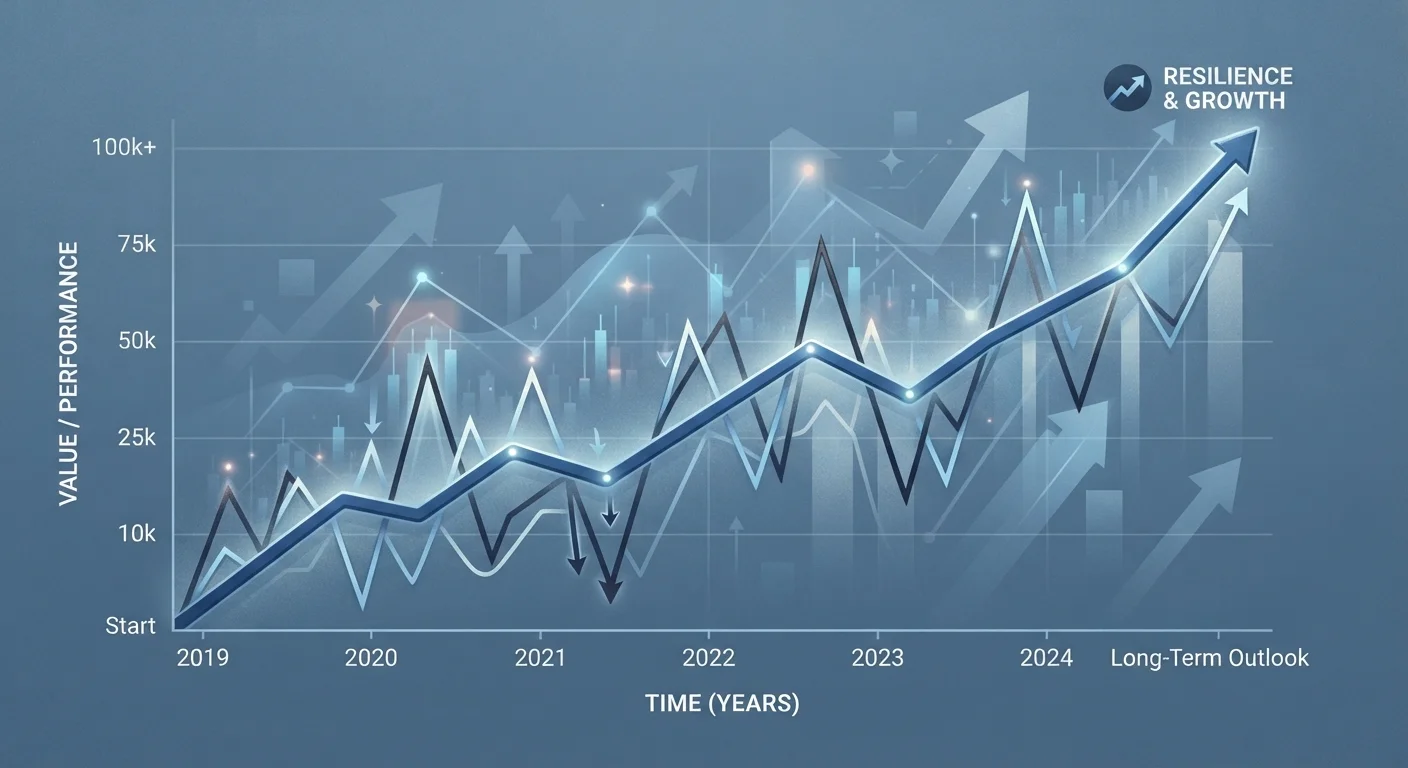
While past performance is never a guarantee of future results, the historical record of U.S. and global markets offers a consistent pattern: major downturns have eventually been followed by recoveries. The S&P 500, for instance, has experienced dozens of corrections and multiple bear markets since its inception, yet its long-term trajectory has trended upward over multi-decade periods.
The catch is timing. Recoveries have ranged from a few months to several years, and not every individual stock or sector recovers at the same pace — or at all. This is precisely why diversification matters so much: spreading holdings across asset types reduces the risk that one failing sector derails an entire portfolio.
~11 months
Average length of a bear market (S&P 500)
Analysis of S&P 500 bear markets since 1928 suggests they have lasted roughly 9–18 months on average, compared to bull markets that have historically lasted several years.
10 days
Best trading days that define long-term returns
Research by J.P. Morgan Asset Management has consistently found that missing just the 10 best market days in a given decade can cut long-term returns roughly in half compared to staying fully invested.
Critically, investors who sold during a downturn and waited to reinvest often missed the sharpest early days of a recovery — days that can account for a disproportionate share of long-term returns. Missing even a handful of the market's best single days historically has a meaningful negative impact on overall outcomes.
Best Practices for Investing Through Volatility
Knowing that downturns are a normal part of market cycles is one thing. Having a practical approach for navigating them is another. The following principles are grounded in widely accepted long-term investing frameworks — not speculation or short-term tactics.
Define your time horizon before making any portfolio changes.
Your time horizon — how long before you need the money — is the single most important factor in determining how much short-term volatility you can reasonably absorb. Investors with decades ahead of them have historically had far more opportunity to recover from downturns than those who need funds within a year or two.
Avoid making portfolio decisions based on news headlines or short-term market moves.
Financial media is structured to generate attention, which means volatility gets amplified coverage. Reacting to each headline often results in buying high after enthusiasm and selling low after fear — the opposite of sound investing practice. Several common investing myths thrive precisely because emotional decision-making feels rational in the moment.
Maintain a diversified portfolio aligned with your risk tolerance.
Concentration in a single asset, sector, or geography amplifies both gains and losses. Diversification doesn't eliminate risk, but it distributes it — so that poor performance in one area doesn't devastate an entire portfolio. Risk tolerance isn't just about how much loss you can mathematically afford; it's also about how much volatility you can emotionally withstand without making impulsive decisions.
Continue regular contributions when possible, rather than pausing during downturns.
Regular, fixed contributions — a strategy often called dollar-cost averaging — mean you automatically buy more shares when prices are lower and fewer when prices are higher. This doesn't guarantee profit, but it removes the near-impossible task of trying to time the market perfectly. Pausing contributions during a downturn often means missing the lower-price entry points that can benefit long-term outcomes.
Revisit — but don't overhaul — your investment plan during a downturn.
A downturn is a reasonable time to confirm that your asset allocation still matches your goals and time horizon. It is not a reasonable time to dramatically restructure your portfolio out of fear. Small, deliberate adjustments are very different from reactive wholesale changes. Short-term trading and long-term investing operate on entirely different logic — and conflating them during a downturn is a common mistake.
Getting Started: Actions You Can Take Now
If a recent downturn has left you second-guessing your approach, the goal isn't to find a perfect strategy — it's to build habits that hold up across market conditions. New investors especially can benefit from reviewing common risk misconceptions before making changes during volatile periods.
Also worth revisiting: whether your broader financial foundation is solid. Investing during a downturn is easier to stay the course on when you're not carrying high-interest debt or operating without an emergency fund. Our saving and debt hub covers those foundations.
This article is for general informational and educational purposes only and does not constitute personalized financial, investment, tax, or legal advice. All investing involves risk, including the possible loss of principal. Past market performance does not guarantee future results. Please consult a qualified, licensed financial adviser before making investment decisions based on your individual circumstances.
The content on this site is for informational purposes only and is not a substitute for professional advice. Always consult a qualified professional for guidance specific to your situation.