

Our Verdict
Short-term trading and long-term investing are fundamentally different disciplines with different demands, costs, and risk profiles. For most everyday consumers, long-term investing — built around diversified, low-cost holdings held over years — is the more accessible and historically reliable path to growing wealth. Short-term trading can appeal to those with specific knowledge, time, and capital to absorb potential losses, but it is not a shortcut to wealth and carries real downside risk.
| Best for | Recommended |
|---|---|
| Those building wealth steadily over years with limited daily involvement | Long-Term Investing |
| Experienced market participants with dedicated capital and time to monitor positions | Short-Term Trading |
| Anyone saving for retirement, a home, or another multi-year goal | Long-Term Investing |
What Separates Trading from Investing?
The words "trading" and "investing" get used interchangeably in everyday conversation, but they describe two meaningfully different activities. Before exploring which might suit your situation, it helps to understand what each actually involves.
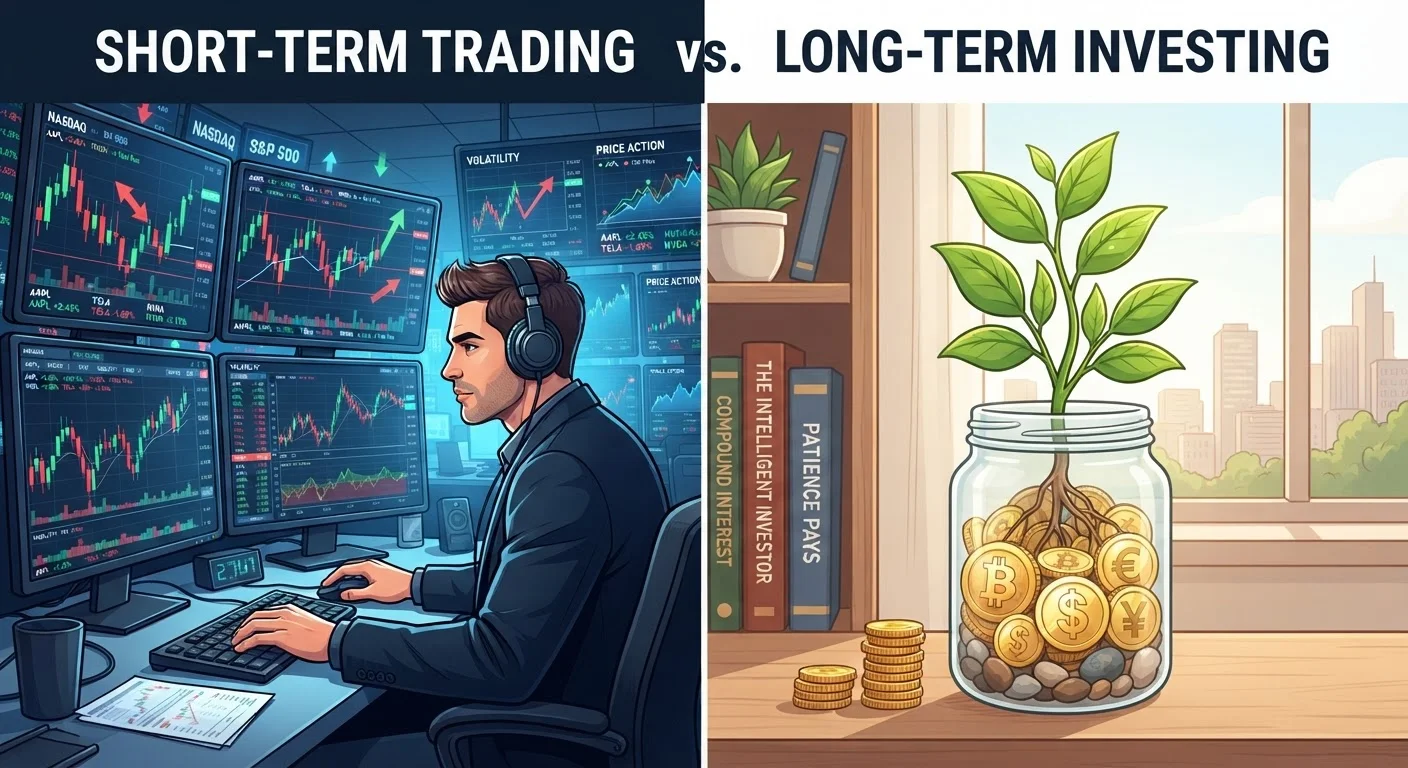
Short-term trading involves buying and selling financial assets — stocks, options, currencies, or other instruments — over relatively brief time frames. Some traders hold positions for seconds or minutes (day trading); others for days or weeks (swing trading). The core goal is to profit from price movements in the near term.
Long-term investing means purchasing assets with the intention of holding them for years or even decades. The underlying assumption is that well-chosen assets — or broad market index funds — will appreciate in value over time, even if they fluctuate significantly along the way. If you're unfamiliar with foundational market concepts, the investing terminology guide is a useful starting point.
How Each Approach Works in Practice
Understanding the mechanics of each approach makes the differences concrete.
Short-Term Trading
Traders typically rely on technical analysis — reading price charts, volume patterns, and market momentum — to identify short-term opportunities. They may place multiple trades in a single day or week. Because they're reacting to price shifts rather than business fundamentals, the decision-making is fast-paced and time-intensive. Transaction costs (commissions, bid-ask spreads) accumulate quickly, and each profitable trade may trigger a taxable event.
Long-Term Investing
Long-term investors usually focus on the underlying value of what they're buying — a company's earnings potential, a fund's diversification, or a broad market index. They make fewer transactions, often holding positions through market dips without selling. This approach leans heavily on compounding (earning returns on previous returns over time), which becomes more powerful the longer it runs. It also tends to generate lower tax bills, since assets held over a year typically qualify for lower long-term capital gains rates.
| Short-Term Trading | Long-Term Investing | |
|---|---|---|
| Typical time horizon | Seconds to months | Years to decades |
| Primary strategy | Price movement, technical signals | Asset value, compounding growth |
| Transaction frequency | High — multiple trades regularly | Low — infrequent buying/selling |
| Tax treatment of gains | Short-term rates (ordinary income) | Long-term capital gains rates (lower) |
| Time commitment | High — active daily monitoring | Low — periodic review |
| Risk concentration | High — concentrated in short windows | Spread across years; time buffers volatility |
| Skill/knowledge required | Technical analysis, rapid decision-making | Fundamental understanding, patience |
The Risk Picture Is Very Different
Risk shows up differently in each approach, and understanding that distinction matters — especially for newer market participants.
Short-term trading concentrates risk in narrow time windows. A single news event, earnings report, or market shift can move a position sharply against a trader in minutes. There's also the behavioral challenge: trading research consistently finds that emotional decision-making — panic selling, chasing momentum — erodes returns. Academic studies on retail day traders, including research from the University of California, have found that the majority of active traders lose money over time after accounting for costs.
Long-term investing involves risk too — markets fall, sometimes significantly — but time tends to dilute short-term volatility. Historical market data shows that despite recessions and crashes, broad equity markets have generally recovered and grown over multi-decade periods. That's not a guarantee of future performance, but the time horizon itself is a form of risk management.
For a deeper look at how beginners often misread risk, see common risk mistakes first-time investors make.
Don't Confuse Excitement With Edge
Short-term trading can feel engaging and dynamic in a way that long-term investing doesn't. That emotional appeal is worth being cautious about. The thrill of active trading can lead people to overestimate their skill and underestimate costs and losses. If you're drawn to trading, consider starting with a paper trading account (simulated trades with no real money) to test strategies before risking capital you can't afford to lose.
Costs, Taxes, and Time Commitment
The practical burdens of each approach differ significantly and deserve honest consideration.
~70–80%
Retail day traders who lose money
Multiple academic studies, including research from the University of California, consistently find the large majority of active retail traders lose money net of costs over time.
15%
Maximum long-term capital gains rate for most filers
Assets held longer than one year qualify for long-term capital gains tax rates, which are generally lower than ordinary income rates applied to short-term gains, per U.S. IRS guidelines.
Trading costs: Frequent buying and selling generates transaction costs and short-term capital gains taxes (taxed at ordinary income rates, which are generally higher than long-term rates). These costs compound over time and can significantly reduce net returns even if individual trades are profitable.
Investing costs: Long-term investors typically face lower transaction frequency and, when using low-cost index funds, minimal management fees. Gains held longer than one year are taxed at lower long-term capital gains rates. The comparison between index funds and actively managed funds explores how fund costs affect long-run outcomes.
Time commitment: Active trading can be a near-full-time activity requiring constant market monitoring. Long-term investing, particularly through diversified funds, can be managed with periodic check-ins — making it far more compatible with everyday life.
Which Approach Fits Your Situation?
Neither approach is inherently superior for every person, but a few factors help clarify which might align with your goals.
- Time horizon: Saving for retirement in 20 years? Long-term investing is generally more appropriate. Looking to actively engage with markets as a learned skill? Trading might be worth exploring — with real caution and only with capital you can afford to lose.
- Risk tolerance: Can you watch a position drop 20% without panicking? Trading demands psychological resilience that many people underestimate.
- Available time: Trading actively requires hours of daily attention. Most people building financial security alongside careers and families are better served by a lower-maintenance, long-term approach.
- Financial foundation: Before either approach, a solid emergency fund and manageable debt load matter. See saving and debt resources for grounding steps.
It's also worth reading about common investing myths — many people avoid long-term investing based on misconceptions that don't hold up to scrutiny.
Start With Goals, Not Strategies
Before deciding between trading and investing, get clear on what you actually want to accomplish financially and over what time frame. Most consumer financial goals — retirement, home purchase, education savings — are inherently long-term and align more naturally with investing principles than with active trading. If you're just getting started, focusing on building consistent savings habits first will serve you well regardless of which approach you eventually explore.
This article is for general informational and educational purposes only and does not constitute personalised financial, investment, tax, or legal advice. Consult a qualified financial professional before making decisions based on your individual circumstances.
The content on this site is for informational purposes only and is not a substitute for professional advice. Always consult a qualified professional for guidance specific to your situation.