

Beyond the Beaten Path: What Specialty Travel Actually Means
Standard vacation planning tends to orbit a familiar constellation: beach resorts, city sightseeing, theme parks, or cruise itineraries. That planning framework works well for millions of travelers — but it leaves a vast landscape of niche experiences almost entirely off the map. Specialty travel refers to any trip organized around a specific interest, purpose, or methodology that falls outside mainstream tourism. The range is genuinely wide.
Some of these formats are passion-driven — built around literature, geology, astronomy, or food. Others are purpose-driven, centering on environmental contribution or cross-cultural learning. A few are methodology-driven, prioritizing how a person travels rather than where. Understanding these distinctions helps curious travelers find experiences that match who they actually are, not just what's heavily marketed. For a deeper look at how travel pace itself shapes the experience, see Slow Travel vs. Itinerary-Driven Tourism.
Dark Sky Tourism
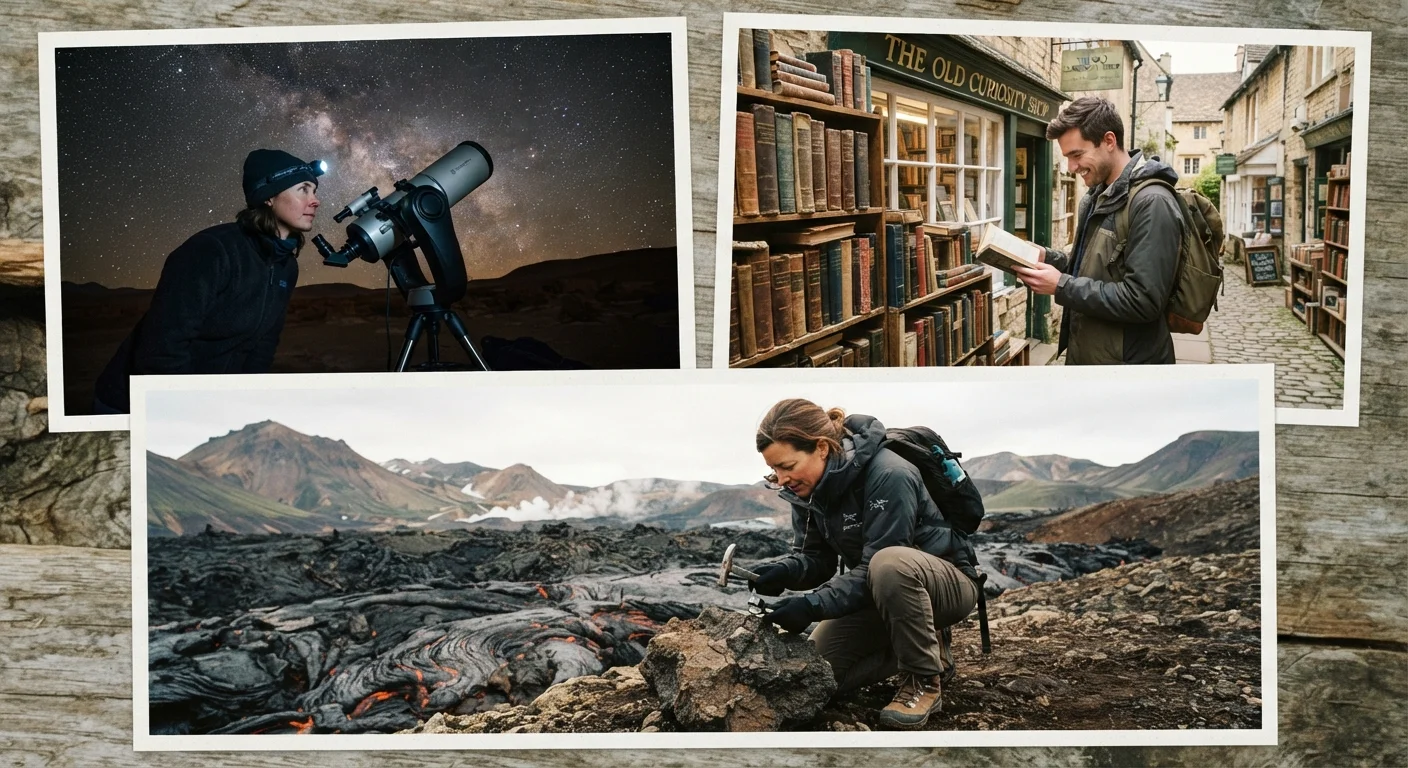
Dark sky tourism — sometimes called astrotourism — draws travelers to locations specifically chosen for minimal light pollution, where the night sky becomes the main attraction. Designated dark sky reserves, parks, and sanctuaries exist across the United States, Chile, Namibia, New Zealand, and elsewhere. These sites are often certified by organizations like the International Dark-Sky Association, which maintains publicly available designations.
Trips are typically timed around new moon phases and may include guided telescope sessions, astrophotography workshops, or simply open-air stargazing. Many dark sky destinations are rural and require planning around accommodation options that may be limited.
The night sky becomes the destination when light pollution disappears from the equation.
Geotourism
Geotourism focuses on geological landscapes — volcanic fields, karst formations, ancient fossil beds, canyon systems, and mineral-rich coastlines. Unlike geology-adjacent sightseeing (visiting the Grand Canyon, for instance), dedicated geotourism often involves guided interpretation, time with geologists or naturalists, and travel to less-visited formations. UNESCO-designated Global Geoparks offer one framework for finding vetted sites.
This format appeals to travelers who want to understand the deep physical history of a place rather than just admire its surface. Some geopark experiences are family-friendly; others involve moderate to strenuous hiking on uneven terrain.
Geotourism reveals the physical history beneath a landscape, not just the scenery above it.
Bibliophile Travel
Book-centered travel — sometimes called literary tourism or bibliophile travel — organizes trips around the written word. This can mean visiting the homes and haunts of authors, exploring destinations made famous by specific novels, attending literary festivals, or spending days in notable independent bookshops and rare book archives. Cities like Edinburgh, Dublin, and Buenos Aires have robust literary tourism infrastructure; smaller towns sometimes anchor around a single writer or genre tradition.
The experience is quietly immersive — less about crossing sights off a list and more about inhabiting the atmosphere of a story or a writer's life. It pairs naturally with slow travel approaches that allow time for reading, wandering, and unhurried discovery.
Literary travel invites readers to inhabit the world of a book or an author's life firsthand.
Voluntourism (With Caveats)
Voluntourism combines travel with community service or conservation work — teaching, building, environmental restoration, wildlife monitoring, or disaster recovery assistance. In principle, it channels traveler energy toward meaningful contribution. In practice, the sector carries documented concerns: programs that displace local workers, short-term projects with negligible lasting impact, and organizations that profit from volunteers without delivering community benefit.
Responsible voluntourism requires careful vetting. Reputable programs are typically longer-term (weeks rather than days), involve genuine skills matching, are led or co-led by local organizations, and are transparent about how volunteer fees are allocated. Travelers genuinely interested in ethical contribution often benefit from connecting with established nonprofits or development-focused NGOs rather than commercial voluntourism marketplaces.
Responsible voluntourism demands thorough vetting — not all programs deliver the community benefit they promise.
Culinary Immersion Travel
While food tours are now common in most major cities, culinary immersion travel goes considerably deeper — encompassing multi-day fermentation retreats, farmhouse residencies, foraging expeditions, fishing village stays, and cooking apprenticeships with regional specialists. The distinction from a standard food tour is depth: participants engage with production, technique, and cultural context rather than sampling a curated itinerary of restaurants.
Culinary tourism as a full travel format has expanded significantly, and many travelers are surprised to discover how much of it happens outside urban restaurant settings — in rural kitchens, fishing harbors, and family farms.
True culinary immersion engages with food production and technique, not just the finished dish.
Genealogy and Heritage Travel
Heritage travel centers on personal history — visiting ancestral homelands, tracing family lineages through local archives and cemeteries, and connecting with distant relatives or community memory. For many Americans with immigrant ancestry, this form of travel carries particular emotional resonance. It often involves advance research through genealogical records, coordination with local historians or cultural organizations, and visits to churches, civil registries, or village archives.
Some travel companies and cultural organizations specialize in heritage journey facilitation, including translation support and archive access. The experience tends to be deeply personal and rarely follows a standard itinerary — which is part of its appeal.
Heritage travel transforms a destination from a place on a map into a chapter of personal history.
Planning for Niche: What to Keep in Mind
Specialty travel often requires more upfront research than a standard package trip. Operators may be small and local, availability may be seasonal, and some experiences — particularly in conservation zones or sensitive cultural sites — require permits or advance registration. Travelers with very specific interests may also find that specialty travel agencies are better equipped to handle logistics than generalist booking platforms.
Start With Interest, Then Find the Place
Specialty travel planning often works better in reverse: identify the specific interest or experience you're after, then find destinations where that experience is authentic and well-developed. Searching for 'dark sky reserves near me' or 'literary festivals in Europe' tends to surface better options than trying to retrofit a niche interest onto a pre-chosen destination. Specialty travel agencies — particularly those focused on a single niche — can be valuable resources when standard booking tools fall short.
It's also worth noting that niche travel doesn't automatically mean remote or expensive. Bibliophile weekends, urban foraging walks, and dark sky experiences near small towns can all be remarkably accessible. The key is knowing that these options exist and looking for them with intention. For travelers weighing the gap between expectation and reality, destination photography versus on-the-ground experience is a useful reference before any trip.
The content on this site is for informational purposes only and is not a substitute for professional advice. Always consult a qualified professional for guidance specific to your situation.