

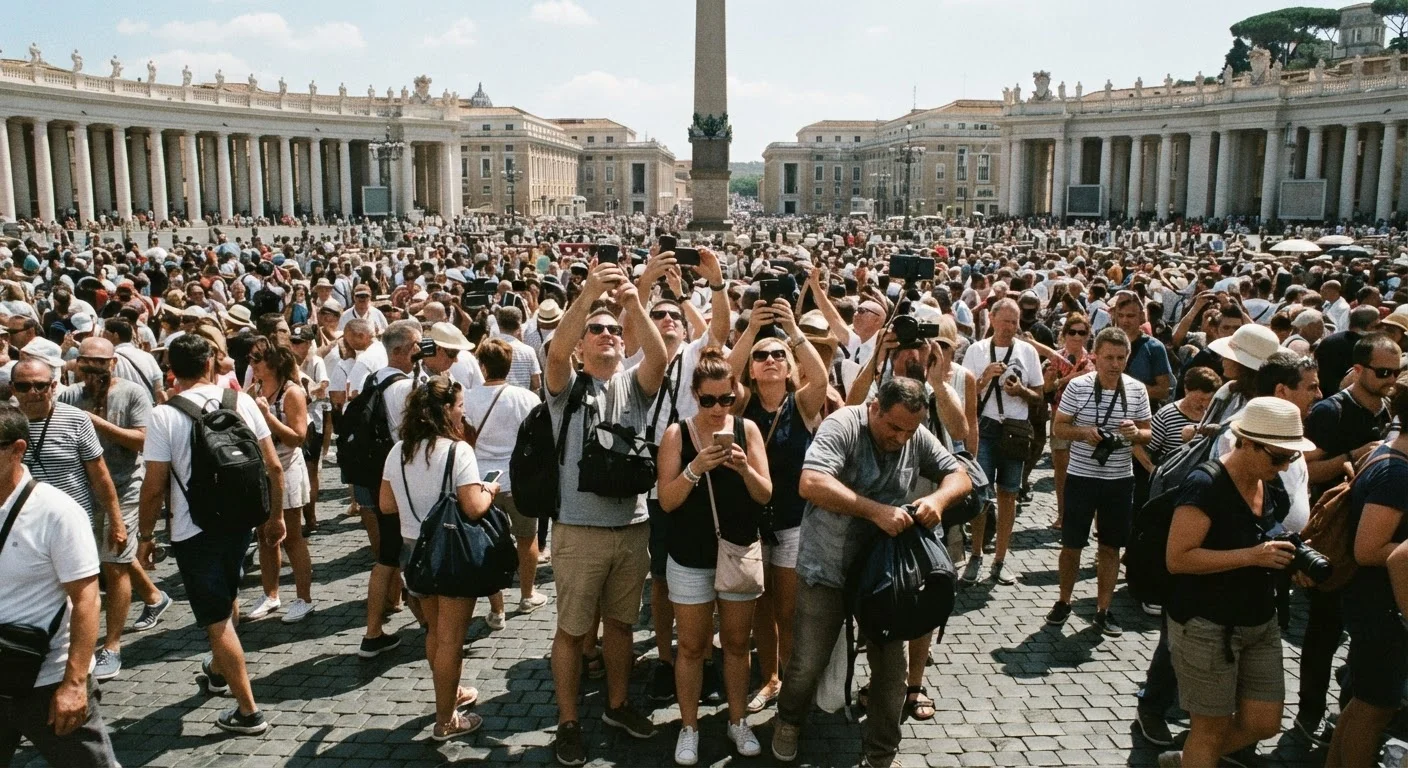
The Myth of the Empty Landmark
Scroll through travel accounts of Venice's Piazza San Marco, the Eiffel Tower, or Antelope Canyon and you'll encounter a consistent visual: an impossibly serene, crowd-free scene bathed in golden light. It looks like the whole place was reserved just for the photographer. In reality, those same spots host thousands of visitors daily during peak season, with queue lines, tour groups, and ambient noise that no Instagram filter can silence.
This expectation gap — where anticipation shaped by photography collides with the loud, crowded, very human reality of a popular destination — is one of the most common forms of travel disappointment. Understanding what creates the gap is the first step to closing it.
Myth
Famous landmarks look the same in person as they do in travel photos — just with people in the frame.
Fact
Professional photography routinely uses specialized timing, equipment, and editing to remove crowds, enhance colors, and reshape spatial proportions.
The empty, luminous version of a landmark almost never matches the visitor experience. Long exposures erase moving people entirely; ultra-wide lenses distort space; post-processing saturates colors beyond what the eye perceives. The result is a technically derived image, not a documentary one. Travelers often describe feeling like they're at a different place than the one they'd seen online.
Myth
If a destination looks stunning in photos, it will be equally stunning whenever you visit.
Fact
Most iconic destination photos are captured during a narrow seasonal or daily window that the average tourist rarely hits.
Golden-hour light lasts minutes. Peak bloom periods for famous floral landscapes span days to weeks. Snow cover, autumn color, and low tide exposures are all time-bound. Promotional imagery gravitates toward these peak moments, while the reality for most visitors is overcast skies, bare fields, or a different season entirely. Researching the conditions that create the famous image — and planning around them — makes a meaningful difference.
Myth
Crowds are only a problem at the most hyped global icons, not at mid-tier or 'hidden gem' destinations.
Fact
Social media has dramatically compressed the timeline between a destination being 'discovered' and becoming overcrowded.
A waterfall or viewpoint labeled a hidden gem in a viral post can go from obscure to overwhelmed within months. This phenomenon, sometimes called the 'Instagram effect,' has affected sites from small-town murals to remote canyon trails. Overtourism is no longer only the problem of Paris or Machu Picchu. Off-season travel can help, but even that window is narrowing at rapidly trending destinations.
Myth
Travel photos accurately represent the scale of natural features — what looks massive really is massive.
Fact
Wide-angle lenses and aerial drone photography routinely distort scale in ways that both exaggerate and diminish features depending on the shot.
A canyon wall can be photographed to look cathedral-tall or compressed and shallow depending on focal length. A beach that appears endless from drone height might be a narrow strip in person. Conversely, a small waterfall photographed close and low with a wide lens can appear imposing. These are legitimate photographic techniques — but they set expectations that physical presence then resets, often abruptly.
Myth
Visiting at off-peak times guarantees a quieter, more photogenic experience.
Fact
Off-season visits can reduce crowds but often introduce weather, service closures, or conditions that don't match the imagery either.
The famous autumn foliage of New England, for instance, is peak-season — visiting in November for fewer crowds means missing the color entirely. Winter at beach destinations brings empty shores but also shuttered restaurants and cold water. The trade-offs are real. Off-peak travel has genuine advantages, but 'quieter' doesn't automatically mean 'more like the photo.' Understanding what conditions created the image in the first place is the more useful frame.
Why the Photography Itself Is the Problem
Travel images go through layers of transformation before they reach you. A professional photographer might wake at 4 a.m. to shoot in blue-hour light before the crowds arrive, use a wide-angle lens that dramatically expands apparent space, employ a long-exposure technique that erases moving pedestrians entirely, and then spend hours in post-processing adjusting color, contrast, and sky. The result can be technically accurate — those rocks really are that red at that angle — but experientially misleading.
~90%
Travel images altered in post-processing
Industry surveys of professional travel photographers consistently find that the vast majority of published travel images undergo significant color and light editing before publication.
4–6 hrs
Average wait at peak-season iconic sites
Visitor management data from sites like the Vatican Museums, Sagrada Família, and popular US national park trailheads document multi-hour wait times during summer peak periods.
Drone photography adds another layer of unreality. Aerial views of the Amalfi Coast or the Scottish Highlands look nothing like the narrow, traffic-clogged cliff roads or muddy hiking trails you'll actually navigate. As the same principle applies to hotel photography, flattering angles and selective framing serve the image, not the traveler.
Timing, Season, and the Light Nobody Tells You About
Even without any editing, a destination photographed in late May at the golden hour looks radically different from the same spot in August at noon. Seasonal light angles, foliage states, snow cover, and water levels can transform how a landscape reads. The lavender fields of Provence bloom for roughly three weeks a year; the tulip rows of the Netherlands peak over an equally narrow window. Outside those windows, the fields are bare or green — not purple or yellow — and most visitors arrive expecting the postcards.
Weather, too, is routinely edited out of destination imagery. The Scottish Highlands look dramatic and moody in gray mist, which is also what they look like most of the time — but the photos that circulate tend to feature the rare blue-sky days. Understanding how time of year shapes destination experience is one of the most practical things a traveler can do before booking.
Don't Book Around a Single Photo
If a destination is on your list primarily because of one striking image you saw online, research the conditions that created that image before you commit to dates. Verify the season, the time of day, and whether that specific viewpoint is publicly accessible. Some iconic photos are taken from private property, restricted zones, or locations that require advance permits. Check with official tourism boards or local government sources for current access information.
What to Do With Realistic Expectations
None of this means popular destinations aren't worth visiting. It means visiting them differently. Arriving at a landmark before the tour buses, accepting that famous views often come with famous crowds, and building in buffer time can all shift the experience. Travelers who practice slow travel rather than rushing a checklist of sights frequently report feeling less let down — partly because they're not treating a destination as a photo opportunity with logistics attached.
It's also worth considering that the places with the biggest gaps between image and reality tend to be the most heavily marketed. Lesser-visited national parks and destinations often deliver a closer match simply because there's less hype to overcome. And niche or specialty travel formats — geotourism, heritage travel, culinary journeys — tend to prioritize experience over aesthetics in ways that don't rely on photogenic staging at all.
The content on this site is for informational purposes only and is not a substitute for professional advice. Always consult a qualified professional for guidance specific to your situation.