

Our Verdict
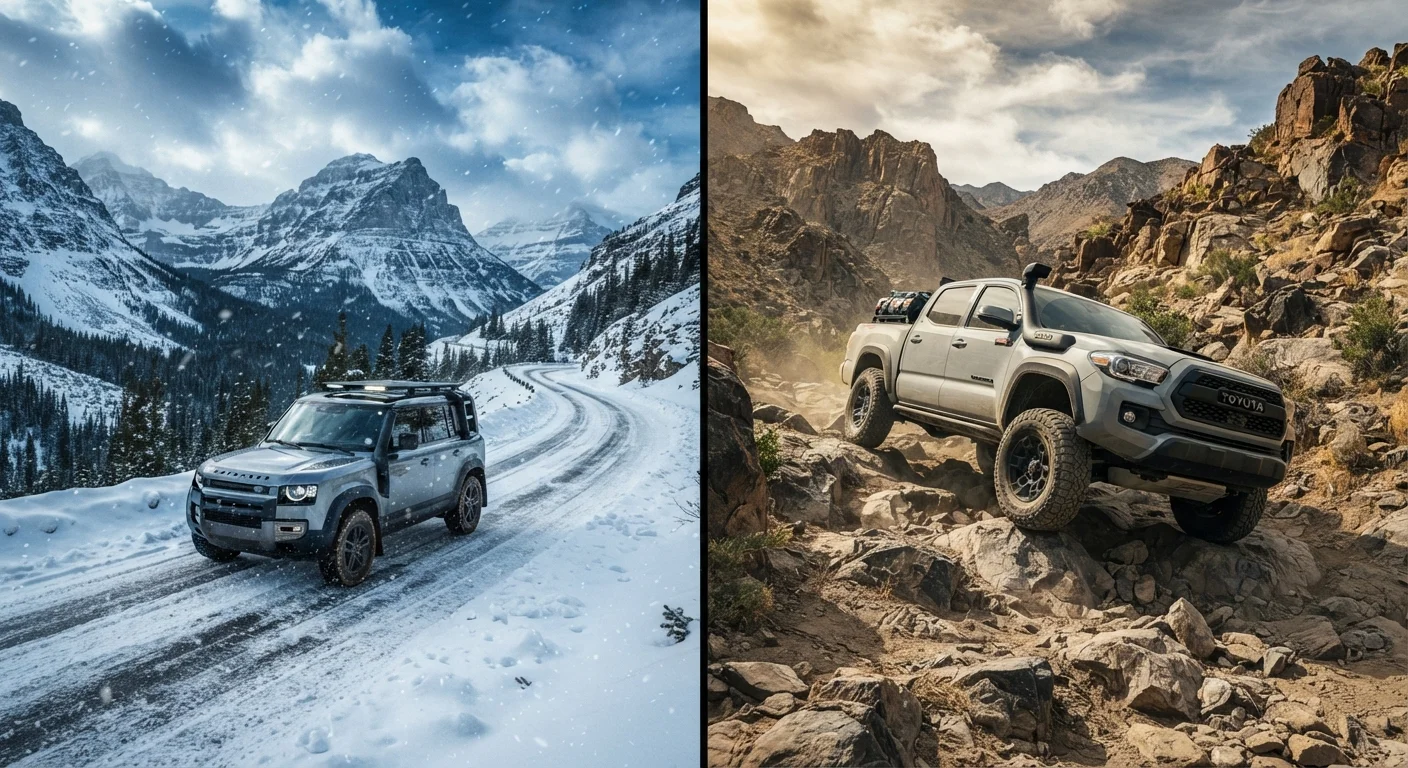
AWD and 4WD solve different problems. AWD provides seamless, always-on traction enhancement for commuters and drivers who encounter wet or lightly snowy roads. 4WD delivers the mechanical grunt and low-range capability needed for genuine off-road use and extreme terrain. Choosing between them starts with an honest assessment of where you actually drive.
| Best for | Recommended |
|---|---|
| Daily commuters in snowy or rainy climates | All-Wheel Drive (AWD) |
| Off-road enthusiasts, overlanders, and serious trail drivers | Four-Wheel Drive (4WD) |
| Drivers who tow heavy loads or frequently traverse unimproved roads | Four-Wheel Drive (4WD) |
| Those seeking better wet-road confidence without sacrificing fuel economy | All-Wheel Drive (AWD) |
How Each System Actually Works
All-wheel drive and four-wheel drive both send power to all four wheels, but the engineering behind each approach is fundamentally different — and those differences determine where each system performs well.
AWD systems use a center differential or electronically controlled clutch packs to continuously distribute torque between front and rear axles. Most modern AWD setups operate automatically, reading wheel-slip data and redirecting power in milliseconds without any driver input. They are designed to remain engaged at highway speeds and on paved surfaces without causing driveline stress.
4WD systems, by contrast, lock the front and rear driveshafts together mechanically (or electronically), forcing all four wheels to rotate at the same speed. This rigidity is what makes 4WD so capable off-road, but it also means 4WD is generally unsuitable for tight turns on dry pavement — the system can "wind up" and cause driveline damage. Most 4WD-equipped vehicles offer a 4Hi mode for moderate off-road and loose surfaces, and a 4Lo (four-wheel drive low range) mode that multiplies torque dramatically for rock crawling and extreme inclines.
For a broader look at how drivetrain options intersect with vehicle categories, see our guide to major motor vehicle types.
| All-Wheel Drive (AWD) | Four-Wheel Drive (4WD) | |
|---|---|---|
| Engagement | Automatic, continuous | Driver-engaged (part-time or full-time) |
| Best terrain | Wet, icy, or lightly snowy pavement | Mud, rock, deep snow, trails |
| Low-range gearing | Not available | Available on most systems |
| Dry pavement use | Safe at all times | Can cause driveline bind in 4Hi/4Lo |
| Common vehicle types | Crossovers, sedans, performance cars | Trucks, body-on-frame SUVs, off-road platforms |
| Fuel economy impact | Moderate reduction vs. 2WD | Larger reduction, especially in 4WD mode |
| Driver action required | None | Must engage and disengage manually |
Where AWD Has the Advantage
AWD excels in everyday driving conditions where traction can change without warning — rain-slicked highways, slushy parking lots, or lightly snow-covered suburban streets. Because it requires no driver action, the system responds before most drivers would even register wheel slip occurring.
Crossovers and car-based SUVs almost universally use AWD rather than 4WD, reflecting the reality that their buyers are more likely to encounter a wet on-ramp than a boulder field. AWD also integrates naturally with stability control systems, which is one reason many modern performance sedans and sports cars have adopted it as well.
The trade-off: AWD adds weight, mechanical complexity, and generally reduces fuel economy compared to a two-wheel-drive equivalent. It also offers no low-range gearing, which limits its usefulness when torque multiplication — not just traction — is what the terrain demands.
Test AWD in Real Conditions Before Assuming It's Enough
If you live in an area with frequent heavy snow or ice, test your AWD vehicle's behavior in those conditions rather than assuming the system will handle anything winter delivers. AWD significantly improves traction on acceleration but does not reduce stopping distances. Pairing AWD with dedicated winter tires offers substantially better all-around performance in severe cold-weather conditions.
If your vehicle shopping centers on crossovers and SUVs, the distinction between SUVs and crossovers is worth understanding before assuming drivetrain options are equivalent across both categories.
Where 4WD Has the Advantage
Four-wheel drive is the appropriate system when the terrain itself is the obstacle — deep mud, loose rock, steep rutted trails, or sand that swallows tires. The mechanical lock between axles and the torque multiplication of low range provide a level of capability that no AWD system is engineered to match.
Truck-based vehicles — full-size pickups, traditional body-on-frame SUVs, and dedicated off-road platforms — are typically the vehicles that offer true 4WD with a transfer case and low range. This also makes them better suited for heavy towing, where drivetrain robustness matters as much as traction.
The limitation: 4WD systems generally shouldn't be used on dry, hard pavement in 4Hi or 4Lo mode. Driving in 4WD on a dry road causes binding that stresses axles, differentials, and transfer cases. Modern part-time 4WD systems require the driver to remember to disengage when conditions no longer warrant it.
Don't Use 4WD on Dry Pavement
Engaging 4WD on dry, hard pavement — even briefly — can cause driveline binding that damages axle shafts, differentials, and transfer case components. This is a commonly overlooked risk for new 4WD owners. Always consult your owner's manual for specific guidance on when to engage and disengage the system, and err toward disengaging as soon as terrain improves.
For those still weighing what vehicle type fits their actual lifestyle, our vehicle type matching guide offers a useful framework before drivetrain decisions become relevant.
Tires, Conditions, and Realistic Expectations
One point worth emphasizing: neither AWD nor 4WD improves a vehicle's ability to stop. Braking distance is determined by tires and weight, not by how many wheels are driven. A vehicle with AWD or 4WD on worn all-season tires will brake no better than a front-wheel-drive vehicle — and overconfidence in traction systems has contributed to real-world accidents.
Dedicated winter tires fitted to any drivetrain configuration will typically outperform all-season tires on AWD or 4WD when ice and packed snow are the main hazard. Drivetrain choice and tire choice are complementary decisions, not substitutes for each other.
Fuel economy is also worth considering honestly. AWD vehicles typically consume more fuel than their two-wheel-drive counterparts, and 4WD vehicles — often heavier and less aerodynamic — tend to sit at the lower end of fuel efficiency ratings. If powertrain efficiency is a priority alongside traction, that broader trade-off is covered in our comparison of fuel type trade-offs across gas, hybrid, and electric vehicles. For parts, maintenance, and service considerations related to drivetrain components, the Vehicle Parts & Services hub is a useful starting point.
The content on this site is for informational purposes only and is not a substitute for professional advice. Always consult a qualified professional for guidance specific to your situation.