

Our Verdict
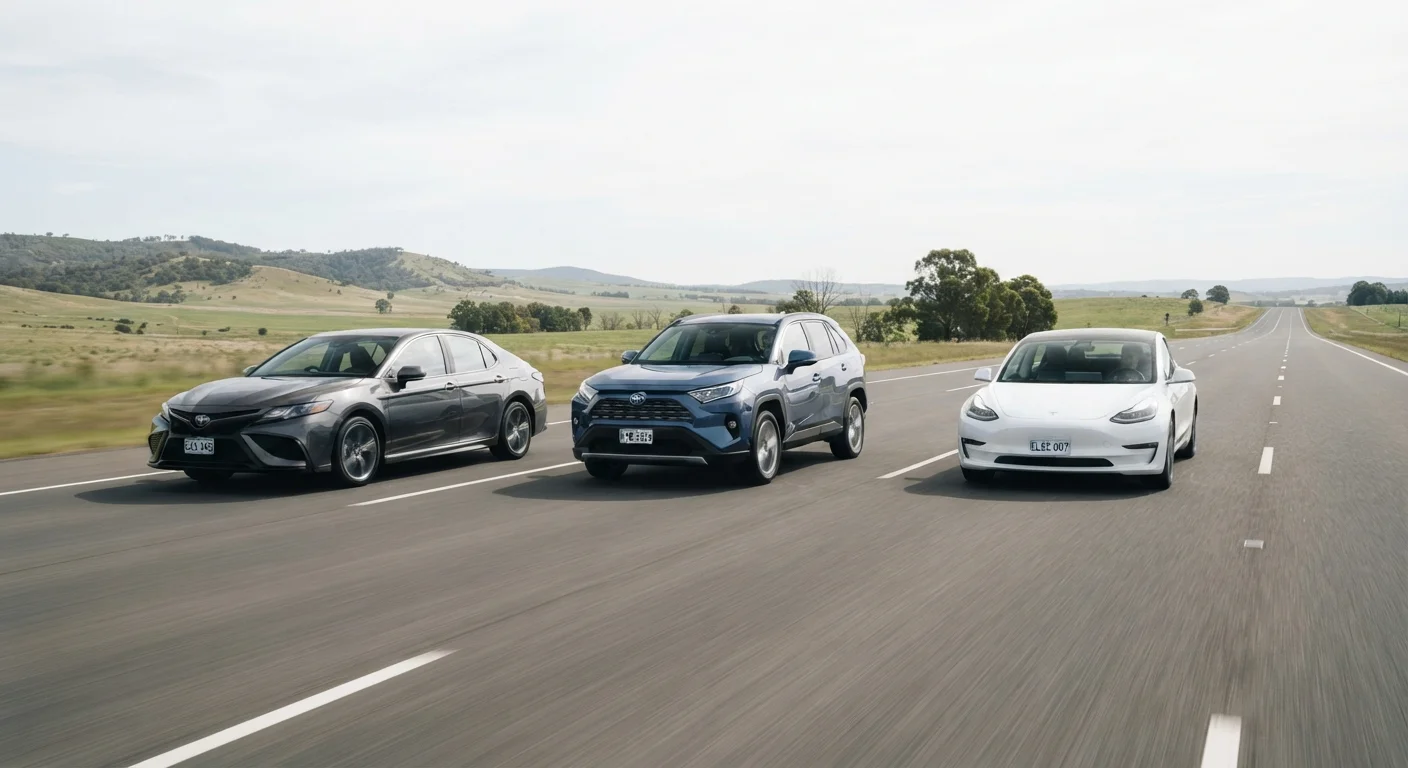
No single powertrain type wins across all situations. Gas vehicles remain the most flexible choice for drivers with unpredictable routes or limited charging infrastructure. Hybrids offer a low-friction middle path that suits a wide range of drivers without requiring behavioral changes. EVs deliver the most compelling operating economics for drivers who can charge at home and stick largely to predictable routes.
| Best for | Recommended |
|---|---|
| Drivers who frequently travel long distances or rural routes | Gas |
| Drivers seeking better fuel economy without infrastructure changes | Hybrid |
| Commuters with home charging access and consistent daily mileage | Electric |
| Those wanting electric-mode capability with gas backup for flexibility | Plug-In Hybrid (PHEV) |
Understanding What You're Actually Comparing
When shoppers weigh fuel types, they're not just comparing what goes in the tank — they're comparing entire ownership experiences. Fueling habits, maintenance schedules, range anxiety, tax incentives, and resale behavior all differ by powertrain. Before landing on a choice, it helps to understand what each system actually involves day to day.
This comparison covers conventional gasoline, standard hybrid (HEV), plug-in hybrid (PHEV), and battery electric vehicles (BEV). For a deeper look at how BEVs work mechanically, see our EV ownership guide. And if you're still deciding between new and used, the cost trade-offs of new vs. used vehicles are worth reviewing alongside powertrain choice.
| Gas (ICE) | Hybrid (HEV) | Plug-In Hybrid (PHEV) | Electric (BEV) | |
|---|---|---|---|---|
| Typical upfront cost | Lower | Moderate | Moderate–Higher | Higher |
| Per-mile fuel/energy cost | Highest | Lower than gas | Lowest with charging | Lowest overall |
| Charging infrastructure needed | None | None | Optional (improves value) | Essential for practicality |
| Long-distance range flexibility | Excellent | Excellent | Excellent | Requires planning |
| Maintenance complexity | Highest | Moderate | Moderate | Lowest |
| Emissions profile | Highest tailpipe | Reduced tailpipe | Lower (when charged) | Zero tailpipe |
| Potential tax incentives | Minimal | Limited | Available (income-capped) | Available (income-capped) |
Cost of Ownership: Where the Numbers Diverge
Sticker price is only part of the story. Gas vehicles typically carry the lowest purchase price among equivalent models, but fuel and maintenance costs accumulate quickly. The U.S. Department of Energy estimates that electricity as a fuel source generally costs less per mile than gasoline, though exact figures vary by local energy prices and driving patterns.
Hybrids often cost more upfront than comparable gas trims but close that gap through improved fuel economy — typically 20–50% better than a non-hybrid equivalent, depending on the vehicle and drive cycle. PHEVs go further, allowing short all-electric commutes while retaining a gas engine for longer trips. For a detailed look at how standard and plug-in hybrids differ in practice, see our hybrid vs. PHEV comparison.
EVs carry the highest average purchase price but the lowest per-mile operating costs. Federal tax credits — subject to income limits, vehicle price caps, and assembly requirements — can reduce net acquisition cost, though eligibility should be confirmed with a tax professional for your specific situation.
3–5¢
Typical EV cost per mile (electricity)
The U.S. Department of Energy's Alternative Fuels Data Center estimates electricity-fueled driving at roughly 3–5 cents per mile at average U.S. residential electricity rates.
~40%
Fuel savings hybrids can deliver in city driving
EPA data consistently shows hybrid powertrains achieving substantially higher city fuel economy than equivalent non-hybrid models, where regenerative braking provides the greatest benefit.
8 yrs / 100k mi
Federal minimum EV battery warranty
Federal law requires EV manufacturers to warranty the high-voltage battery for at least 8 years or 100,000 miles across all states, providing a meaningful ownership assurance.
Infrastructure and Convenience Trade-Offs
Gas stations remain ubiquitous across the U.S., including rural and remote corridors where alternatives are scarce. This makes conventional gas vehicles the default choice for drivers whose routes are unpredictable or who regularly travel long distances outside metro areas.
Hybrids require no charging infrastructure whatsoever — they recharge their battery through regenerative braking and the engine itself. PHEVs add the option of plugging in at home or at Level 2 public chargers to extend electric range, but the gas engine means you're never stranded by charging limitations.
EVs demand the biggest infrastructure adjustment. Home charging via a 240V Level 2 outlet is the most practical setup for most owners, providing a full charge overnight. Public fast-charging networks have expanded significantly, but coverage gaps persist in rural areas. If you don't have reliable home charging — common in apartment living or older housing stock — EV ownership requires more planning. Matching your vehicle type to your actual driving life is a useful next step once you've narrowed down powertrain preferences.
Don't Assume Public Charging Is Sufficient
Relying solely on public charging networks — without home charging capability — adds meaningful time and planning friction to EV ownership. Before committing to a BEV, confirm whether your residence can support a Level 2 charger installation. Renters should check with their landlord, and condo or HOA residents should review association rules, as installation rights vary considerably.
Maintenance Differences Worth Knowing
Gas vehicles carry the most complex drivetrains — oil changes, transmission service, spark plugs, belts, and exhaust components all require periodic attention. Standard hybrids share most of these requirements but generally have longer brake service intervals thanks to regenerative braking reducing wear on friction brakes.
EVs eliminate oil changes, spark plugs, transmission fluid, and most drivetrain complexity entirely. The main consumables are tires, brake fluid, cabin air filters, and the high-voltage battery — which is covered by federally mandated warranties (typically 8 years/100,000 miles for battery capacity) across all EV manufacturers selling in the U.S. Battery longevity in real-world use has generally outpaced early projections, though some degradation over high mileage is expected.
For gas and hybrid owners, choosing the right maintenance products still matters. Our guide on synthetic vs. conventional motor oil covers what your owner's manual is really communicating about engine protection.
Calculate Your Own Break-Even Point
Before choosing a powertrain, estimate your annual mileage and look up your local gas and electricity prices. Many online calculators let you compare projected fuel costs across powertrain types using your actual numbers. The results are often more illuminating than national averages alone, since energy prices vary significantly by region.
The content on this site is for informational purposes only and is not a substitute for professional advice. Always consult a qualified professional for guidance specific to your situation.