

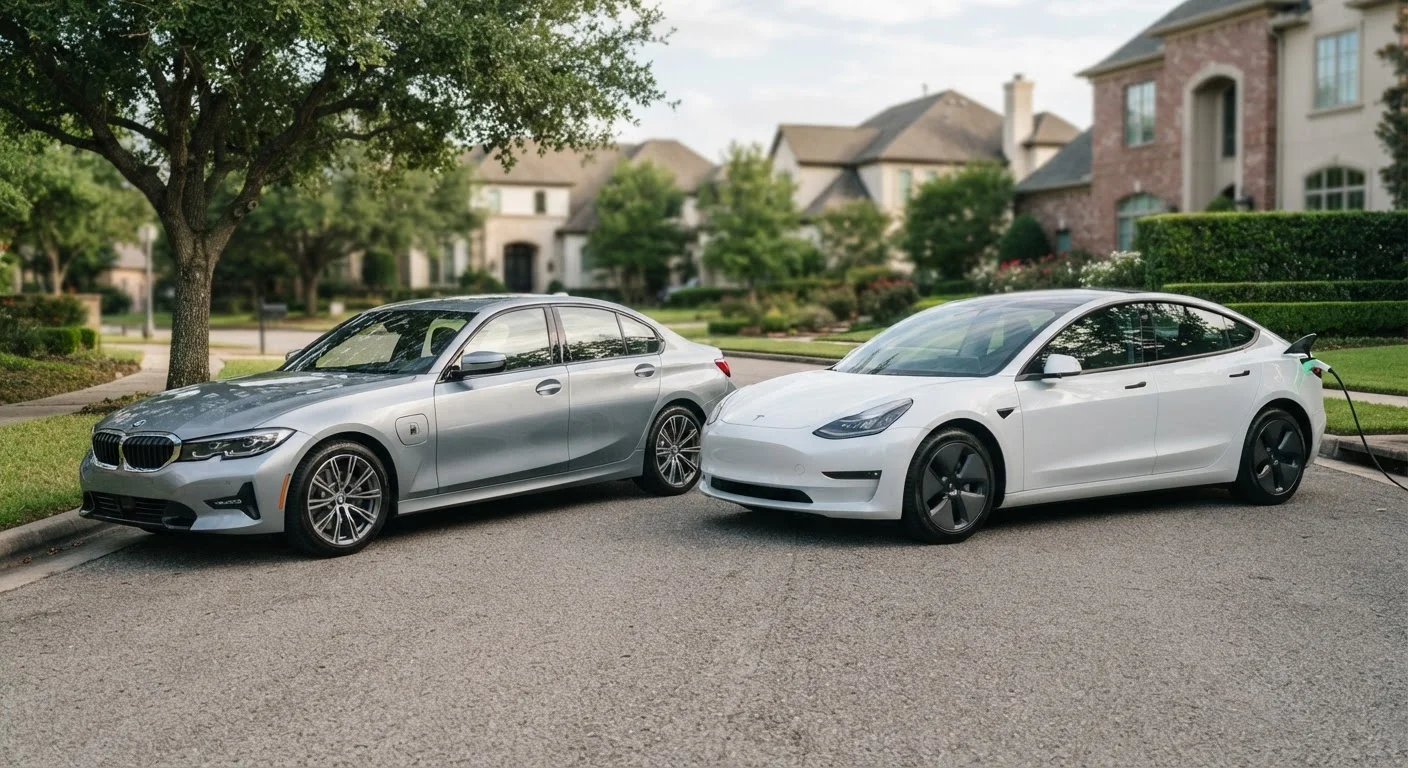
Option A
Standard Hybrid (HEV)
The self-sufficient, no-plug-required efficiency upgrade.
Best for: Drivers who want better fuel economy without changing how they refuel or think about charging.
Option B
Plug-In Hybrid (PHEV)
The flexible bridge between gas and fully electric driving.
Best for: Drivers who complete most daily trips on electricity but want a gas engine available for longer hauls.
What Actually Makes Them Different
The word "hybrid" covers a lot of ground, which is exactly why the distinction matters. Both a standard hybrid (often called an HEV, for hybrid electric vehicle) and a plug-in hybrid (PHEV) combine a gasoline engine with an electric motor and a battery pack. Beyond that shared architecture, though, their designs serve meaningfully different purposes.
A standard hybrid uses a relatively small battery that is charged entirely through the vehicle's own operation — primarily through regenerative braking, which converts kinetic energy back into electricity as the car slows down. The gas engine also contributes to battery charging at times. The driver never needs to plug in. The battery assists the engine during acceleration and allows brief low-speed electric-only movement, but it is not large enough to power the vehicle independently for any significant distance.
A plug-in hybrid carries a substantially larger battery — often five to ten times the capacity of a standard hybrid's pack. That larger battery must be replenished from an external electrical source, either a standard household outlet or a dedicated EV charger. In return, it delivers a genuine all-electric driving range, typically somewhere between 20 and 50 miles depending on the vehicle, before the gas engine engages. Once the battery is depleted, a PHEV operates much like a conventional hybrid.
| Criterion | Standard Hybrid (HEV) | Plug-In Hybrid (PHEV) |
|---|---|---|
| Battery size | Small (1–2 kWh typical) | Large (8–25 kWh typical) |
| Charging required | No — self-charges while driving | Yes — external plug required |
| All-electric range | Minimal (under 2 miles) | Typically 20–50 miles |
| Fuel refueling | Standard gas station only | Gas station + electric charger |
| Best fuel savings scenario | City stop-and-go traffic | Short daily commutes charged nightly |
| Infrastructure dependency | None beyond gas stations | Requires charging access at home or work |
| Typical added vehicle weight | Modest increase over gas equivalent | More significant due to larger battery |
How Your Driving Habits Decide the Answer
The technical differences translate directly into lifestyle differences. With a standard hybrid, your routine changes almost not at all — you drive, brake, and fill up with gas just as you always have. Fuel economy improves noticeably, particularly in stop-and-go city traffic where regenerative braking has the most opportunity to capture energy. For drivers who log long highway miles, the efficiency gains from a standard hybrid are more modest.
With a PHEV, your daily experience depends heavily on whether you actually charge the vehicle. A plug-in hybrid that is never plugged in will still function — it will default to hybrid operation — but you will have paid for a large, heavy battery pack without using most of its potential. The fuel savings that make PHEVs compelling are realized mainly by drivers who charge frequently and whose daily mileage falls within the vehicle's electric range.
Access to charging is the pivotal question. Drivers with a garage or a dedicated parking spot can typically install a Level 2 home charger relatively easily. Those who rely on street parking or shared lots face a more complicated path. See our guide to EV ownership for a deeper look at what charging infrastructure actually involves day to day.
20–50 mi
Typical PHEV all-electric range
The U.S. Department of Energy notes that most current PHEVs offer between 20 and 50 miles of EPA-estimated electric-only range before transitioning to hybrid operation.
~40–50 MPG
Typical city fuel economy for standard hybrids
Many mid-size standard hybrid sedans achieve EPA city estimates in the 40–50 mpg range, with regenerative braking contributing significantly in urban driving.
For a broader view of how these powertrains stack up financially and practically against each other and against full EVs, the fuel type trade-offs comparison is a useful next step. And if you are still figuring out which vehicle category fits your life in general, matching a vehicle type to your driving life offers a broader framework.
Tax Credits and Incentives Vary
PHEVs have historically been eligible for federal tax credits that standard hybrids are not, based on battery capacity thresholds. Eligibility rules, income limits, and vehicle qualification criteria change over time and depend on individual circumstances. Consult a qualified tax professional and review current IRS guidance before factoring any credit into a purchase decision.
The content on this site is for informational purposes only and is not a substitute for professional advice. Always consult a qualified professional for guidance specific to your situation.