

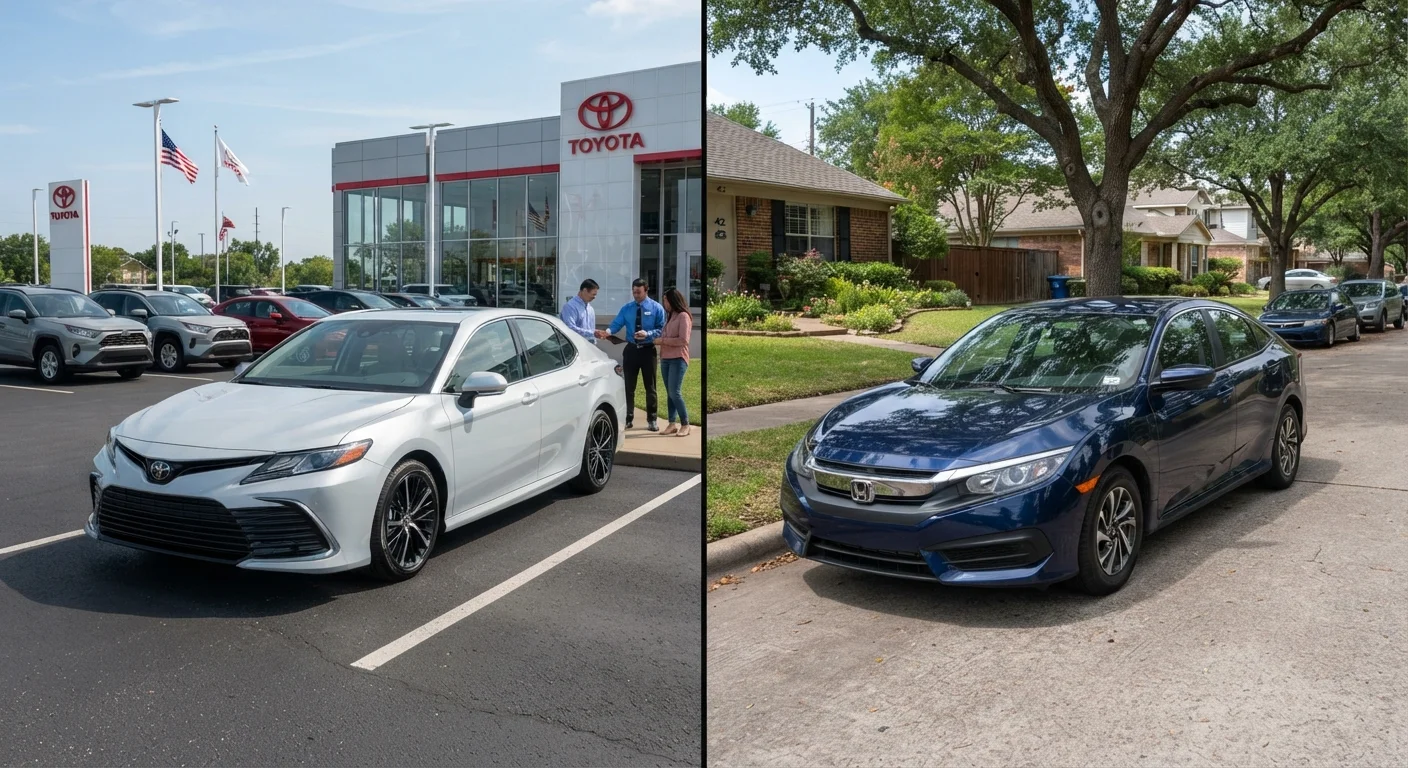
Option A
New Car
The full-warranty, zero-history choice.
Best for: Buyers who prioritize the latest safety technology, warranty coverage, and financing flexibility, and plan to keep the vehicle long-term.
Option B
Used Car
The depreciation-adjusted, lower-entry-cost alternative.
Best for: Budget-conscious buyers comfortable with some ownership history who want to avoid the steepest depreciation curve.
The Depreciation Factor: Where the Biggest Cost Hides
Depreciation is the single largest cost most drivers never see as a line item. A new vehicle begins losing value the moment it leaves the lot, and that loss is front-loaded — industry data consistently shows that many vehicles shed roughly 15–25% of their value in the first year of ownership. By year three, cumulative depreciation can reach 40% or more, depending on the segment and brand.
When you buy used, a previous owner has absorbed that steepest portion of the depreciation curve. You pay a lower price, and while the vehicle continues to depreciate, the rate is generally slower and less dramatic. This is the core financial argument for buying used.
New car buyers do get something in return: they own the full depreciation curve and can time their resale strategically. They also start with zero miles, a complete ownership record, and access to any manufacturer incentives or rebates that may be available at time of purchase. Whether that trade-off makes sense depends on how long you plan to keep the vehicle. See our full breakdown of total ownership costs to model this across a realistic ownership period.
| Criterion | New Car | Used Car |
|---|---|---|
| Purchase Price | Higher (full MSRP) | Lower (post-depreciation) |
| Depreciation Exposure | Absorbs steepest early drop | Prior owner absorbed early drop |
| Loan Interest Rate | Generally lower | Generally higher |
| Insurance Cost | Higher (higher replacement value) | Lower (for equivalent model) |
| Warranty Coverage | Full manufacturer warranty | Expired or limited (CPO varies) |
| Ownership History | None — clean slate | Prior use; history report needed |
| Technology & Safety Features | Latest available | Depends on model year |
| Selection Availability | Limited to current model year | Broad across ages and trims |
Financing, Insurance, and the Costs That Compound
The purchase price is only the beginning. How you finance the vehicle — and how much you pay to insure it — significantly affects the real comparison.
Financing: New vehicles typically qualify for lower interest rates than used ones. Lenders view new cars as lower-risk collateral, and manufacturers sometimes offer promotional rates through their captive finance arms. Used car loans, by contrast, generally carry higher rates, and older vehicles may face loan term restrictions. A lower sticker price financed at a higher rate can close the monthly payment gap more than buyers expect.
Insurance: Comprehensive and collision coverage on a new vehicle costs more in absolute terms because the insurer is on the hook for a higher replacement value. A used car of the same type will generally carry lower premiums for those coverages, though liability costs are similar regardless of age. The specific model matters enormously here — a used performance vehicle may cost more to insure than a new economy sedan.
~20%
Average first-year new car depreciation
Industry analysts, including those at Edmunds and iSeeCars, have consistently documented that many vehicles lose approximately 20% of their value within the first 12 months of ownership.
1–2%+
Typical rate premium for used auto loans
According to Federal Reserve consumer credit data, used vehicle loan rates have historically run one to two or more percentage points above comparable new vehicle loan rates.
3–5 yrs
Typical new car basic warranty duration
Most mainstream manufacturers offer a three-year/36,000-mile bumper-to-bumper warranty; powertrain coverage commonly extends to five years or 60,000 miles.
If you're also considering leasing rather than buying outright, our guide to leasing vs. buying walks through how those structures compare across a similar set of cost factors.
Reliability, Warranties, and the Risk of Unknown History
A new vehicle comes with a clean slate: zero prior owners, documented dealer prep, and a manufacturer's warranty covering defects in materials and workmanship — typically three years or 36,000 miles for basic coverage, and five years or 60,000 miles for powertrain, though this varies by manufacturer. Many new vehicles also include roadside assistance and scheduled maintenance for the first year or two.
Used vehicles carry uncertainty about how the prior owner drove and maintained the vehicle. A vehicle history report (such as those generated from the VIN) can surface accidents, title issues, and service records, but it doesn't capture everything. An independent pre-purchase inspection by a qualified mechanic can substantially reduce this risk and is generally worth the modest cost.
Certified pre-owned (CPO) programs sit between these two options. Manufacturer-backed CPO vehicles must meet specific age and mileage thresholds and pass multi-point inspections; they come with extended limited warranties. Our explainer on CPO programs covers exactly what that certification covers and when it justifies the premium over a standard used vehicle.
CPO: A Third Path Worth Considering
Certified pre-owned vehicles are inspected, reconditioned, and backed by an extended warranty through the manufacturer or dealer network. They typically fall within the first one to four model years and under a set mileage ceiling. CPO pricing lands between standard used and new, so the value proposition depends on how much the warranty and inspection peace of mind are worth to you versus an outright used purchase.
Maintenance costs generally favor new vehicles in the short term — everything is under warranty and parts are current-generation. As vehicles age, parts availability can narrow and some repairs become more expensive. That said, a well-maintained used vehicle from a reliable segment can remain affordable to operate well into six-figure mileage.
Making the Decision: Framing Your Real Trade-Off
Neither choice is universally better. The right answer depends on your driving habits, how long you plan to own the vehicle, your financing situation, and how much residual uncertainty you're comfortable absorbing.
Buyers who drive high annual mileage, plan to keep a vehicle for many years, and value warranty coverage tend to find new purchases easier to justify over the full ownership period. Buyers focused on lower monthly exposure, shorter ownership timelines, or simply getting reliable transportation at a lower entry cost often come out ahead with a well-selected used vehicle.
One useful exercise: price out both options on the same model — a current-year new version versus a two- or three-year-old equivalent — and compare total projected costs across five years, including estimated depreciation, financing cost, insurance, and maintenance. That exercise often produces a different winner than simply comparing sticker prices. The budgeting basics hub has tools to help structure that kind of multi-year cost comparison.
The motor vehicles by type hub can also help you narrow down which vehicle category fits your needs before making the new-vs.-used call — because the segment you choose shapes how dramatically depreciation and maintenance costs will differ between the two options.
This article is for general informational purposes only and does not constitute financial or purchasing advice tailored to your individual situation. Consult a qualified financial professional before making significant financial decisions.
The content on this site is for informational purposes only and is not a substitute for professional advice. Always consult a qualified professional for guidance specific to your situation.