

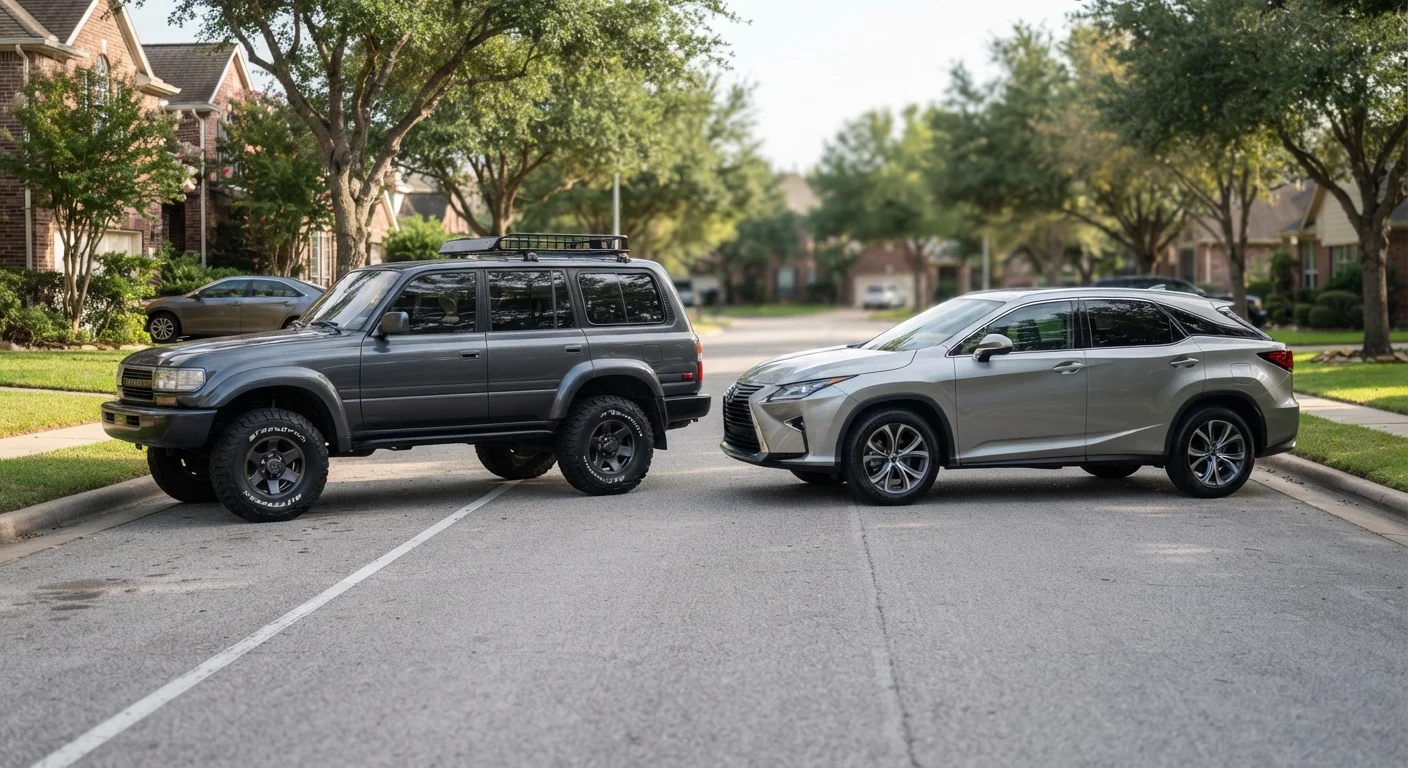
Option A
Traditional SUV
The truck-based, heavy-duty hauler.
Best for: Buyers who need serious towing capacity, genuine off-road capability, or maximum payload for work and adventure.
Option B
Crossover (CUV)
The car-based, comfort-forward alternative.
Best for: Drivers who want the high seating position and cargo flexibility of an SUV with a smoother, more fuel-efficient daily driving experience.
What Separates an SUV from a Crossover
Walk into any dealership and you'll find vehicles labeled "SUV" that are, by engineering definition, crossovers. The confusion is widespread — and intentional on the part of marketers. But the structural difference is real and has direct consequences for how a vehicle performs.
A traditional Sport Utility Vehicle (SUV) is built on a body-on-frame platform — the same architecture used by pickup trucks. The body and frame are two separate structures bolted together. This design prioritizes strength, towing capacity, and durability under heavy loads.
A crossover utility vehicle (CUV), by contrast, uses a unibody construction, where the body and frame are a single integrated structure — the same approach used in passenger cars and sedans. This makes the vehicle lighter, stiffer as a unit, and generally more refined on paved roads.
| Criterion | Traditional SUV | Crossover (CUV) |
|---|---|---|
| Construction | Body-on-frame (truck-based) | Unibody (car-based) |
| Typical towing capacity | Up to 8,000+ lbs | 1,500–5,000 lbs |
| Ride quality | Firm, trucky feel | Smooth, car-like |
| Fuel efficiency | Generally lower | Generally higher |
| Off-road hardware availability | Commonly available | Limited on most models |
| Weight | Heavier | Lighter |
| Interior refinement | Varies; can be utilitarian | Typically more refined |
For a broader look at how these vehicle types fit within the wider automotive landscape, see our guide to motor vehicle categories.
How Construction Affects Real-World Performance
The platform choice isn't just trivia — it shapes nearly every measurable aspect of ownership.
~8,500 lbs
Typical max tow rating for body-on-frame SUVs
Full-size body-on-frame SUVs such as the Chevrolet Tahoe and Ford Expedition are commonly rated at or above this figure when properly equipped.
3,500 lbs
Common tow limit for mid-size crossovers
Many popular mid-size crossovers are rated in the 1,500–3,500 lb range, reflecting the structural limits of their unibody platforms.
~5 MPG
Typical fuel economy gap between platforms
EPA combined ratings often show crossovers outpacing comparably sized body-on-frame SUVs by roughly 4–6 MPG, depending on engine and configuration.
Ride and Handling
Unibody crossovers absorb road imperfections through their integrated structure and car-derived suspension tuning. The result is a smoother, quieter cabin experience on highways and city streets. Body-on-frame SUVs, with their separate chassis, can feel more trucky — slightly bouncier at low speeds and more deliberate in steering response. This isn't a flaw; it's a trade-off built into the architecture.
Towing and Payload
Frame-based construction can absorb and distribute the stress of heavy towing in ways a unibody platform is not optimized to handle. Rated towing capacities for body-on-frame SUVs often exceed 8,000 lbs; many crossovers are rated considerably lower, typically between 1,500 and 5,000 lbs depending on size and powertrain. If you're frequently connecting to a trailer, this gap matters significantly. For guidance on pairing the right vehicle with an RV or camper, the Campers & RVs hub offers additional context.
Off-Road Capability
True off-road hardware — low-range four-wheel drive, solid rear axles, reinforced skid plates — is far more common on body-on-frame SUVs. Most crossovers offer all-wheel drive, which improves traction on slippery surfaces but is not the same as a purpose-built off-road drivetrain. To understand that distinction fully, see AWD vs. 4WD explained.
Fuel Economy
The lighter, more aerodynamic unibody structure of crossovers generally translates to better fuel efficiency than comparably sized body-on-frame SUVs. For drivers whose priorities are daily commuting and lower fuel costs, this advantage compounds over years of ownership.
Why the Label Gets Blurred — and What to Do About It
Automakers recognized years ago that consumers associate "SUV" with versatility and capability, making it a commercially attractive term even for vehicles that don't meet the traditional engineering definition. Today, many vehicles marketed as SUVs — particularly compact and mid-size models — are crossovers in all meaningful technical respects.
Marketing Language vs. Engineering Reality
Automakers are not required to use "SUV" and "crossover" according to any standardized engineering definition — the terms are used interchangeably in sales materials. When a manufacturer calls a vehicle an SUV, it does not confirm body-on-frame construction. The only reliable way to determine a vehicle's platform is to check the manufacturer's technical specifications or consult an independent automotive source.
The practical takeaway: don't shop by label. Instead, identify what your driving life actually demands — towing weight, terrain type, fuel budget, passenger needs — and then research whether a given vehicle's platform is suited to those demands. Our article on matching a vehicle type to your actual life provides a structured framework for doing exactly that.
If you're considering a larger family vehicle and the idea of three-row seating appeals to you, it's worth reading what three-row SUVs actually offer before assuming more rows automatically means more usable space. And for anyone comparing powertrain technologies across either vehicle type, hybrid vs. plug-in hybrid is a related distinction worth understanding.
This article provides general automotive information for educational purposes. Specifications, towing ratings, and fuel economy figures vary by manufacturer, model year, trim level, and configuration. Always verify details with the manufacturer or a qualified automotive professional before making a purchase decision.
The content on this site is for informational purposes only and is not a substitute for professional advice. Always consult a qualified professional for guidance specific to your situation.