

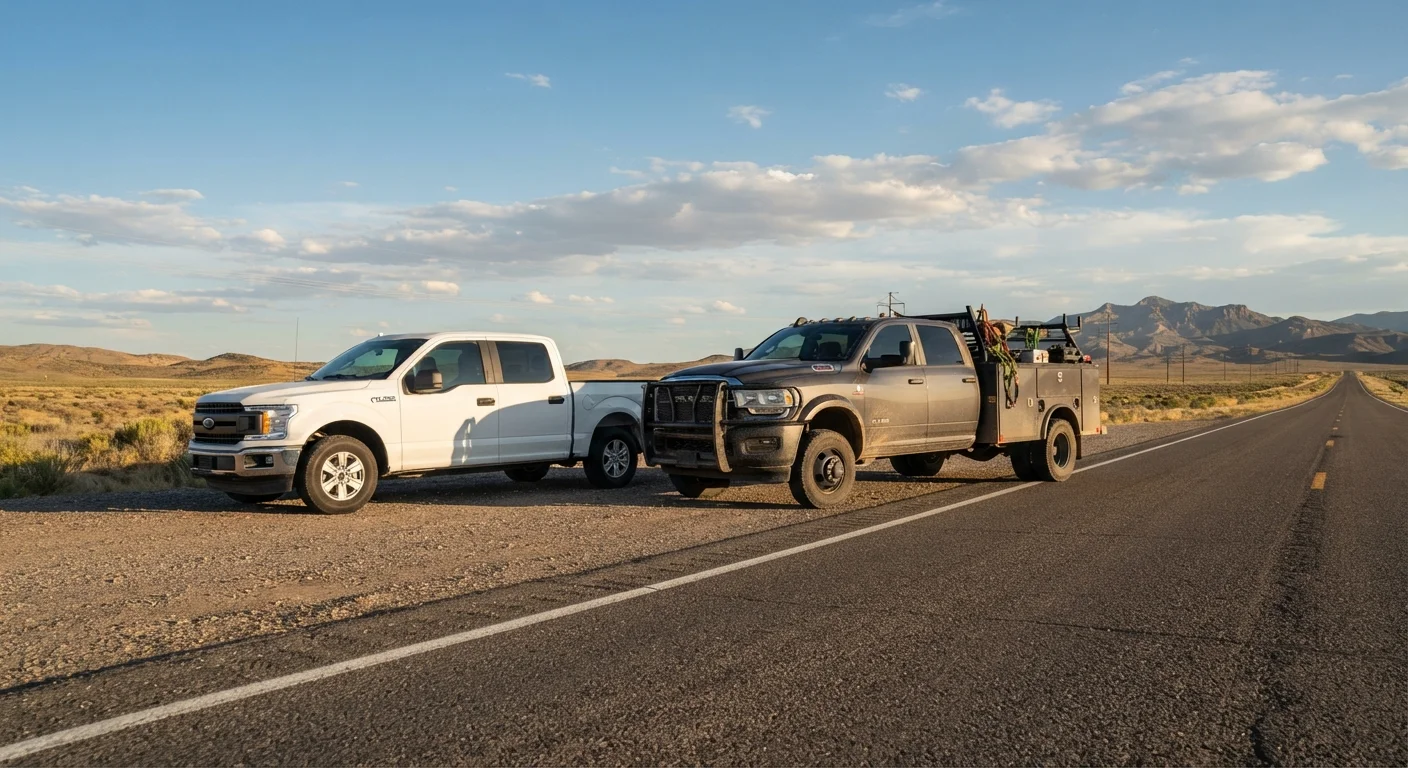
Option A
Light-Duty Pickup Trucks (Half-Ton)
The versatile everyday workhorse for most drivers.
Best for: Commuters, weekend haulers, and light towers who want truck utility without the size and operating costs of a heavy-duty model.
Option B
Heavy-Duty Pickup Trucks (¾-Ton & 1-Ton)
The high-capacity hauler built for serious professional demands.
Best for: Contractors, farmers, and owners who regularly tow large trailers, fifth-wheels, or carry heavy payloads as part of their work or lifestyle.
Where the Old Terminology Comes From
Walk into any dealership and you'll hear shorthand like "half-ton," "three-quarter-ton," and "one-ton" used as though they describe what a truck can actually carry. They don't — not literally. These designations originated decades ago when they did approximate payload capacity. A half-ton truck could haul roughly 1,000 lbs; a one-ton could haul around 2,000 lbs.
Today's trucks far exceed those historical figures. A modern half-ton pickup can often carry well over 2,000 lbs of payload when properly configured. The terms have survived as rough shorthand for market segments, but the actual numbers that matter — Gross Vehicle Weight Rating (GVWR), payload capacity, and maximum tow rating — are found on the manufacturer's door placard and in the owner's manual, not in the model nickname.
For a broader orientation to how vehicle categories are organized, see our overview of motor vehicle types. And if you want to understand the engineering traits that define a truck in the first place, what makes a truck a truck is worth reading before you compare classes.
The Numbers That Actually Define Each Class
The U.S. Department of Transportation assigns vehicles to weight classes 1 through 8. Most consumer pickup trucks fall into Classes 1, 2, and 3, which correspond directly to the light-duty and heavy-duty segments shoppers encounter at dealerships.
| Criterion | Light-Duty (Half-Ton) | Heavy-Duty (¾-Ton / 1-Ton) |
|---|---|---|
| DOT Vehicle Class | Class 1–2 (GVWR up to ~10,000 lbs) | Class 2b–3 (GVWR up to ~14,000 lbs) |
| Typical Payload Range | 1,500–2,300 lbs | 2,500–4,000+ lbs |
| Max Tow Rating (equipped) | Up to ~13,000–14,000 lbs | Up to ~36,000+ lbs (gooseneck) |
| Engine Options | Gas V6/V8, small-displacement diesel, hybrid | Gas V8, large-displacement diesel (common) |
| Fuel Economy | Generally higher; EPA-rated | Lower; many HD models exempt from EPA window sticker |
| Ride Quality (unloaded) | Smoother, car-like in premium trims | Stiffer, load-biased suspension |
| Typical Use Case | Daily driving, light hauling, moderate towing | Commercial work, large trailer towing, heavy payload |
GVWR — Gross Vehicle Weight Rating — is the maximum a truck can weigh when fully loaded with passengers, cargo, and fuel. Payload capacity is derived from it: GVWR minus the truck's curb weight equals how much you can add. Tow ratings are separate and depend on the powertrain, hitch, and frame configuration. Exceeding either the payload or tow rating isn't just hard on the truck — it can compromise braking, stability, and in commercial contexts, it may create legal liability.
~14,000 lbs
Max tow rating, top light-duty trucks
Several current half-ton pickups, when configured with max tow packages, approach or reach 14,000 lbs — a figure that would have been heavy-duty territory a decade ago.
36,000+ lbs
Gooseneck tow capacity, top 1-ton trucks
Leading 1-ton diesel pickups with gooseneck hitch configurations are rated to tow over 36,000 lbs, enabling them to handle commercial livestock and equipment trailers.
Class 2b
DOT threshold separating light from heavy
The U.S. DOT places the light-duty/heavy-duty dividing line at Class 2b, which begins at a GVWR of 8,501 lbs — meaning some HD pickups straddle this regulatory boundary.
For anyone towing a larger recreational vehicle, these numbers connect directly. Our guide on RV weight ratings and GVWR explains how the tow vehicle's ratings interact with the trailer's own weight limits.
Practical Differences Between Light-Duty and Heavy-Duty
The capability gap between a half-ton and a one-ton isn't just about numbers on paper — it shows up in daily ownership. Heavy-duty trucks typically ride on stiffer suspension tuned for loaded use, which can feel harsh when the bed is empty. They're longer, wider, and more challenging to park in urban environments. Fuel economy is meaningfully lower, especially with the large-displacement diesel engines commonly paired with ¾-ton and 1-ton platforms.
Light-duty trucks, by contrast, have evolved to blur the line between utility and passenger comfort. Many half-tons now offer air-ride or continuously damping suspension, turbocharged engines with strong low-end torque, and interiors that rival mid-size SUVs. The tradeoff is that they reach their limits sooner under sustained heavy use. Towing at or near the maximum rating for extended periods puts greater stress on cooling systems and transmissions that simply aren't built to the same commercial standard as HD counterparts.
Understanding which class fits your actual life — not your aspirational use — is central to the guidance in matching a vehicle type to your driving life.
Half-Tons Are Getting Heavier — Literally
Modern half-ton trucks have grown in curb weight significantly compared to earlier generations. Some premium crew-cab configurations now have a curb weight approaching 5,500–6,000 lbs, which reduces the available payload despite a higher GVWR. Always check the door-pillar sticker for the specific truck you're considering — not just the segment's advertised maximum figures, which typically apply to base-cab, stripped configurations.
It's also worth knowing that vehicle classification affects more than just capability. As explained in what the vehicle class system means for safety and insurance, the class a truck falls into influences EPA fuel economy testing, federal safety standards, and how insurers assess the vehicle.
The content on this site is for informational purposes only and is not a substitute for professional advice. Always consult a qualified professional for guidance specific to your situation.