

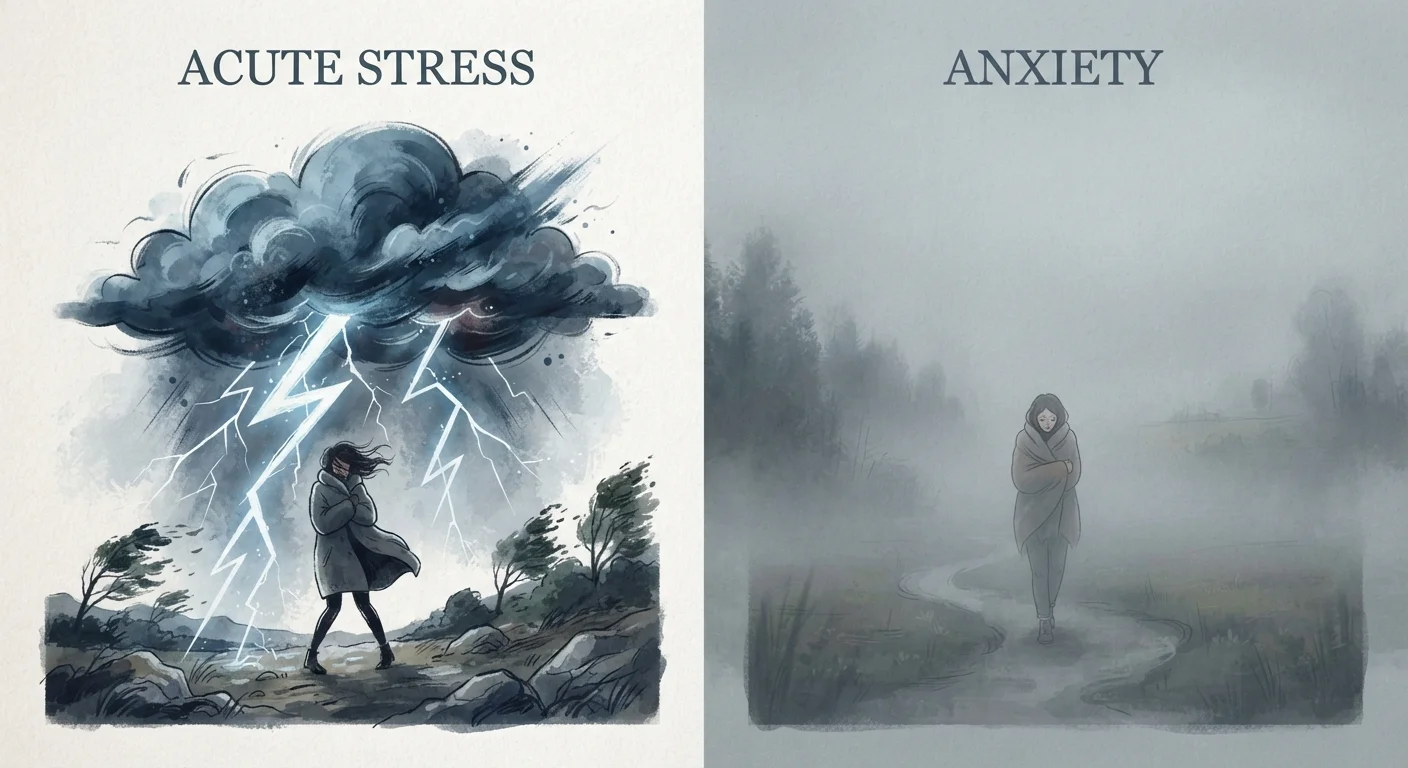
Option A
Stress
A normal, time-limited response to an identifiable external pressure.
Best for: Understanding a temporary reaction to a specific, recognizable life demand or challenge.
Option B
Anxiety
A persistent internal state that can exist without a clear external trigger.
Best for: Recognizing a pattern of worry or fear that lingers beyond the situation that may have prompted it.
Why the Confusion Is So Common
Stress and anxiety share a family resemblance: racing heart, tight chest, restless sleep, and a mind that won't quiet down. Because the physical sensations overlap so heavily, many people use the words interchangeably — and understandably so. But treating them as synonyms can lead to mismatched coping strategies, delayed support, and unnecessary frustration when nothing seems to work.
Understanding the distinction isn't about applying a clinical label to yourself. It's about knowing yourself well enough to choose approaches that actually match what you're experiencing. Mindfulness and meditation, for example, are two tools that are often recommended together — but each addresses different aspects of mental tension, and the same logic applies here.
| Criterion | Stress | Anxiety |
|---|---|---|
| Primary driver | External identifiable stressor | Internal; may lack clear trigger |
| Duration | Resolves when stressor passes | Persists beyond triggering situation |
| Physical symptoms | Tension, elevated heart rate, fatigue | Similar, plus often restlessness or panic |
| Thought pattern | Focused on present demands | Focused on future or undefined threats |
| Clinical status | Normal response; can become chronic | Can meet criteria for anxiety disorder |
| Primary care approach | Stress management, lifestyle changes | Therapy (e.g., CBT), sometimes medication |
What Stress Actually Is
Stress is a response to something happening outside you. A looming work deadline, a difficult conversation, financial pressure, or a health scare in the family — these are external stressors. Your nervous system recognizes a demand and mobilizes resources to meet it. Cortisol and adrenaline rise, attention narrows, and your body shifts into a heightened state of readiness.
Critically, stress is typically proportionate and time-limited. When the stressor is removed — the deadline passes, the conflict resolves — the physiological response winds down. This is a healthy, adaptive mechanism. The biology of that stress response is worth understanding: it explains why even manageable pressure can produce surprisingly intense physical sensations.
Chronic stress is a different matter. When external demands are relentless and relief never comes, the sustained physiological activation takes a toll. Over time, chronic stress can contribute to sleep disruption, weakened immune response, and — if left unaddressed — can shade into anxiety or depression.
33%
U.S. adults reporting extreme stress
Roughly one in three American adults report experiencing extreme stress, according to surveys conducted by the American Psychological Association.
31%
Adults experiencing an anxiety disorder
The National Institute of Mental Health estimates that approximately 31% of U.S. adults will experience an anxiety disorder at some point in their lives.
What Anxiety Actually Is
Anxiety is best understood as an internal state — one that doesn't require an ongoing external threat to sustain itself. A person experiencing anxiety may feel persistent dread, apprehension, or fear even when circumstances are objectively calm. The worry often focuses on future events, worst-case scenarios, or undefined threats that feel real but can't be pinpointed.
Clinically, anxiety exists on a spectrum. Everyday anxiety is a normal part of human experience — it primes us to prepare for challenges. Anxiety disorders, however, involve patterns of worry or fear that are disproportionate, difficult to control, and significantly disruptive to daily life. The most common include Generalized Anxiety Disorder (GAD), social anxiety disorder, and panic disorder.
Because anxiety can arise without an obvious cause, people sometimes dismiss it or feel embarrassed by it. This is worth naming directly: anxiety is not a character flaw, weakness, or failure of willpower. It reflects changes in how the brain's threat-detection systems are calibrated — and it responds well to evidence-based treatment. Knowing the signs that something has shifted is a useful next step if you recognize a persistent pattern.
Anxiety Isn't Only a Human Experience
Research suggests that anxiety-like states can occur in animals as well. If you've noticed persistent fearfulness or avoidance behavior in a pet, it may reflect something beyond situational stress. Understanding anxiety in dogs follows similar principles: identifying triggers, recognizing patterns, and knowing when to consult a professional.
When to Seek Professional Support
Self-awareness is valuable, but neither stress nor anxiety should be self-diagnosed or self-treated in isolation. A licensed mental health professional — such as a psychologist, licensed counselor, or psychiatrist — can accurately assess what you're experiencing and recommend an appropriate path forward.
Consider reaching out when: symptoms are interfering with work, relationships, or daily functioning; physical symptoms have no clear medical explanation; coping strategies that once helped are no longer effective; or the sense of dread or overwhelm feels constant rather than situational.
For stress management, approaches like structured problem-solving, exercise, adequate sleep, and social support have strong evidence behind them. For anxiety disorders, cognitive behavioral therapy (CBT) is among the most well-supported interventions, sometimes combined with medication under medical supervision. The right path depends on your individual situation — which is exactly why professional guidance matters.
This article is for general informational purposes only and is not a substitute for professional medical or mental health advice. If you are concerned about symptoms of stress or anxiety, please consult a qualified healthcare provider.
The content on this site is for informational purposes only and is not a substitute for professional advice. Always consult a qualified professional for guidance specific to your situation.