

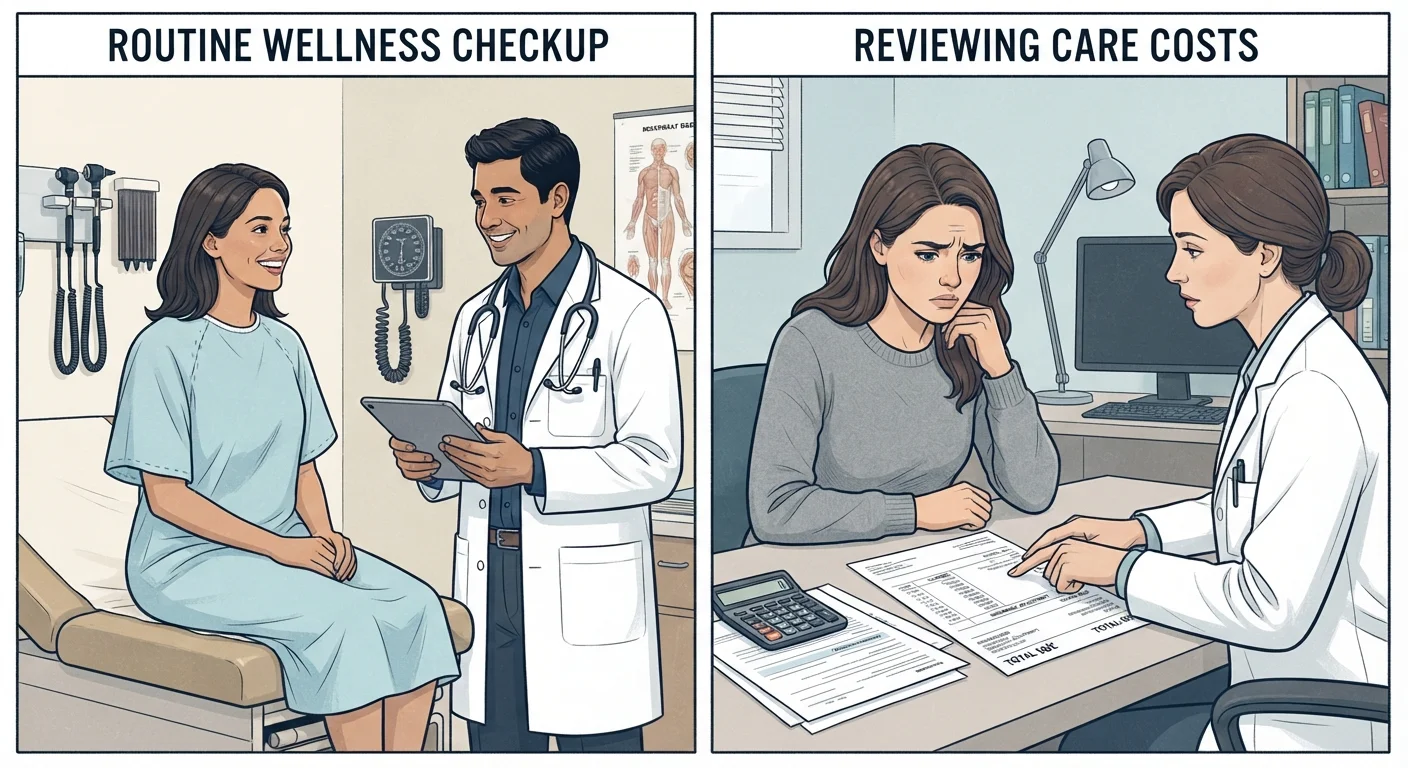
Option A
Preventive Care
The proactive, often fully covered visit.
Best for: Healthy individuals seeking routine screenings, vaccinations, and annual wellness exams to catch problems before they develop.
Option B
Diagnostic Care
The investigative visit that follows a symptom or concern.
Best for: Patients experiencing a specific symptom, following up on an abnormal result, or managing a known health condition.
The Core Distinction: Purpose Determines Billing
When you schedule a doctor's visit, the reason for that visit — not the procedures performed — largely determines how it gets billed to your insurance. Preventive care is delivered to healthy individuals with no specific complaint: think annual wellness exams, recommended cancer screenings, blood pressure checks, and immunizations. Diagnostic care, by contrast, is triggered by a symptom, a concern you raise, or an abnormal finding that requires further investigation.
Under the Affordable Care Act (ACA), most health insurance plans sold in the U.S. are required to cover a defined set of preventive services — such as colonoscopies, mammograms, and cholesterol screenings — at no cost to the patient when delivered by an in-network provider. No copay, no deductible. Diagnostic services, however, are generally subject to your plan's standard cost-sharing: deductibles, copays, and coinsurance apply. This single distinction can mean the difference between a $0 bill and hundreds of dollars in out-of-pocket costs. To understand how those cost-sharing structures work, see our overview of deductibles vs. out-of-pocket maximums.
| Criterion | Preventive Care | Diagnostic Care |
|---|---|---|
| Purpose | Routine screening, no complaint | Evaluate a symptom or abnormal result |
| ACA coverage requirement | Covered at 100% (in-network) | No federal mandate; subject to plan terms |
| Deductible applies? | Generally no | Generally yes |
| Copay or coinsurance | Usually $0 (in-network) | Typically applies per plan terms |
| Trigger for the visit | Scheduled interval or age guideline | Patient symptom or clinical concern |
| Common examples | Annual physical, mammogram, colonoscopy | Follow-up on chest pain, abnormal lab, rash |
| Billing code type | Wellness or preventive (e.g., Z-codes) | Office visit or evaluation/management code |
How One Conversation Can Change Your Bill
One of the most common — and costly — surprises happens when a patient mentions a symptom during what they expected to be a free annual wellness visit. If you tell your doctor that you've been having knee pain, irregular heartbeat, or persistent fatigue, your provider may appropriately shift the visit's billing code — or add a separate diagnostic code — to reflect that additional clinical work. That shift can activate your deductible.
This isn't a billing error or a loophole; it reflects a real clinical and regulatory distinction. Providers are required to code visits accurately. But it does mean that what you say in the exam room directly affects what you'll owe. If you have both a routine wellness need and a specific health concern, consider asking your provider whether it makes sense to schedule two separate appointments — one billed as preventive, one as diagnostic. Not all situations allow for this, but it's a reasonable question to raise.
$0
Cost-sharing for covered preventive services (in-network, ACA-compliant plans)
The ACA mandates that most health plans cover USPSTF-recommended preventive services with no patient cost-sharing when delivered in-network.
~1 in 4
Adults who report skipping recommended preventive care due to cost concerns
National survey data consistently finds that concerns about out-of-pocket costs — including billing confusion — are among the top reasons Americans delay or avoid preventive visits.
Varies widely
Patient cost when a preventive visit shifts to diagnostic billing
Depending on a patient's deductible and coinsurance, a visit recoded as diagnostic can result in tens to hundreds of dollars in unexpected out-of-pocket expense.
For tips on how to communicate proactively with your provider about screenings and coverage, see our guide on how to talk to your doctor about preventive care.
Practical Steps to Protect Yourself Before Your Appointment
Understanding the billing distinction is useful; acting on it before you arrive is even better. Here are evidence-informed steps to reduce your exposure to unexpected costs:
- Verify coverage in advance. Call your insurer or check your plan's Summary of Benefits and Coverage (SBC) to confirm which specific preventive services are covered at no cost. Coverage lists vary by plan and are tied to established guidelines from bodies such as the U.S. Preventive Services Task Force (USPSTF).
- Ask how your visit will be coded. Before or at the start of your appointment, ask the front desk or your provider how the visit is expected to be billed. This gives you information — not a guarantee — about potential costs.
- Use in-network providers. Even a perfectly coded preventive visit can generate costs if your provider is out of network. Our article on in-network vs. out-of-network care explains why this matters more than most people realize.
- Review your Explanation of Benefits (EOB). After any appointment, review the EOB your insurer sends. If a preventive visit was coded as diagnostic, contact your provider's billing department to ask whether the coding was accurate.
When Preventive Services Are Added to a Diagnostic Visit
The reverse situation also occurs: a diagnostic visit may include a preventive service (such as a blood pressure check during a sick visit). In these cases, the preventive portion may still be billed separately and covered at no cost, while the diagnostic portion is billed under standard cost-sharing. Insurers and providers handle this differently, so it's worth asking your billing department how combined visits will be processed.
Making the most of your health plan overall — from tracking your deductible to using covered services strategically — is covered in our guide to getting the most out of a health plan you already have.
This article is for general informational purposes only and does not constitute medical, insurance, or financial advice. Coverage rules vary by plan and insurer. Consult a licensed health insurance professional or your plan documents for guidance specific to your situation, and speak with a qualified healthcare provider about your personal health needs.
The content on this site is for informational purposes only and is not a substitute for professional advice. Always consult a qualified professional for guidance specific to your situation.