

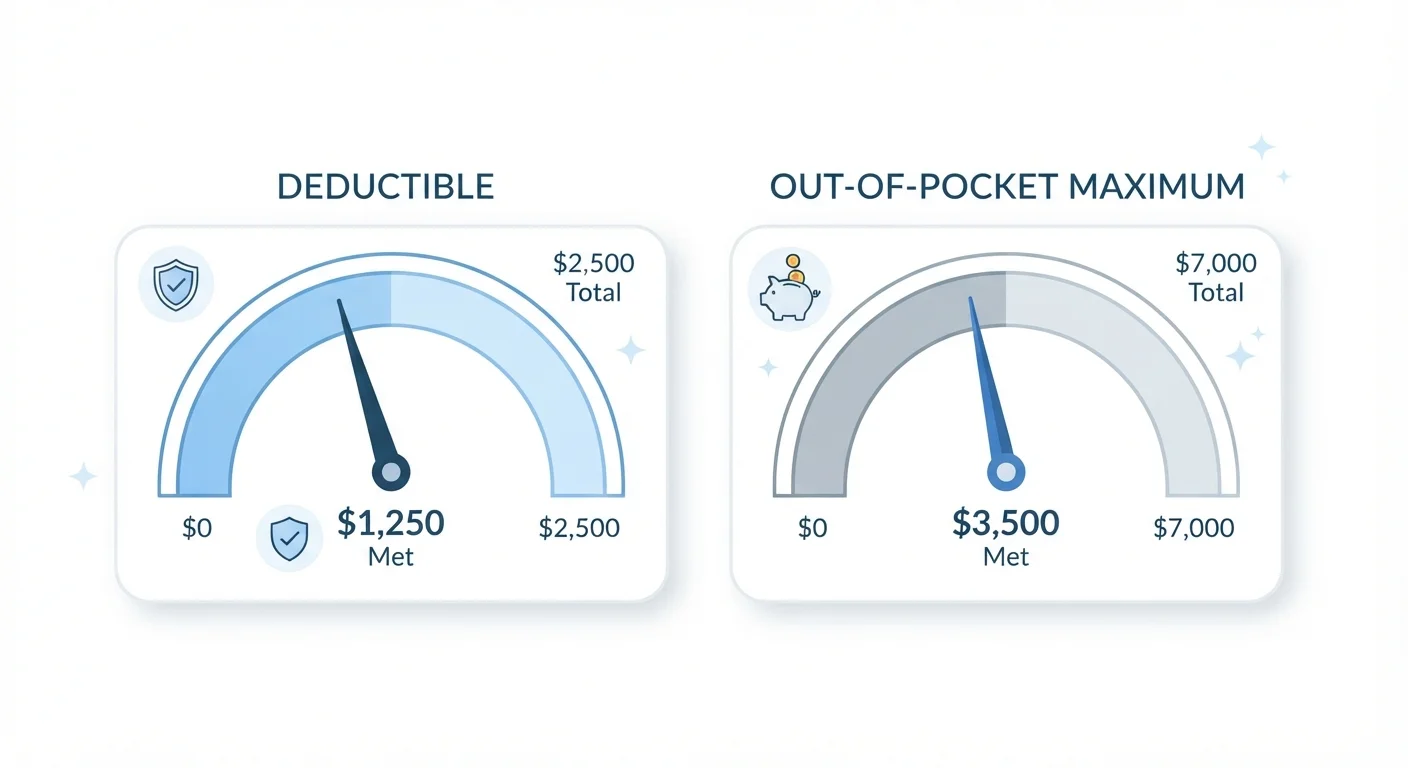
Option A
Deductible
The threshold you cross before insurance starts sharing costs.
Best for: Understanding how much you pay entirely on your own before your insurer begins to contribute.
Option B
Out-of-Pocket Maximum
The annual ceiling that caps your total covered cost exposure.
Best for: Knowing the absolute most you can be required to pay for covered services in a plan year.
How the Deductible Works
A deductible is the fixed dollar amount you pay for covered health care services before your insurance plan begins sharing the cost. If your deductible is $1,500, you pay the first $1,500 of covered medical bills yourself each plan year. After that, cost-sharing — through copays (flat fees per visit) and coinsurance (a percentage of the bill you split with the insurer) — typically begins.
A few important clarifications: most plans fully cover preventive services — like annual wellness exams and recommended screenings — regardless of whether you've met your deductible. That distinction matters. See how preventive and diagnostic care are billed differently to avoid unexpected charges at routine appointments.
Prescription drug costs may or may not count toward your medical deductible depending on your plan design — some plans use a separate drug deductible. Always check your Summary of Benefits and Coverage (SBC) document for specifics.
| Criterion | Deductible | Out-of-Pocket Maximum |
|---|---|---|
| What it is | Amount you pay before insurance cost-sharing begins | Total annual cap on your covered cost exposure |
| When it matters | Early in the plan year, or after a new year resets | After significant medical use accumulates |
| What counts toward it | Most covered medical services (varies by plan) | Deductible + copays + coinsurance for covered services |
| Premiums count? | No | No |
| Effect on insurer payment | Insurer begins cost-sharing once met | Insurer pays 100% of covered costs once met |
| Family plan structure | Individual + combined family deductible | Individual + combined family OOP max |
| ACA federal limits | No federal maximum deductible for most plans | Federally capped annually for ACA-compliant plans |
How the Out-of-Pocket Maximum Works
The out-of-pocket maximum (OOP max) is the most you will pay for covered services in a single plan year. Once your qualifying payments — typically your deductible, copays, and coinsurance — add up to that limit, your insurer pays 100% of covered costs for the rest of the year.
Under the Affordable Care Act (ACA), non-grandfathered individual and small-group plans must cap out-of-pocket costs at federally set limits. These limits are updated annually by the Department of Health and Human Services. Large employer plans may have different rules, so reviewing your plan documents is essential.
$9,450
ACA individual OOP max (2024)
For 2024, the ACA set the out-of-pocket maximum at $9,450 for self-only coverage on qualifying plans, per the Department of Health and Human Services.
$18,900
ACA family OOP max (2024)
Family coverage under ACA-compliant plans in 2024 was capped at $18,900 in combined out-of-pocket costs, per HHS annual limit updates.
~83%
Workers with an annual deductible
According to KFF's Employer Health Benefits Survey, about 83% of covered workers in employer-sponsored plans face a general annual deductible.
Critically, premiums do not count toward the out-of-pocket maximum. Neither do costs for out-of-network care on plans that don't cover it, or services your plan excludes entirely. For a detailed look at how network status affects your costs, see how in-network vs. out-of-network care is priced.
The Relationship Between the Two Numbers
Think of the deductible and out-of-pocket maximum as two sequential milestones on the same cost track. Before the deductible: you pay everything. Between the deductible and the OOP max: you and your insurer split costs through coinsurance or copays. After the OOP max: your insurer covers 100%.
Embedded vs. Non-Embedded Deductibles
Family plans use either an "embedded" or "non-embedded" (aggregate) deductible structure. With an embedded deductible, each family member has their own individual threshold — once one person meets it, cost-sharing starts for that individual even if the family total hasn't been reached. With a non-embedded structure, the family must collectively reach the combined deductible before cost-sharing begins for anyone. This distinction can significantly affect how quickly coverage kicks in for a family with one high-cost member. Check your SBC carefully to identify which structure your plan uses.
On family plans, this structure doubles. Each family member typically has an individual deductible and OOP max, and the family unit also has a combined threshold. If one family member's individual costs reach their deductible, only their care transitions to cost-sharing — the others continue paying in full until they also hit their individual deductibles, or until the family deductible is reached collectively.
This layered structure means understanding both numbers — not just one — is essential for accurate budgeting. A plan with a low deductible but a very high OOP max could still expose you to substantial costs if you face a serious illness or injury. Conversely, a high deductible paired with a low OOP max may be appropriate if you're building an emergency fund to cover early-year expenses. For more on how premium levels interact with these figures, see why the lowest premium isn't always the lowest cost.
To make the most of whatever plan you already hold, practical habits for tracking your deductible and avoiding surprise costs can make a real difference throughout the year.
This article provides general health insurance education and is not personalized insurance, financial, or legal advice. Coverage terms, limits, and regulations vary by plan and provider. Always review your plan's Summary of Benefits and Coverage and consult a licensed insurance professional for guidance specific to your situation.
The content on this site is for informational purposes only and is not a substitute for professional advice. Always consult a qualified professional for guidance specific to your situation.