

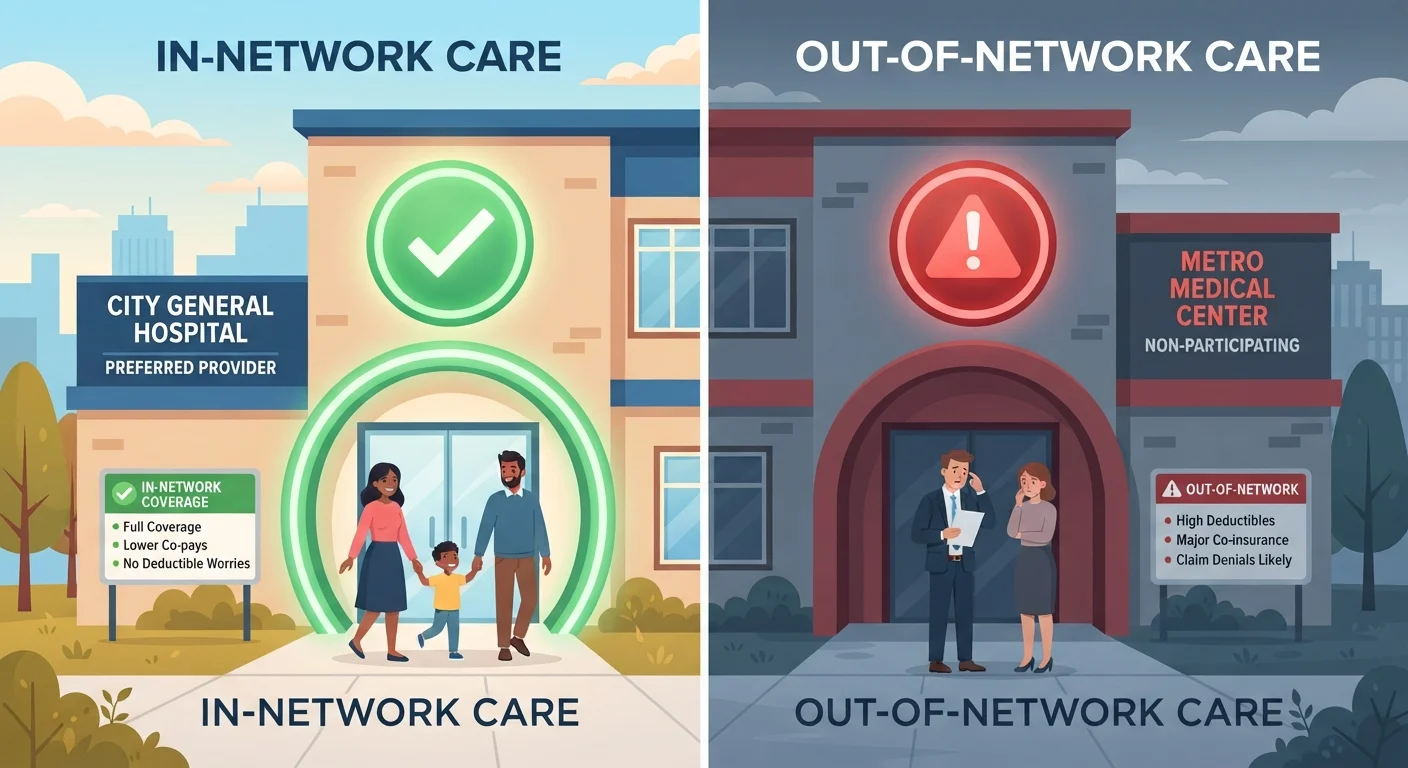
Option A
In-Network Care
The contracted, cost-sharing-friendly option.
Best for: Patients who want predictable costs and the full benefit of their insurance plan's negotiated rates.
Option B
Out-of-Network Care
The unconstrained but often far costlier alternative.
Best for: Situations where a specific provider is unavailable in-network or in genuine emergencies where choice is limited.
What 'Network' Actually Means in Health Insurance
When an insurer builds a health plan, it negotiates contracts with hospitals, physicians, labs, and other providers. Those who agree to the insurer's fee schedule become in-network providers. Providers who have not signed such an agreement are out-of-network.
The negotiated rate matters enormously. If a specialist charges $400 for a consultation, an insurer may have negotiated that service down to $180. An in-network patient pays their share of $180. An out-of-network patient may be billed the full $400 — or more — and their insurer may contribute little or nothing depending on the plan type.
This cost gap is one of the most consequential — and least understood — mechanics in American health insurance. As common insurance misconceptions show, many people assume their plan covers any licensed provider at the same rate. That is rarely true.
| Criterion | In-Network Care | Out-of-Network Care |
|---|---|---|
| Provider agreement | Contracted with your insurer | No contract with your insurer |
| Rates applied | Pre-negotiated, lower allowed amount | Provider's full billed rate |
| Balance billing risk | Not permitted | Often permitted (except where law limits it) |
| Deductible | Lower in-network deductible | Separate, higher OON deductible |
| Coinsurance | Typically 10–30% after deductible | Typically 30–50% (if covered at all) |
| OOP maximum applies | Yes — costs count toward your limit | Often no — OON costs may not count |
| HMO / EPO coverage | Fully covered per plan terms | Typically not covered (non-emergency) |
| Emergency care | Covered at in-network rates | Federally protected at in-network rates |
How Out-of-Network Costs Stack Up
Out-of-network charges typically work through two separate mechanisms that compound your exposure:
- Higher cost-sharing: Most plans that offer any out-of-network benefit apply a separate, higher deductible and a less generous coinsurance rate — for example, you pay 40% instead of 20% after the deductible.
- Balance billing: Even after your insurer pays its portion, the provider can bill you for the difference between the allowed amount (what your insurer considers reasonable) and the billed amount (what the provider actually charges). This gap can be substantial.
Understanding how these costs interact with your annual deductible is essential. Our explanation of deductibles vs. out-of-pocket maximums can help you see how out-of-network bills affect your yearly cost ceiling — and why out-of-network charges often don't count toward your in-network out-of-pocket maximum.
~3x
Typical cost multiplier for OON vs. in-network
Analyses of insurer claims data have found out-of-network charges are often two to three times the in-network allowed amount for equivalent services.
1 in 5
Emergency visits with an unexpected OON bill
Research published in JAMA found roughly one in five emergency inpatient admissions included a claim from an out-of-network provider, even when the facility was in-network.
$240B+
Estimated annual OON billing in the U.S.
Health policy researchers estimate out-of-network billing generates hundreds of billions in excess charges annually across American healthcare.
Plan Type Determines How Much Network Status Matters
Not every plan handles out-of-network care the same way. The plan structure is the starting point:
- HMO (Health Maintenance Organization): Generally covers only in-network care, except for genuine emergencies. Going out-of-network without a referral typically means 100% of the cost falls on you.
- EPO (Exclusive Provider Organization): Similar to an HMO in that out-of-network non-emergency care is usually not covered at all, but referrals to see specialists are typically not required.
- PPO (Preferred Provider Organization): Offers both in-network and out-of-network coverage, but with meaningfully different cost-sharing rates. You have more flexibility — at a price.
- POS (Point of Service): A hybrid; usually requires a primary care referral for specialist visits, but allows some out-of-network access at higher cost.
If your plan has a narrow network or is an HMO, the network question isn't just about saving money — it's about whether you have any coverage at all for a given visit. Choosing a lower-premium plan often correlates with a narrower provider network, so understand the tradeoff before enrolling.
Network Tiers Within PPO Plans
Some PPO and POS plans further divide their in-network providers into tiers — for example, a 'preferred' or 'select' tier with the lowest cost-sharing and a standard in-network tier with slightly higher patient costs. If your plan has tiered networks, it pays to confirm not just whether a provider is in-network, but which tier they fall into. Your insurer's member portal or a call to customer service can clarify this before your visit.
Federal Surprise Billing Protections: What They Cover
The No Surprises Act, which took effect in 2022, introduced meaningful federal protections against unexpected out-of-network bills in specific situations:
- Emergency care: Insurers must apply in-network cost-sharing to emergency services at any facility, regardless of network status. Providers cannot balance bill you beyond those in-network amounts.
- Non-emergency care at in-network facilities: If you receive non-emergency services from an out-of-network provider at an in-network hospital or ambulatory surgical center — such as an anesthesiologist you did not choose — surprise billing protections generally apply.
However, these protections do not cover all situations. If you knowingly and voluntarily choose an out-of-network provider for a scheduled, elective service and sign a consent form acknowledging the extra cost, balance billing is still permitted. Always verify the network status of every individual clinician involved in your care, not just the facility. Getting more from your existing plan includes practical steps for checking provider status before you book.
How to Verify Network Status Before Your Appointment
Provider directories on insurer websites are a useful starting point but are not always current. Providers join and leave networks, and directories can lag behind by weeks or months. Use a layered verification approach:
- Search your insurer's online directory using the provider's name and their NPI (National Provider Identifier) number for precision.
- Call your insurer directly and ask them to confirm network status for the specific provider and the specific service location — a physician may be in-network at one clinic but not at a second location where they also see patients.
- Call the provider's billing office and ask them to confirm they accept your specific plan and network tier.
- If you are having a procedure, ask about every clinician who may be involved — surgeon, anesthesiologist, and assistant surgeon — since each is contracted independently.
This matters especially for specialist care, where the billing distinction between preventive and diagnostic coding can also affect cost. See our guide on preventive vs. diagnostic care billing for context on how visit classification intersects with network rules.
This article provides general information about health insurance concepts and is not personalised insurance, financial, or legal advice. Coverage rules, cost-sharing structures, and applicable protections vary by plan and state. Read your plan documents carefully and consult a licensed insurance professional or your insurer directly for guidance specific to your situation.
The content on this site is for informational purposes only and is not a substitute for professional advice. Always consult a qualified professional for guidance specific to your situation.