

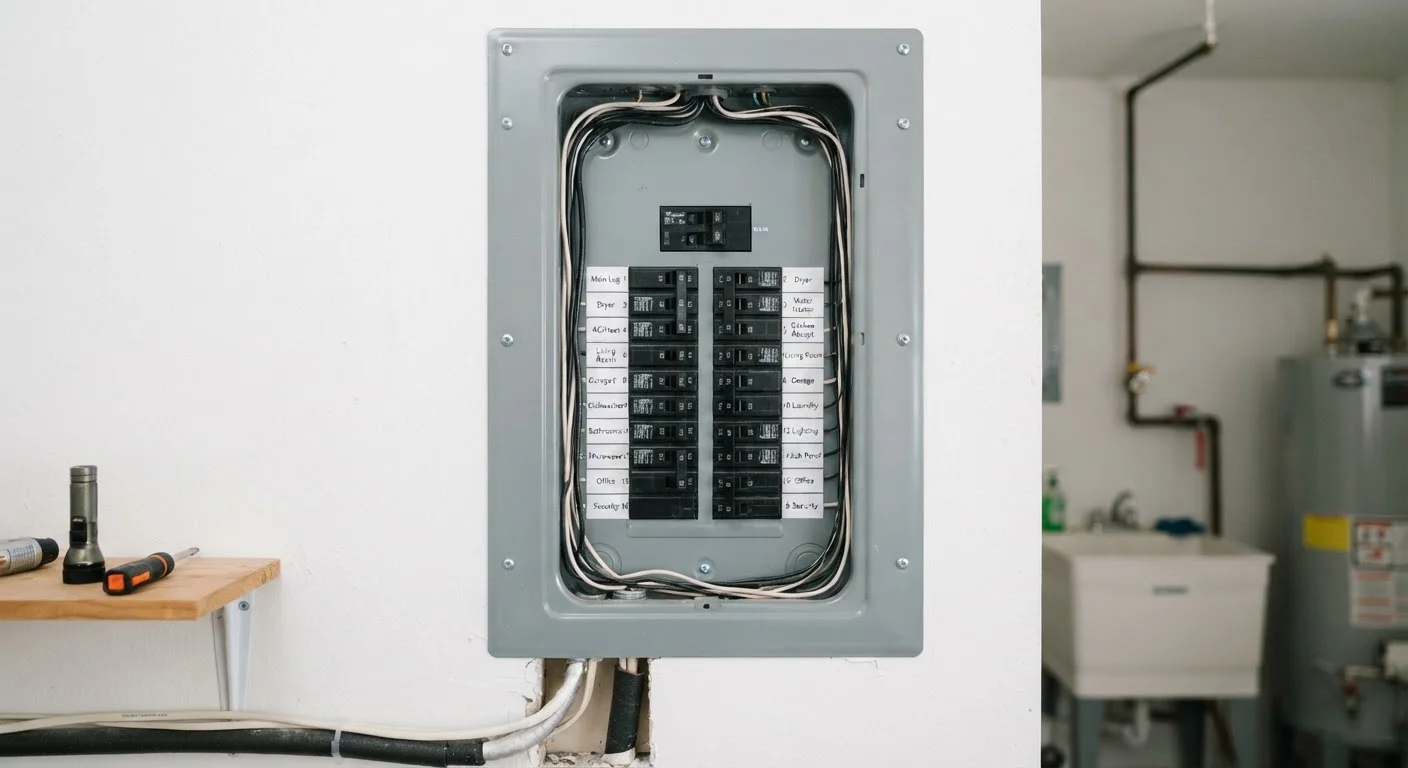
What's Inside Your Electrical Panel
Open the door of your breaker box and you'll see rows of switches — those are your individual circuit breakers. Each one controls a separate circuit: one for the kitchen, one for the master bedroom, one for the HVAC, and so on. At the top of the panel sits the main breaker, a large double-pole switch that controls power to the entire home and is the first thing you'd switch off in a serious electrical emergency.
Behind the breaker switches lies the wiring infrastructure: two hot bus bars (the energized metal rails breakers clip onto), a neutral bus bar, and a ground bus bar. These components work together to deliver current to your outlets and appliances and provide a safe return path. The wiring behind the panel cover carries live voltage at all times — even when the main breaker is off — because power still flows in from the utility line. This is why panel interiors should only be accessed by licensed electricians.
For a deeper look at home maintenance terminology, including electrical terms, see our common home maintenance terms guide.
51,000+
Home electrical fires annually in the US
According to the US Fire Administration, electrical fires account for a significant share of residential fires each year, with wiring and equipment issues among the leading causes.
~40 years
Typical lifespan of a residential electrical panel
Industry guidance generally places panel service life at 25–40 years, after which components may degrade and a professional inspection is strongly recommended.
200 amps
Standard service capacity for modern US homes
Most new construction is wired for 200-amp service; older homes with 60- or 100-amp panels may be insufficient for today's appliance loads, including EV charging.
Common Problems Homeowners Notice
Most homeowners first engage with their panel after a breaker trips. This is normal — a breaker tripping is the system working as designed. But patterns matter:
- Frequent trips on the same circuit may indicate a consistently overloaded circuit or a failing appliance drawing excessive current.
- A breaker that won't stay reset often points to a short circuit or ground fault in the wiring — a condition requiring professional diagnosis.
- Flickering or dimming lights throughout the home (not just one room) can signal a loose connection at the panel or a problem with the utility feed.
- A burning smell or scorch marks near the panel are serious warning signs. Turn off the main breaker and call a licensed electrician immediately — do not delay.
- A warm panel door suggests the panel may be working harder than it should, possibly from an overloaded circuit or deteriorating connections.
Keep the Area Around Your Panel Clear
Building codes in most US jurisdictions require a clear working space of at least 30 inches wide and 36 inches deep in front of any electrical panel. Storing boxes, furniture, or other items in front of the panel is a code violation — and in an emergency, every second matters. Make panel access a priority when organizing utility spaces.
Panel Labeling: A Simple Maintenance Task
One of the most practical things a homeowner can do is ensure every breaker in the panel is accurately labeled. Poorly labeled panels waste time during outages and create confusion in emergencies. To label your panel:
- Work with a partner — one person at the panel, one walking the home with a plug-in night light or hair dryer.
- Switch breakers off one at a time and have your partner identify which outlets or fixtures lose power.
- Write clear, specific labels (e.g., "Kitchen outlets — south wall" rather than just "Kitchen").
This task is safe for most homeowners and takes an hour or two to complete thoroughly. Keeping an up-to-date panel map is also a standard part of seasonal home maintenance that pays dividends when contractors visit or emergencies arise.
Certain Older Panel Brands Have Been Flagged
Some electrical panels manufactured in past decades have been associated with safety concerns or product recalls — notably certain Federal Pacific Electric Stab-Lok and Zinsco/Sylvania models. If your home has one of these panels, consult a licensed electrician for a professional assessment. This is general educational information; coverage and insurance implications vary by provider and policy.
When to Call a Licensed Electrician
Electrical work is one area where the professional-versus-DIY boundary is sharply drawn. Tasks involving the panel interior, new circuit installation, service upgrades, or any permitted work must be handled by a licensed electrician. Attempting this work without proper training is dangerous, may violate local codes, and can complicate homeowners insurance claims.
Call an electrician if you experience any of the following:
- Breakers that trip repeatedly or won't hold a reset
- A panel over 25–30 years old with no documented inspection
- Plans to add a major appliance (EV charger, hot tub, large HVAC system) — note that home EV charging, explored in our EV ownership overview, typically requires a dedicated 240V circuit
- Burning smells, sparking, or scorch marks anywhere near outlets or the panel
- A fuse box rather than a breaker panel
- Any visible corrosion, water intrusion, or pest damage inside the panel enclosure
For a broader framework on deciding which home jobs to tackle yourself, see our guide on DIY repairs vs. calling a pro. Electrical panel work sits firmly in the "call a pro" column, and the cost of a professional inspection is modest compared to the risk of ignoring a developing problem.
Frequently Asked Questions
First, unplug or turn off the devices on that circuit. Locate the breaker in your panel — it will be in a middle or "off" position. Firmly push it all the way to "off," then switch it back to "on." If it trips again immediately, the circuit may be overloaded or have a fault, and you should consult a licensed electrician.
Both protect circuits from overloads, but a fuse burns out and must be replaced each time, while a circuit breaker simply trips and can be reset. Most homes built after the 1960s use breaker panels. Fuse boxes are generally considered outdated and may present insurance complications.
Signs include frequent breaker trips, a panel that feels warm to the touch, flickering lights, visible rust or corrosion, or a panel with a capacity below 100 amps. If your home still uses a fuse box or a brand flagged for safety recalls, consult a licensed electrician for an assessment.
Simple tasks like resetting a breaker or labeling circuits are generally safe. However, any work involving new wiring, adding circuits, or touching the main breaker or service entrance is dangerous, often requires permits, and must be done by a licensed electrician. See our guide on <a href="/home-real-estate/home-maintenance/diy-repairs-vs-calling-a-pro-where-to-draw-the-line">when to call a pro</a>.
A GFCI (Ground Fault Circuit Interrupter) breaker or outlet detects tiny current imbalances and shuts off power within milliseconds to prevent shock. US building codes generally require GFCI protection in bathrooms, kitchens, garages, and outdoor areas. Older homes may lack them — a licensed electrician can assess compliance.
Panels are commonly found in utility rooms, basements, garages, hallways, or laundry areas. They must remain accessible and unobstructed at all times — placing storage in front of a panel is a code violation in most jurisdictions. Every household member should know its location for emergencies.
The content on this site is for informational purposes only and is not a substitute for professional advice. Always consult a qualified professional for guidance specific to your situation.