

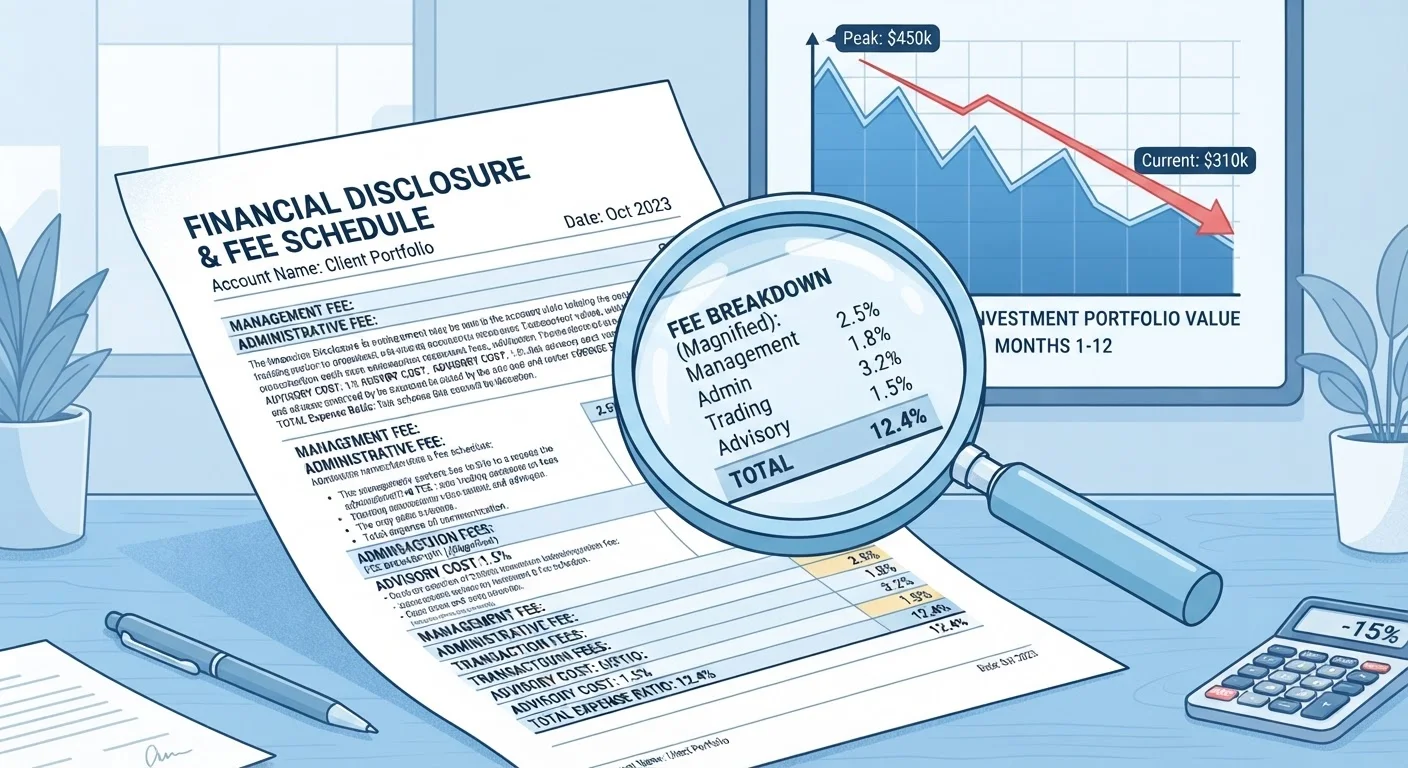
Why Fees Feel Small but Aren't
A 1% annual fee sounds almost trivial. But thanks to compounding, small percentages extracted year after year produce an outsized reduction in your final portfolio value. Consider a straightforward example: two investors each start with $50,000 and earn the same 7% gross annual return over 30 years. One pays a 0.10% expense ratio; the other pays 1.10%. The result is not a 1% difference in outcomes — it's a gap of roughly $100,000 or more in ending wealth, depending on additional contributions.
This happens because fees compound against you the same way returns compound for you. Every dollar paid in fees is a dollar that can no longer grow. Over decades, that lost compounding is the real cost — and it's invisible in the sense that no one sends you a bill. The money simply isn't there.
~$100K+
Potential lifetime cost of a 1% fee gap
Hypothetical projection based on a $50,000 starting balance, 7% gross return, and a 1 percentage point fee difference sustained over 30 years.
0.05%–0.10%
Typical expense ratio for broad index funds
Many widely available index ETFs and mutual funds fall within this range, according to published fund prospectuses from major fund providers.
0.50%–1.25%
Common range for actively managed fund fees
Actively managed U.S. equity funds have historically carried expense ratios in this range, though costs vary widely by fund category and provider.
This dynamic is worth keeping in mind any time you evaluate a new fund or account type. As our guide to index funds vs. actively managed funds explains, fee differences between these two categories are often substantial and persistent.
The Main Fee Types You'll Encounter
Understanding where fees come from is the first step to managing them.
- Expense ratio: An annual percentage deducted directly from a fund's assets to cover operating and management costs. It reduces the fund's daily share price, so you never receive a bill — it's already reflected in your returns.
- Advisory or management fee: Charged by financial advisers or robo-advisors, typically as a percentage of assets under management (AUM) per year. A 0.25% robo-advisor fee is meaningfully different from a 1.00% human advisory fee at scale.
- Trading costs: Commissions on trades have largely been eliminated by major brokerages for stocks and ETFs, but may still apply in certain contexts. Funds that trade frequently internally can also incur hidden costs reflected in the fund's return figures but not in the stated expense ratio.
- Load fees: Some mutual funds charge a sales commission — either upfront (front-end load) or when you sell (back-end load). No-load funds do not carry these charges.
- Account fees: Annual maintenance fees, inactivity fees, or transfer fees charged at the brokerage level.
Use the Prospectus Fee Table
Before investing in any mutual fund or ETF, locate the fund's summary prospectus and find the "Fees and Expenses" table. Focus on the "Annual Fund Operating Expenses" row and the hypothetical 10-year cost example. These two data points let you compare funds on a consistent, apples-to-apples basis.
How to Read Fee Disclosures
Every registered mutual fund and ETF in the U.S. is required by the SEC to publish a prospectus that includes a standardized fee table. This table will show the expense ratio broken into its components (management fees, 12b-1 fees, other expenses) and a hypothetical illustration of what a $10,000 investment would cost in fees over 1, 3, 5, and 10 years.
The 10-year illustration is particularly useful. It translates an abstract percentage into a concrete dollar figure, making comparisons between funds easier to grasp at a glance.
Expense Ratio vs. Total Cost
The stated expense ratio does not capture every cost a fund may incur. Trading costs within the fund and bid-ask spreads on ETF purchases are real economic costs that may not appear in the expense ratio. For most long-term, buy-and-hold investors these additional costs are modest, but they are worth acknowledging when evaluating total fund efficiency.
For adviser relationships, the SEC requires advisers to provide a Form ADV Part 2, which details how the adviser is compensated — including whether they earn commissions from recommending certain products. Understanding whether your adviser is a fiduciary (legally required to act in your best interest) or operates under a lesser suitability standard is important context for evaluating their fee structure.
The principle that fees are a real, calculable cost applies well beyond investing. Our article on the total cost of vehicle ownership shows how a similar "hidden cost" framework applies to major purchases — ongoing charges that are easy to overlook until you add them up.
Practical Steps to Manage What You Pay
Reducing fees does not require advanced financial knowledge — it largely comes down to awareness and a few deliberate choices.
- Compare expense ratios before investing. Most fund research platforms display this figure prominently. Choosing a broadly diversified index fund over a higher-cost alternative in the same asset class is a direct, permanent reduction in fees.
- Audit existing holdings. If you have funds in a workplace retirement plan or brokerage account, look up the expense ratio for each one. Some employer-plan menus include both expensive and inexpensive options — you may have room to switch.
- Understand what you're paying advisers for. Advisory fees can be worth paying for comprehensive planning services, but it's fair to ask an adviser to itemize exactly what services their fee covers.
- Watch for account-level fees. Some brokerage accounts waive maintenance fees only above a certain balance threshold. Knowing the threshold helps you avoid an unnecessary charge.
If you're also working on building the savings to invest in the first place, the patterns that quietly drain savings piece offers useful context on where money often leaks before it ever reaches an investment account.
This article is for general informational purposes only and does not constitute personalized financial or investment advice. Consult a qualified financial professional regarding decisions specific to your situation.
Frequently Asked Questions
Broadly diversified index funds and ETFs often carry expense ratios below 0.10%, while actively managed funds typically range from 0.50% to over 1.00%. Neither number is universally "right," but higher fees generally require a demonstrable benefit to justify them. Reviewing the fund's prospectus will show the exact figure.
The fund's prospectus or summary prospectus discloses the expense ratio. Brokerage platforms usually display a fund's expense ratio on its detail page. For advisory accounts, your adviser is required to provide a Form ADV or fee schedule explaining how they are compensated.
Research consistently shows that lower fees are one of the strongest predictors of relative fund performance over time, because fees are a guaranteed drag on returns while outperformance is not. This does not mean the cheapest fund is always ideal — but fees are a concrete, controllable factor.
Yes. Load fees (sales charges on certain mutual funds), account maintenance fees, redemption fees, and 12b-1 marketing fees can all reduce returns without appearing as an obvious line-item deduction. Always read the fee table in a fund's prospectus carefully.
That depends on the services provided and your personal situation. Some investors benefit significantly from professional guidance on tax strategy, estate planning, or behavioral coaching. Others find low-cost, self-directed approaches equally effective. This is a personal financial decision — consulting a fee-only fiduciary adviser can help clarify the trade-off.
The content on this site is for informational purposes only and is not a substitute for professional advice. Always consult a qualified professional for guidance specific to your situation.