

The Slow Leak in Your Financial Plan
Most people expect a financial setback to arrive as a single, obvious event — a job loss, a medical bill, a car breakdown. In reality, many Americans find their savings quietly hollowed out by patterns so ordinary they barely register as spending decisions at all.
The habits listed below aren't about shaming everyday choices. They're about building awareness of recurring costs that, left unchecked, make it harder to build a financial cushion, pay down debt, or invest for the future. If you've ever tracked your spending and been surprised by the total, you've already felt this effect firsthand. Our budgeting basics hub covers practical strategies to get a clearer picture of where money actually goes each month.
Small Numbers Add Up Faster Than Expected
A single $10-per-month expense costs $120 per year and roughly $600 over five years. When several such habits run in parallel, the combined annual cost can easily rival a significant one-time expense. This isn't meant to create anxiety — it's meant to show that small redirections in the other direction carry the same compounding logic in your favor.
This article is general financial information and education — not personalized financial advice. For guidance tailored to your situation, consider consulting a licensed financial professional.
Subscription Creep
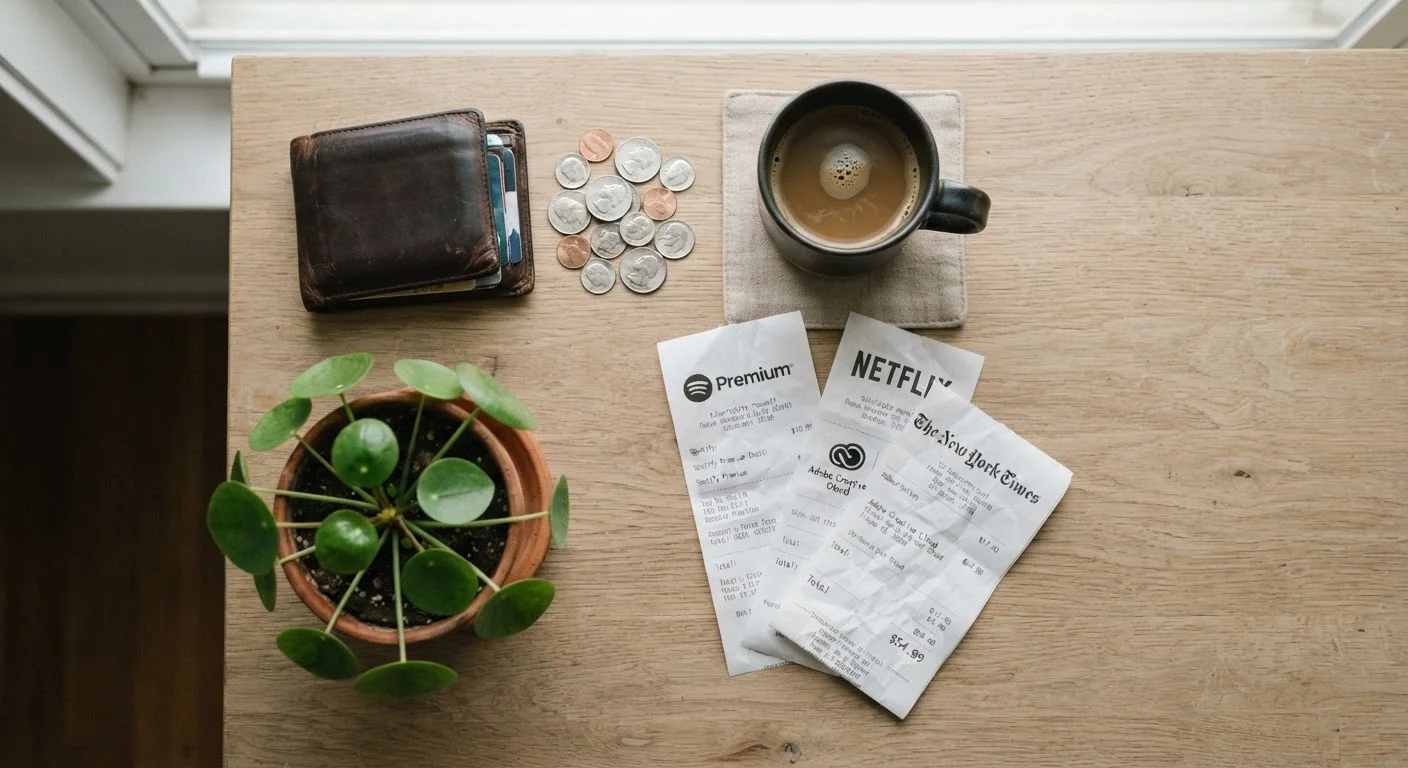
Streaming services, app upgrades, gym memberships, meal kit trials, cloud storage tiers — individually, each costs less than a dinner out. Collectively, Americans routinely underestimate how many active subscriptions they carry. A single unused $15-per-month subscription costs $180 per year; three or four forgotten ones approach $600–$700 annually.
The fix is a periodic audit, not permanent deprivation. Cancel services you haven't used in the past 30 days, and set calendar reminders before free trials convert to paid plans. Tools that scan bank and credit card statements for recurring charges can surface subscriptions you've genuinely forgotten about. See spending categories most budgets get wrong for a broader look at overlooked costs.
Three forgotten subscriptions can silently cost $600 or more every year.
Convenience Spending
Convenience spending encompasses delivery fees, single-use purchases, last-minute travel bookings, and choosing the pricier option simply because it's easier. Each transaction feels justified in the moment — time is valuable, after all. But when convenience becomes a default rather than an occasional choice, the cumulative cost is substantial.
Delivery fees and tips on food orders, for instance, can add 25–35% to the base cost of a meal. Doing a rough weekly tally of what you're paying purely for convenience — not for the product itself — often reveals a number that surprises people. Reducing convenience spending doesn't mean eliminating it; it means making it a deliberate choice rather than a reflex.
Delivery fees and service charges routinely add 25–35% on top of the base cost.
Lifestyle Inflation After Income Increases
Lifestyle inflation — sometimes called "lifestyle creep" — describes the tendency to raise spending proportionally whenever income rises. A raise gets absorbed into a nicer apartment, a newer car, or upgraded dining habits rather than flowing into savings or debt repayment. This pattern is particularly insidious because it feels earned and reasonable.
Financial planners commonly suggest allocating at least a portion of any income increase — some suggest 50% or more — directly to savings or investments before adjusting your lifestyle. This "pay yourself first" approach preserves the benefit of earning more rather than letting it disappear into expanded expenses. Consider pairing this habit with a sinking fund strategy to build buffers for future costs at the same time.
Lifestyle inflation makes raises feel invisible — spending rises as fast as income does.
Carrying High-Interest Debt Month to Month
Carrying a revolving credit card balance is one of the most direct ways lifestyle habits translate into sustained savings loss. Interest charges on high-rate credit card debt effectively apply a surcharge to everything you've purchased — including purchases made months or years ago. When that balance persists, the interest compounds, meaning you're paying interest on previously accrued interest.
Even modest balances at high rates erode savings capacity significantly over time. Understanding the real cost of carrying debt versus aggressively paying it down is worth examining carefully. Our article on saving versus paying off debt walks through the trade-offs in plain terms.
Revolving credit card debt applies a surcharge to past purchases through compounding interest.
Emotionally Driven Spending
Stress, boredom, social pressure, and the emotional lift of a purchase all drive spending patterns that don't necessarily reflect underlying preferences or needs. Retail therapy, impulse buys triggered by social media, and "treating yourself" as a default stress response are common examples. These aren't character flaws — they're well-documented psychological patterns.
Awareness is more effective than willpower alone. Introducing a deliberate pause before discretionary purchases — commonly called a "cooling-off period" — gives the initial emotional impulse time to subside. The psychology behind overspending is worth understanding if this pattern resonates, because lasting change tends to start with recognizing the trigger rather than simply trying to resist it.
A deliberate pause before discretionary purchases is more effective than relying on willpower alone.
Neglecting Small Account Fees and Low-Return Savings
Monthly maintenance fees on checking or savings accounts, ATM surcharges, and keeping money in accounts that earn minimal interest are quiet but persistent drains. A $12 monthly account fee costs $144 per year. Money sitting in a low-rate account during periods when higher-yield alternatives are available represents an opportunity cost — not a catastrophic loss, but a real and avoidable one.
Periodically reviewing the accounts you hold, what they charge, and what they return is worth the hour it takes. Our comparison of high-yield versus traditional savings accounts explains the key differences and what to look for. Similarly, if you're investing, understanding what investment fees actually cost over decades puts those small percentages in meaningful context.
A $12 monthly account maintenance fee quietly costs $144 each year — often for nothing in return.
Turning Awareness Into Action
Identifying these patterns is genuinely half the battle. Once you can see where money is quietly leaving, you're in a position to redirect it with intention rather than letting inertia decide. A useful starting point is a monthly spending audit — reviewing every recurring charge and asking whether it still delivers value. Our guide on tracking your spending without losing your mind outlines practical approaches that don't require hours of spreadsheet work.
Even small redirections matter. Consistent, modest contributions to savings or debt repayment build momentum over time — a principle that applies whether you're deciding between saving and paying off debt or beginning to explore investing fundamentals. The goal isn't perfection; it's reducing the drag that invisible habits create on your long-term financial picture.
Start With a One-Month Spending Audit
Pull three months of bank and credit card statements and highlight every recurring charge and convenience-related expense. You don't need to cut everything — just identify which items you'd miss and which you wouldn't. That distinction alone tends to free up more breathing room than any strict budget. Revisit the list every quarter to catch new additions before they become invisible.
This article is for general informational purposes only and does not constitute personalized financial advice. Consult a qualified financial professional before making decisions about your own financial situation.
The content on this site is for informational purposes only and is not a substitute for professional advice. Always consult a qualified professional for guidance specific to your situation.