

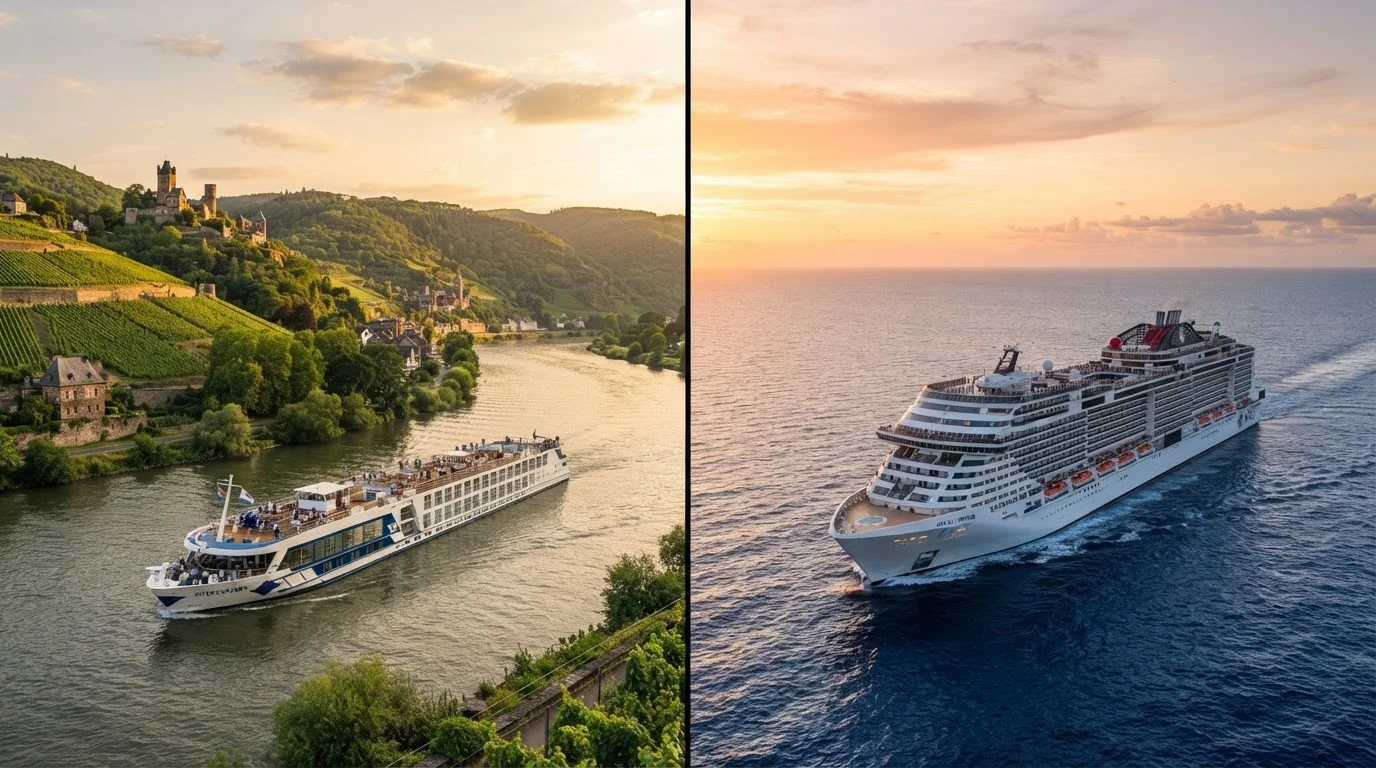
Option A
River Cruise
The intimate, destination-immersive choice.
Best for: Travelers who want to wake up in the heart of historic towns and explore culture and landscapes at a slower, more personal pace.
Option B
Ocean Cruise
The expansive, amenity-rich alternative.
Best for: Travelers who want a wide variety of onboard entertainment, activities, and dining alongside stops at major ports.
Same Word, Very Different Vacation
The word "cruise" conjures different images for different travelers — and that gap in imagination is actually justified. A river cruise and an ocean cruise share the basic premise of sleeping aboard a moving vessel, but nearly everything else diverges: ship size, destination style, onboard culture, and the overall rhythm of each day. Understanding those differences is the starting point for choosing the format that fits your travel personality.
River ships typically carry between 100 and 200 passengers. Ocean ships range from a few hundred passengers on boutique vessels to well over 5,000 on the largest mass-market ships. That scale difference alone reshapes the entire experience — from how you board to how crowded the lounge feels after dinner. If you're weighing which type to book, common cruise misconceptions are worth dispelling first, since assumptions about either format often don't reflect reality.
Ship Size, Amenities, and Onboard Life
Ocean ships are floating resorts. Depending on the line and vessel, you might find multiple pools, rock-climbing walls, Broadway-style theaters, dozens of restaurants, spas, and casinos — all without touching land. The ship itself is a significant part of the appeal, and many passengers spend sea days exploring onboard as much as they do in port. Understanding your cabin type matters here too; cruise ship cabin categories range from compact interior rooms to full suites with private balconies, each carrying real trade-offs in price and comfort.
River ships, by contrast, are intentionally understated. Most offer a single restaurant, a lounge bar, a sun deck, and perhaps a small fitness area. The ship is a means of transport and a comfortable base — not the destination. Evenings tend to feel more like a boutique hotel experience than a resort. That suits travelers who find large ship crowds exhausting but can feel underwhelming for those who want constant onboard entertainment.
| Criterion | River Cruise | Ocean Cruise |
|---|---|---|
| Typical passenger count | 100–200 passengers | 500–6,000+ passengers |
| Ship amenities | Lounge, restaurant, sun deck | Pools, theaters, multiple restaurants |
| Port access | Town center docking | Port terminals, sometimes tendering |
| Motion sickness risk | Very low — calm inland waters | Variable — open-water crossings possible |
| Inclusions in base fare | Often includes excursions, dining, gratuities | Room and most meals; extras cost more |
| Destinations | Europe, Asia, Egypt, Americas | Caribbean, Mediterranean, Alaska, global |
| Typical trip length | 7–15 nights | 3–14+ nights |
Itinerary Style and Port Access
One of the most practical differences is where each format actually drops you. River ships dock in the heart of cities and towns — often within a short walk of a cathedral, wine cellar, or medieval market square. You step off the gangway and you're already in the destination. Ocean ships, especially at busy Caribbean or Mediterranean ports, frequently dock at large commercial terminals that require a bus transfer or taxi ride to reach the actual city center. Some stops involve tendering, where passengers take small boats ashore from an anchored ship.
River itineraries also tend to visit smaller, less tourist-saturated towns that ocean ships simply cannot access. The Rhine might carry you through German wine villages; the Danube through smaller Central European capitals; the Mekong through rural Southeast Asian landscapes. Ocean itineraries, meanwhile, open up entirely different geography — the Greek islands, Alaska's glacial fjords, the Caribbean's beaches, and more. For a broader look at how destination regions compare, the guide to cruise itinerary types breaks down what each sailing region does well.
~100–200
Typical river ship passenger capacity
River cruise vessels are significantly smaller than ocean ships, with most carrying under 200 guests to navigate narrow waterways and historic locks.
6,000+
Passengers on the largest ocean ships
The largest contemporary ocean cruise ships can carry over 6,000 passengers, reflecting a fundamentally different scale of travel experience.
~40+
Countries accessible by river cruise routes
Major river cruise networks in Europe, Asia, Africa, and the Americas collectively span dozens of countries, many accessible only by smaller inland vessels.
Cost, Inclusions, and What to Expect
Pricing structures differ significantly between the two formats. River cruise fares are typically higher per night but often include guided shore excursions, wine or beer with meals, and sometimes gratuities — meaning the all-in cost is more predictable. Ocean cruise base fares are usually lower, but excursions, specialty dining, beverage packages, gratuities, and Wi-Fi are commonly add-ons that accumulate quickly. Neither format is automatically more expensive; the final number depends heavily on the operator, itinerary length, and how many optional extras you purchase.
Shore time also factors into perceived value. River passengers generally spend more hours ashore per port call, with guided walks and cultural visits built into the schedule. Ocean passengers often have more flexibility but face the choice of booking structured excursions or exploring independently — a decision with its own trade-offs. Booking excursions through the cruise line versus independently involves different costs, convenience levels, and risk profiles worth considering before you sail. Onboard dining is another variable: how food and drink work onboard differs considerably between river and ocean ships in scope and inclusion.
Expedition and Small-Ship Ocean Cruises
Not all ocean cruises are mega-ship experiences. Expedition cruises — sailing to Antarctica, the Galápagos, or remote Arctic regions — operate on small vessels carrying 50–200 passengers, sharing the intimacy of river ships with open-water destinations. If the boutique feel of river cruising appeals but you want ocean geography, small-ship and expedition operators are worth exploring as a middle path.
The content on this site is for informational purposes only and is not a substitute for professional advice. Always consult a qualified professional for guidance specific to your situation.