

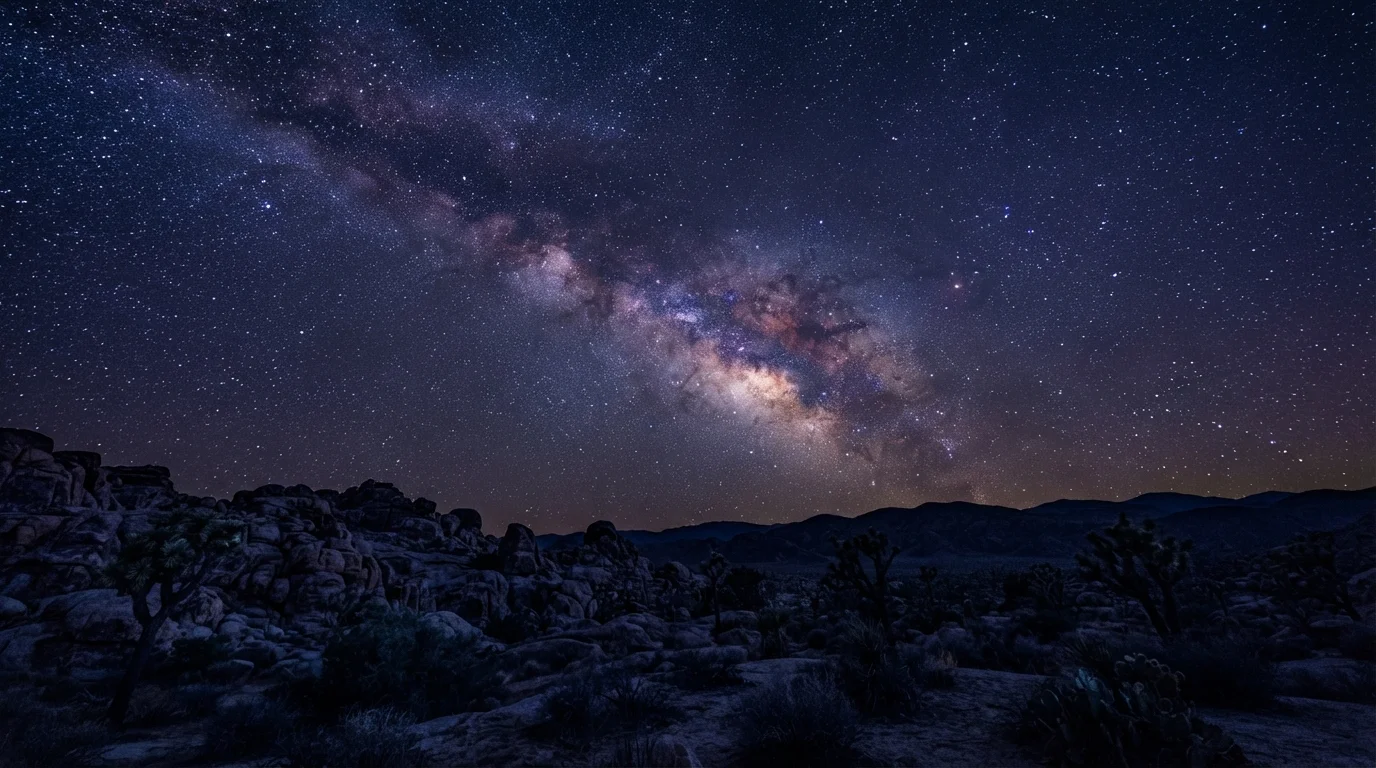
Why the Night Sky Became a Travel Destination
A generation ago, stepping outside on a clear night almost anywhere rural meant a sky crowded with stars. Today, the spread of artificial lighting has fundamentally changed that relationship. According to research published in the journal Science Advances, more than 80% of the world's population — and 99% of Americans and Europeans — live under light-polluted skies. For many urban dwellers, the Milky Way is a concept, not a sight they've personally witnessed.
That scarcity has turned genuine darkness into something travelers now seek out deliberately. Dark sky travel isn't about escaping modernity so much as recovering something that modernity quietly erased. Whether driven by curiosity, a love of photography, or a desire for a genuinely humbling natural experience, more travelers are factoring sky quality into their destination decisions.
This niche sits comfortably alongside other forms of off-grid travel and appeals strongly to the kind of traveler who prioritizes experience over amenity. If you've ever wondered what kind of traveler you are, a night spent under a Class 1 sky tends to answer that question quickly.
80%+
World population living under light-polluted skies
Research published in Science Advances found that more than 80% of the global population cannot see the Milky Way from where they live.
99%
Americans and Europeans affected by light pollution
The same study estimated that 99% of the U.S. and European population lives under skies contaminated by artificial light.
Class 1–9
Bortle scale range for measuring sky darkness
The Bortle Dark-Sky Scale is the standard measure used by astronomers and dark sky certification bodies to rate nighttime sky quality.
How Dark Sky Certification Works
The International Dark-Sky Association (IDA), a nonprofit organization, maintains the most widely recognized certification framework for dark sky places. Designations are awarded to Parks, Reserves, Sanctuaries, Urban Night Sky Places, and Communities — each suited to a different type of location and governing body.
To earn designation, applicants must document sky quality using calibrated meters, demonstrate a commitment to reducing artificial light at the source, and often provide public education programming. Certification isn't permanent: sites must maintain standards to retain their status, and some designations require periodic renewal reviews.
IDA Designation Types Vary Significantly
An IDA-certified Dark Sky Community, for example, is a town or municipality that has adopted responsible lighting ordinances — it may not have dramatically dark skies itself, but it actively protects surrounding areas. A Dark Sky Reserve, by contrast, encompasses a core zone of exceptional darkness surrounded by a buffer of managed land. When researching certified sites, check the specific designation type to understand what you're actually visiting.
Certified sites exist across the U.S., including in places like southeastern Utah's canyon country, the high desert of New Mexico, and the remote reaches of northern Michigan. Internationally, destinations such as the Atacama Desert in Chile and certain areas of New Zealand's South Island are recognized for exceptional darkness. The IDA's public registry allows travelers to locate certified places by country and type.
What to Realistically Expect
Dark sky travel rewards preparation but punishes rigid expectations. Cloud cover, wildfire smoke, and seasonal humidity can all compromise a night that looked perfect on a calendar. The most experienced dark sky travelers treat the trip itself — the remoteness, the quiet, the landscape — as the destination, with a spectacular sky as the hoped-for bonus rather than the guaranteed product.
Practically speaking, these locations often come with real trade-offs. Services may be limited, cell coverage is frequently absent, and accommodation ranges from full-service lodges at national parks to primitive camping with no facilities. Reviewing off-season travel considerations is useful here, since many prime dark sky windows fall in shoulder or winter seasons when support infrastructure thins out further.
For travelers who want structured guidance, ranger programs and guided astronomy nights are offered at many certified parks. Specialty travel agencies that focus on astronomy or wilderness experiences can also handle logistics for more remote international destinations.
Plan Around the Lunar Calendar
The single most impactful planning decision for dark sky travel is timing your visit around a new moon. Even a half moon can reduce visible stars by thousands. Most astronomy-focused travel planning resources publish monthly lunar calendars — build your travel dates around the new moon window for the region you're visiting, then check historical weather patterns for that window as a secondary filter.
The Broader Meaning of Seeking Darkness
There's something quietly radical about traveling specifically toward the absence of something. Dark sky travel isn't defined by what a destination has built or curated — it's defined by what it has protected from erasure. The night sky above a certified reserve looks the way every sky on Earth looked before industrialization, and that historical continuity carries its own weight.
It shares this reflective quality, in a different register, with other forms of experiential travel that ask visitors to engage with difficult or unfamiliar realities. For those curious about the broader landscape of niche travel, the distinctions explored in pieces like dark tourism and disaster tourism illuminate just how varied the motivations behind purposeful travel can be.
What dark sky travel offers, ultimately, is perspective — the particular kind that arrives when you're standing in true darkness and realizing that the sky above you is exactly what it has always been, and that you simply had to go looking for it.
“We are the first generation to lose the night sky, and potentially the last with the knowledge of what we've lost. Recovering even small pockets of darkness is not nostalgia — it's ecological and cultural preservation.”
— Fabio Falchi, Light pollution researcher and co-author of the New World Atlas of Artificial Night Sky Brightness
Frequently Asked Questions
A certified International Dark Sky Place is a location formally recognized by the International Dark-Sky Association for exceptional nighttime environments and responsible outdoor lighting. Designations include Parks, Reserves, Sanctuaries, and Communities, each with slightly different criteria. Certification requires measurable sky quality data, public education programs, and lighting ordinances that limit artificial light.
No telescope is required. In a Class 1 or 2 Bortle site, the Milky Way is visible to the naked eye as a dense, textured band across the sky. Binoculars enhance the experience significantly. Telescopes are valuable for deep-sky objects like nebulae and galaxies but are entirely optional for casual stargazers.
This depends heavily on the specific destination, its elevation, and its climate. Generally, clear, dry seasons with low humidity yield the best views. New moon nights within those seasons are ideal since even a quarter moon can wash out faint stars. Research the destination's specific weather patterns well in advance.
Accessibility varies widely by location. Some certified dark sky parks have paved observation areas, accessible visitor centers, and ranger-led programs designed for diverse visitors. Others require hiking over uneven terrain. It's worth contacting individual parks directly to ask about accessibility accommodations before you travel.
Avoid white flashlight beams — use a red-light headlamp instead, as red wavelengths have far less impact on night-adapted eyes. Allow at least 20–30 minutes for your eyes to fully adjust to darkness before expecting to see faint objects. Avoid looking at phone screens, which can reset your adaptation almost instantly.
Absolutely. Many dark sky reserves sit within wilderness areas that also offer hiking, wildlife watching, and cultural heritage sites. Some travelers combine it with <a href="/travel/specialty-travel/myths-about-off-grid-travel-that-keep-people-away-unnecessarily">off-grid adventures</a> for a broader experience of remote landscapes. Planning flexibility is key since weather can shift viewing conditions overnight.
The content on this site is for informational purposes only and is not a substitute for professional advice. Always consult a qualified professional for guidance specific to your situation.