

Start here
Essential Parts Every Owner Should Know
Next
Understanding Service Intervals
Then
How to Read Your Owner's Manual
Going further
Talking to a Mechanic With Confidence
Final step
Budgeting for Maintenance Costs
Essential Parts Every Owner Should Know
You don't need to be a mechanic to own a car responsibly—but understanding a handful of core systems makes you a far more informed owner. Here's a plain-language overview of the components that matter most day-to-day.
Service interval
The mileage or time period after which a specific maintenance task—such as an oil change or tire rotation—should be performed, as specified by the vehicle manufacturer.
Drivetrain
The system of components that transfers power from the engine to the wheels, including the transmission, driveshaft, and axles.
Brake rotor
A flat metal disc that rotates with the wheel; brake pads clamp against it to slow the vehicle. Rotors wear over time and must eventually be resurfaced or replaced.
Timing belt
A reinforced rubber belt that synchronizes the engine's internal components. If it breaks, it can cause severe engine damage in many vehicle designs.
VIN
Vehicle Identification Number—a unique 17-character code assigned to every vehicle that identifies its make, model, year, and manufacturing details.
Severe service schedule
A more frequent maintenance schedule recommended for vehicles operated under demanding conditions such as extreme temperatures, heavy towing, or frequent short trips.
Engine and drivetrain: The engine converts fuel into motion; the drivetrain transmits that motion to the wheels. Together, they determine how your vehicle performs and how demanding its maintenance schedule will be.
Brakes: Most modern vehicles use disc brakes on the front axle and either disc or drum brakes on the rear. Brake pads press against rotors to slow the vehicle. When pads wear thin, you'll often hear a high-pitched squeal—a built-in wear indicator. Ignoring it can lead to rotor damage, which is significantly more expensive to repair.
Tires: Tires affect safety, fuel economy, and handling. Check pressure monthly (your door jamb sticker lists the correct PSI) and inspect tread depth regularly. Uneven wear often points to alignment or inflation issues.
Battery: Most vehicles use a 12-volt lead-acid battery to start the engine and power electronics. Batteries typically last three to five years. If your engine cranks slowly or accessories behave erratically, a battery test at an auto parts store is a reasonable first step.
For readers interested in how these systems differ in a fully electric vehicle, see our overview of EV ownership.
Understanding Service Intervals
A service interval is the manufacturer-recommended mileage or time period after which a specific maintenance task should be performed. Intervals vary significantly by vehicle make, model, and operating conditions. Relying on memory or hearsay instead of your manual is one of the most common first-timer mistakes.
Common intervals include:
- Engine oil and filter: Often every 5,000–10,000 miles with synthetic oil, but verify for your specific vehicle.
- Tire rotation: Typically every 5,000–7,500 miles to even out wear across all four tires.
- Cabin air filter: Usually every 15,000–25,000 miles; affects interior air quality and HVAC performance.
- Coolant flush: Often every 30,000–50,000 miles, though some vehicles use long-life coolant with extended intervals.
- Transmission fluid: Ranges widely—some manufacturers specify 30,000 miles, others 100,000 or more. Check the manual rather than guessing.
- Timing belt (if equipped): Typically 60,000–100,000 miles. Failure can cause catastrophic engine damage, making this one of the most important intervals to track.
For a deeper look at services drivers frequently overlook, see maintenance intervals most drivers overlook. And if you've heard that the 3,000-mile oil change rule is still gospel, our car maintenance myth-busting guide covers what's actually current.
Use a maintenance log from day one
Keep a simple notebook or digital note recording the date, mileage, and service performed each time your vehicle is serviced. This record is valuable when reselling the vehicle, disputing a warranty claim, or simply tracking what's due next. Many smartphones have free apps designed specifically for this purpose.
How to Read Your Owner's Manual
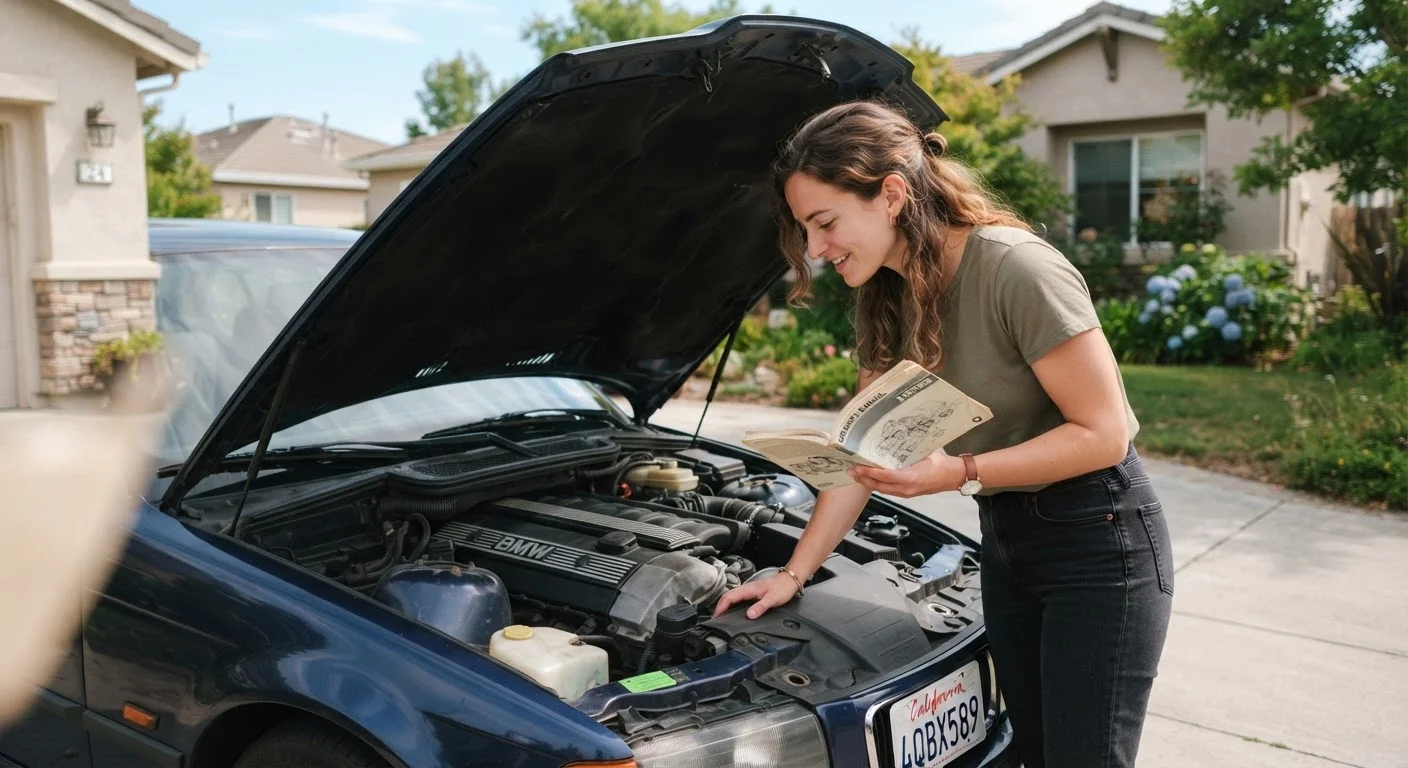
The owner's manual is the single most authoritative document for your vehicle—yet many owners never open it. It contains the maintenance schedule tailored to your exact make, model, and engine, along with fluid specifications, tire pressure, and warning light definitions.
Most manuals organize maintenance into two schedules: Normal and Severe. Severe service applies when you frequently drive in stop-and-go traffic, tow loads, operate in extreme temperatures, or take many short trips under five miles. If your daily commute matches any of those conditions, the severe schedule likely applies to you—and it calls for more frequent service.
Digital versions of most owner's manuals are available through the manufacturer's website if your physical copy is missing. Keep a note of your vehicle's VIN (Vehicle Identification Number), which is visible through the lower-left corner of your windshield, as it may be needed to retrieve the correct document.
Warranty and independent service shops
Under the Magnuson-Moss Warranty Act, vehicle manufacturers generally cannot void your warranty solely because you used an independent repair shop rather than a dealership—provided the work meets the manufacturer's specifications and you retain documentation. If you have questions about your specific warranty terms, review the warranty document or consult the manufacturer directly.
Talking to a Mechanic With Confidence
A common anxiety for first-time owners is feeling out of their depth at a repair shop. A few practical habits reduce that uncertainty considerably.
Describe symptoms, not diagnoses. Say "the car pulls to the right when braking" rather than "I think my rotors are warped." Mechanics work better from observed behavior, and an accurate symptom description helps them diagnose correctly the first time.
Ask for a written estimate before work begins. Reputable shops provide itemized estimates covering parts and labor. This protects you from unexpected charges and gives you something to compare if you seek a second opinion on major repairs.
Request the old parts back. For replaced components like brake pads or filters, asking to see the old parts is reasonable. It confirms work was done and gives you a sense of wear patterns.
Know when to get a second opinion. For any repair estimated above a few hundred dollars—or involving the transmission, engine, or suspension—a second estimate is a sound practice, not an insult. Our guide on transmission repair versus replacement illustrates how to think through high-stakes decisions.
Budgeting for Maintenance Costs
Routine maintenance is a predictable cost of ownership that first-timers sometimes underestimate when budgeting for a vehicle. The sticker price or monthly payment is only part of the picture.
Annual maintenance costs for a typical passenger vehicle can range from several hundred to over a thousand dollars, depending on the vehicle's age, make, and mileage. Older vehicles generally require more frequent attention; some high-end brands carry higher parts costs even for routine services.
A useful rule of thumb: set aside a small amount monthly into a dedicated maintenance fund rather than treating service costs as surprises. This smooths out the irregular nature of repairs and keeps deferred maintenance from becoming a financial decision rather than a mechanical one.
For a full picture of what vehicle ownership actually costs over time—including insurance, fuel, registration, and depreciation—see total cost of vehicle ownership. And if you're still in the shopping phase, the vehicle shopping hub offers practical guidance on choosing the right vehicle before you commit.
Deferred maintenance compounds quickly
Skipping or delaying scheduled services rarely saves money in the long run. A neglected coolant system can lead to an overheated engine; worn brake pads can damage rotors that cost several times more to replace. When a service is due, addressing it promptly is almost always the more cost-effective choice.
Frequently Asked Questions
It depends on your vehicle and the type of oil it uses. Many modern vehicles with synthetic oil can go 7,500 to 10,000 miles between changes. Check your owner's manual rather than relying on generic rules like the outdated 3,000-mile guideline.
Skipping services can allow minor wear to escalate into significant mechanical failures. For example, neglecting coolant flushes can cause overheating and engine damage. Staying on schedule is almost always cheaper than repairing the consequences of deferred maintenance.
Generally, no. Under the Magnuson-Moss Warranty Act, manufacturers cannot require you to use dealership service for routine maintenance to preserve your warranty, as long as you use parts and fluids that meet their specifications and keep your receipts.
Engine oil, coolant, brake fluid, transmission fluid, and windshield washer fluid are the core ones. Power steering fluid applies to vehicles without electric power steering. Your owner's manual shows check intervals and reservoir locations for each.
Tires should be replaced when tread depth reaches 2/32 of an inch—a common test is inserting a penny into the tread groove; if Lincoln's head is fully visible, replacement is due. Age also matters; most manufacturers recommend replacing tires after six to ten years regardless of tread.
Some tasks—like checking fluid levels, replacing wiper blades, or swapping cabin air filters—are straightforward for most people with basic instructions. However, brake work, suspension repairs, and anything involving fuel or electrical systems should generally be handled by a qualified mechanic.
The content on this site is for informational purposes only and is not a substitute for professional advice. Always consult a qualified professional for guidance specific to your situation.