

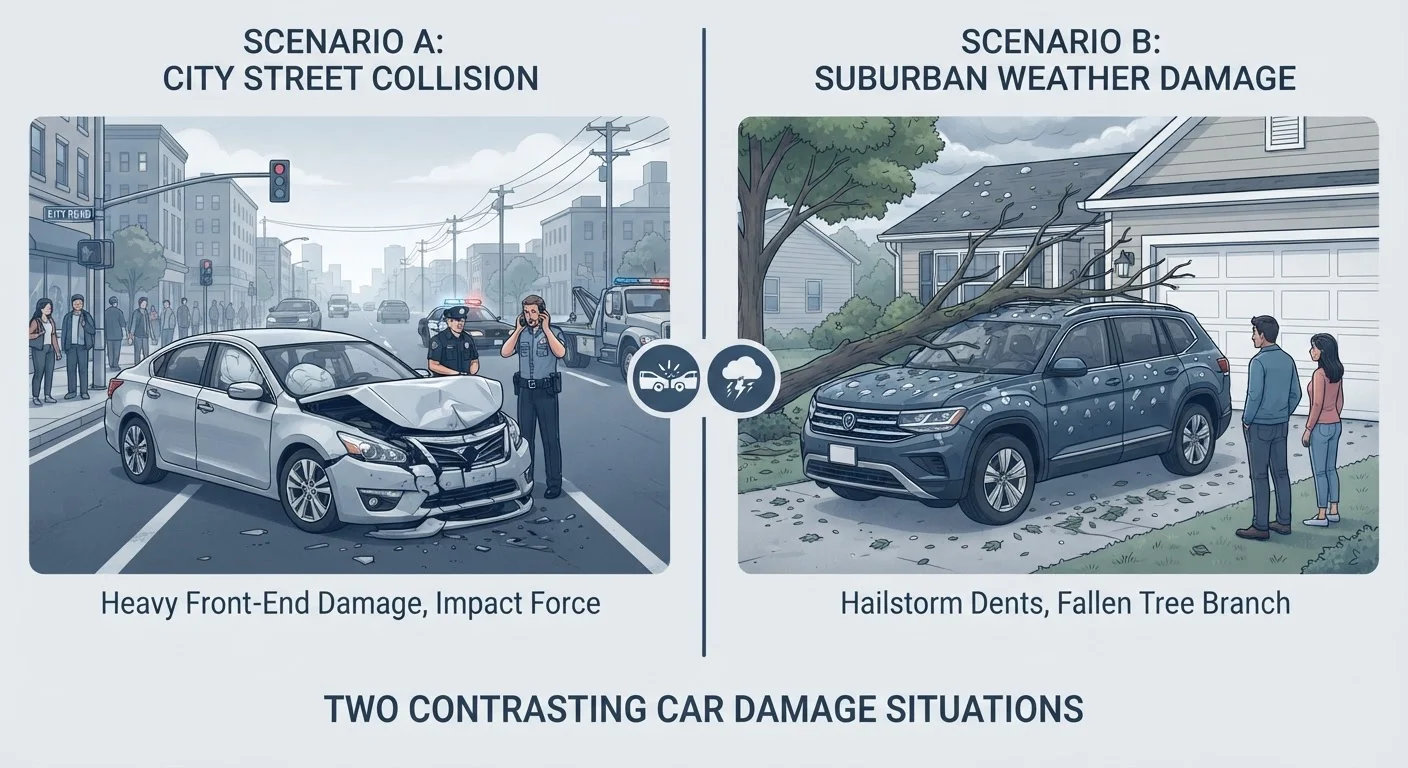
Option A
Collision Coverage
The coverage that pays when your car hits something.
Best for: Drivers who want protection for damage caused by accidents involving their own vehicle, regardless of fault.
Option B
Comprehensive Coverage
The coverage that pays when something happens to your car.
Best for: Drivers who want protection from non-accident events like theft, weather damage, fire, or falling objects.
What Each Coverage Actually Does
Collision coverage pays to repair or replace your vehicle when it's damaged as a result of a collision — your car hitting another vehicle, your car hitting a stationary object like a guardrail or telephone pole, or a rollover accident. Fault doesn't determine whether collision pays; it applies whether or not you caused the accident.
Comprehensive coverage (sometimes called "other than collision") pays for vehicle damage caused by events that don't involve a driving collision. Common covered events include theft, vandalism, fire, flooding, hail, falling objects (such as a tree limb), and contact with animals like deer.
Neither coverage applies to liability — meaning neither pays for damage you cause to someone else's vehicle or property. Those costs fall under your liability coverage. Neither pays for medical expenses, which are addressed by separate coverages such as Personal Injury Protection (PIP) or Medical Payments (MedPay). You can read more in our comparison of Personal Injury Protection vs. Medical Payments Coverage.
| Criterion | Collision Coverage | Comprehensive Coverage |
|---|---|---|
| What triggers a claim | Impact with another vehicle or object; rollover | Theft, weather, fire, vandalism, animals |
| Fault requirement | Pays regardless of fault | Fault is not a factor |
| Deductible applies | Yes | Yes |
| Typical premium cost | Higher (accidents are frequent) | Lower on average |
| Required by lenders | Yes, on financed/leased vehicles | Yes, on financed/leased vehicles |
| Covers theft | No | Yes |
| Covers hail or flood damage | No | Yes |
| Payout basis | Actual cash value of vehicle | Actual cash value of vehicle |
Deductibles, Premiums, and the Cost Trade-Off
Both collision and comprehensive are subject to a deductible — the amount you pay out of pocket before your insurer covers the remainder of a covered claim. Common deductible amounts range from $250 to $1,500. Choosing a higher deductible lowers your premium, but increases what you owe when you file a claim.
Collision coverage typically carries a higher premium than comprehensive because accident-related claims are more frequent. Comprehensive claims, while sometimes costly (a total theft, for example), occur less predictably across the general driving population.
~6 in 10
Insured drivers carrying collision coverage
According to the Insurance Research Council, a majority of insured drivers carry optional physical damage coverage, though rates vary by state and vehicle age.
$3,600+
Average collision claim payment
The Insurance Information Institute has reported average collision claim costs consistently exceeding several thousand dollars, underscoring why deductible selection matters.
When evaluating whether either coverage makes financial sense for your vehicle, one useful reference point is the vehicle's actual cash value (ACV) — what the car is worth on the open market accounting for depreciation. If a repair or total-loss payout under either coverage would be modest relative to the combined annual cost of the premium plus your deductible, you may be paying more than you'd realistically recover. This is a personal financial calculation, not a guaranteed formula. Consulting a licensed insurance agent can help you weigh it for your specific situation.
For a broader look at how these physical damage coverages fit into a full policy, see what auto insurance actually covers and where it stops.
When You're Required to Carry Both
If you're financing or leasing a vehicle, your lender or leasing company will almost certainly require both collision and comprehensive coverage as a condition of the loan or lease agreement. This protects their financial interest in the vehicle if it's damaged or stolen before you've paid off the balance.
Once a vehicle is paid off, these coverages become optional — but dropping them entirely shifts all repair and replacement risk to you. The decision to keep or drop either coverage generally depends on the vehicle's current market value, your ability to self-fund a replacement, and your overall risk tolerance.
Gap Insurance and Loan Payoff Coverage
If you finance a new vehicle, its actual cash value can fall below your loan balance quickly due to depreciation. In that scenario, collision or comprehensive would pay the ACV — but you'd still owe the difference to your lender. Gap insurance (or loan/lease payoff coverage) is a separate optional product designed to cover that difference. It's worth asking your insurer about if you've recently financed a vehicle with a small down payment.
Owners of collector or classic vehicles should be aware that standard collision and comprehensive valuations are based on actual cash value, which accounts for depreciation. This can be problematic for vehicles that appreciate over time or have agreed-upon restoration value. Classic car insurance works differently and may offer agreed value coverage instead.
For a direct look at how liability-only compares to carrying physical damage coverage, see our explainer on liability vs. full coverage trade-offs.
The content on this site is for informational purposes only and is not a substitute for professional advice. Always consult a qualified professional for guidance specific to your situation.