

Our Verdict
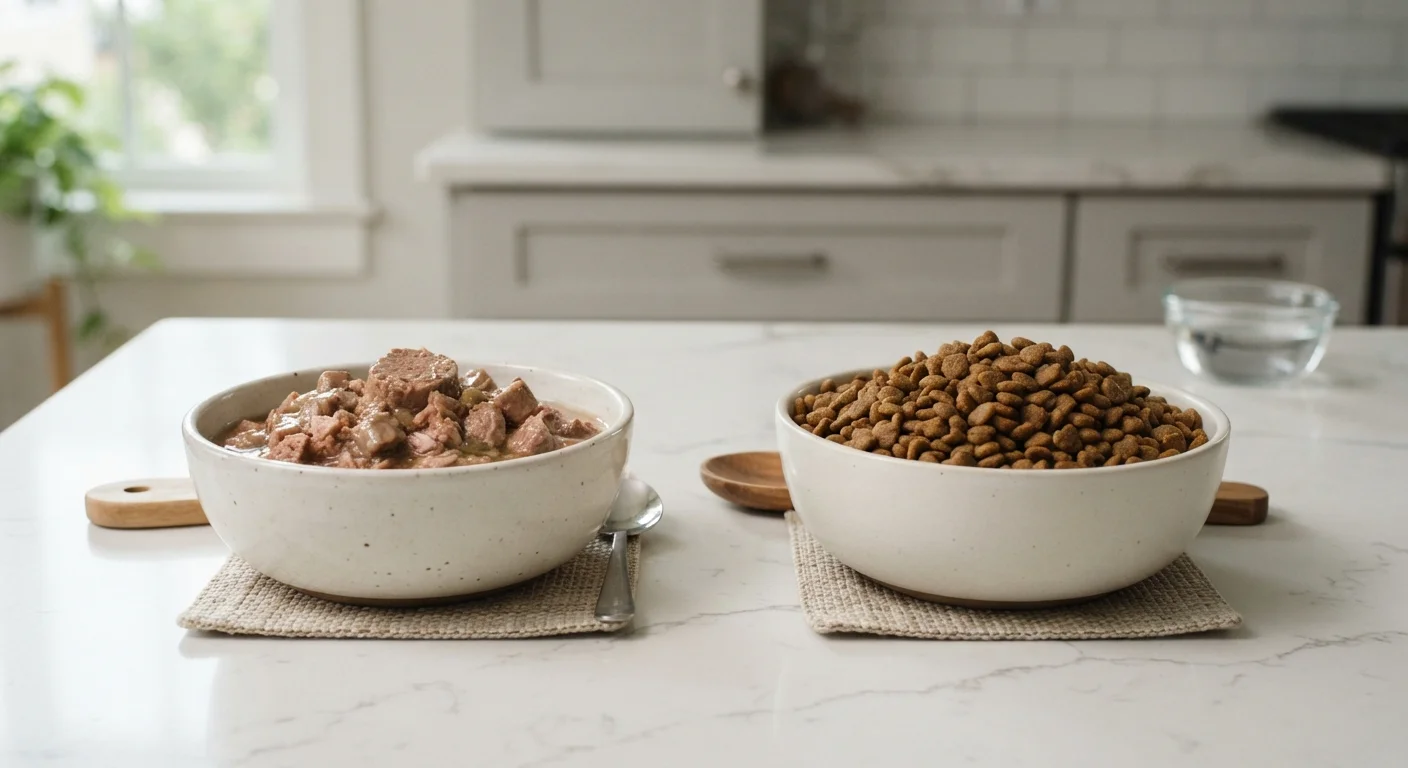
Wet and dry food each carry genuine advantages and real limitations. Research does not establish one format as categorically better; instead, the evidence points toward matching food format to a pet's specific hydration needs, caloric requirements, and health history. For cats especially, moisture content is a meaningful clinical consideration that tilts many veterinary recommendations toward at least partial wet food inclusion.
| Best for | Recommended |
|---|---|
| Cats prone to urinary tract issues or kidney disease | Wet food |
| Pet owners prioritizing convenience and cost-effectiveness | Dry food |
| Pets needing caloric control with better satiety | Wet food |
| Most average healthy adult dogs and cats | A mixed wet and dry approach |
The Core Nutritional Differences Between Formats
The most fundamental difference between wet and dry pet food is water content. Canned wet food is typically 70–80% moisture, while dry kibble contains around 10% or less. This distinction has meaningful downstream effects on how pets process nutrients and maintain hydration.
Beyond moisture, the two formats differ in how they're manufactured. Kibble undergoes high-temperature extrusion, which can affect certain heat-sensitive nutrients like some B vitamins — though reputable formulations compensate through fortification. Wet food is processed at lower temperatures, though the canning process involves heat sterilization as well.
Protein and fat concentrations look deceptively different on labels because of moisture dilution. When comparing labels, looking at dry matter basis — the nutrient content after factoring out water — gives a more accurate picture. Understanding how to read pet food labels is essential for making this comparison accurately.
| Wet Food | Dry Food | |
|---|---|---|
| Moisture content | 70–80% | ~10% |
| Calorie density (per volume) | Lower | Higher |
| Urinary/kidney health support | Strong evidence of benefit | Less supportive |
| Dental cleaning effect | Minimal | Minimal (unless prescription dental diet) |
| Shelf life after opening | 1–2 days refrigerated | Weeks, room temperature |
| Cost per serving | Generally higher | Generally lower |
| Palatability for picky eaters | Often higher | Variable |
What Research Says About Hydration and Urinary Health
Hydration is where wet food holds its clearest evidence-backed advantage, particularly for cats. Cats evolved in arid environments and have a low innate thirst drive; they naturally obtain much of their water through prey. Domestic cats fed primarily dry food may chronically consume less water than is optimal, which veterinary research has associated with higher risk of feline lower urinary tract disease (FLUTD) and the formation of kidney stones.
Multiple studies published in peer-reviewed journals, including work from the Journal of Veterinary Internal Medicine, have found that increasing dietary moisture increases urine volume and dilutes urine — a clinically relevant factor in preventing crystal and stone formation. For cats already managing chronic kidney disease, wet food is frequently part of a veterinarian-directed dietary strategy.
Dogs are generally more efficient water drinkers and less prone to moisture-intake deficits, making this distinction less critical for most healthy dogs — though it remains relevant for those with kidney or urinary conditions.
Boosting Hydration for Dry-Food Cats
If your cat primarily eats dry food, adding a pet water fountain can encourage more frequent drinking through the appeal of moving water. You can also try adding a small amount of low-sodium broth (without onion or garlic) to a water dish. These strategies don't replace wet food's moisture benefits entirely, but they can help increase daily fluid intake. Ask your vet what hydration level is appropriate for your cat's health status.
Calorie Density, Weight Management, and Satiety
Dry food is calorie-dense. A cup of kibble typically contains significantly more calories than an equivalent volume of wet food. This matters in both directions: dry food makes it easier to underestimate portions, contributing to accidental overfeeding. Wet food's higher water content adds volume without adding calories, which can support satiety in pets prone to weight gain.
For pets on a weight management plan, wet food's lower caloric density can help pets feel fuller on fewer calories. However, portion control is still essential — wet food can also contribute to weight gain if served without attention to serving sizes. See common weight management errors in pets for a closer look at where owners often go off track.
Caloric needs vary by species, age, activity level, and reproductive status. What matters most is matching total daily caloric intake to your individual pet — format is one variable, not the whole equation.
The Dental Health Claim: What the Evidence Actually Shows
One of the most repeated arguments for dry food is that the crunching action cleans teeth. The evidence here is weaker than commonly assumed. Most veterinary dentists note that kibble does not provide meaningful mechanical plaque removal — pets often swallow pieces whole or chew with a shearing motion that doesn't scrub tooth surfaces effectively.
Some prescription dental diets are specifically engineered with larger kibble sizes and fiber matrices designed to create more tooth contact, and these have published efficacy data behind them. Standard kibble, however, is not equivalent to a dental hygiene tool. The Veterinary Oral Health Council (VOHC) maintains a list of products with demonstrated plaque-reduction evidence — and most regular kibble doesn't appear on it.
For both wet and dry food feeders, active dental care — including veterinary cleanings and appropriate dental chews or brushing — remains the most evidence-supported approach to oral health. Building consistent pet health habits that include dental care makes a measurable difference over time.
Don't Rely on Kibble for Dental Health
Assuming dry food keeps teeth clean is one of the most common and consequential pet nutrition myths. Dental disease affects the majority of dogs and cats by age three, and food format alone doesn't prevent it. Skipping active dental care based on this belief can lead to painful, costly problems down the line. Talk to your vet about a dental hygiene routine appropriate for your pet.
Practical Considerations: Cost, Storage, and Palatability
Dry food wins on convenience and shelf stability. An open bag of kibble can be stored for weeks, is easy to measure, and is generally less expensive per calorie than wet food. These factors make it the practical default for many multi-pet households or owners managing a tight budget.
Wet food, once opened, must be refrigerated and used within a day or two, which introduces food safety considerations and slightly more daily handling. It also tends to cost more per feeding. That said, for picky eaters — especially cats — wet food's stronger aroma and softer texture often increase palatability and acceptance, which matters when a pet needs to eat consistently for health reasons.
A combined feeding approach, sometimes called split-feeding or mixed feeding, is one way some veterinary nutritionists suggest getting the benefits of both: wet food for moisture and palatability, dry food for convenience and cost management. The proportions depend on the individual pet's needs, which is worth discussing with a veterinarian. For a deeper look at what's actually in either format, learning what pet food label terms actually mean helps cut through marketing language.
This article provides general educational information about pet nutrition and is not a substitute for personalized veterinary advice. Always consult a licensed veterinarian before making significant changes to your pet's diet, especially if your pet has a health condition.
The content on this site is for informational purposes only and is not a substitute for professional advice. Always consult a qualified professional for guidance specific to your situation.