

Why Pet Food Label Language Matters
Walk down the pet food aisle and you'll see claims stacked on every bag: complete and balanced, natural, grain-free, human-grade. Some of these terms carry specific legal definitions enforced by regulatory bodies. Others are essentially unregulated marketing language. Knowing the difference protects your pet's health and your wallet.
In the U.S., pet food labeling is governed primarily by the AAFCO — a non-governmental organization whose model regulations most states adopt — along with the FDA. Understanding which claims fall under their oversight, and which don't, is the first step to reading labels accurately. For a broader look at how ingredient lists work across consumer products, our piece on reading a skincare label shows how similar principles apply.
| Primary U.S. Regulatory Body | AAFCO model regulations (adopted by most states) + FDA oversight |
| "Complete and Balanced" Requirement | Must meet AAFCO nutrient profiles for a stated life stage (AAFCO Model Pet Food Regulations) |
| Ingredient List Rule | Listed by pre-processing weight, heaviest first (FDA pet food labeling requirements) |
| "Holistic" — Regulated? | No — no official definition exists in pet food labeling |
| "Organic" — Governed by | USDA National Organic Program (same as human food) |
| "Human-Grade" — AAFCO Standard | Requires edible-grade ingredients and human food-approved manufacturing facilities (AAFCO Official Publication) |
Regulated Terms: What They Actually Mean
These terms have defined meanings under AAFCO guidelines or FDA regulations:
- Complete and Balanced: This is the most important claim on any pet food. It means the food meets AAFCO's established nutrient profiles for a specific life stage — either through formulation testing or a feeding trial. A food without this statement should not be a pet's sole diet.
- Life Stage (Adult, Puppy/Kitten, All Life Stages): AAFCO sets different nutrient minimums for growth, reproduction, and maintenance. "All Life Stages" meets the most demanding profile (growth/reproduction) and is nutritionally acceptable for any age.
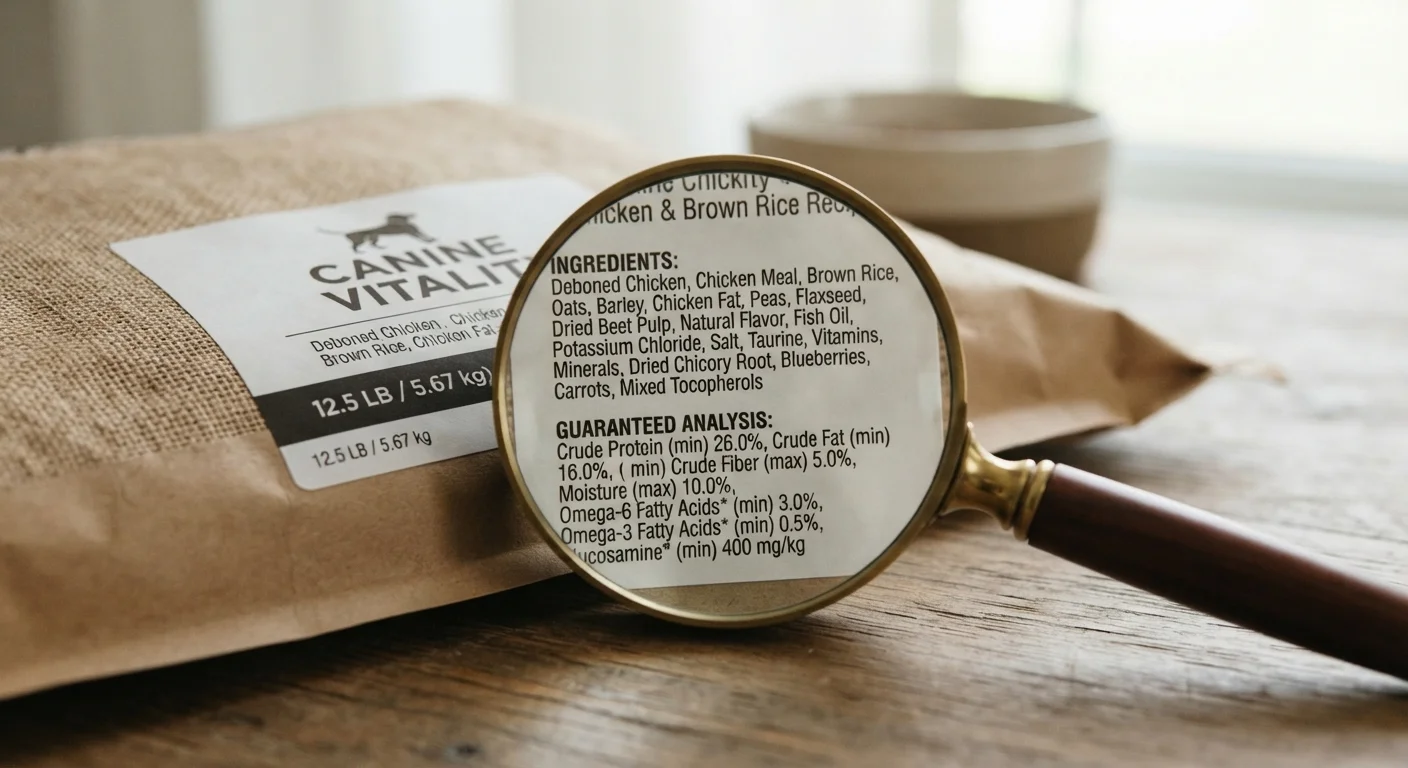
- Ingredient List Order: Ingredients are listed by weight before processing, heaviest first. This is federally mandated — so the first few ingredients reflect the food's dominant components.
- Guaranteed Analysis: This panel lists minimum crude protein, minimum crude fat, maximum crude fiber, and maximum moisture. These are guarantees, not precise measurements, and they don't account for digestibility.
- Natural: AAFCO defines this as derived solely from plant, animal, or mined sources — no chemically synthesized ingredients. However, vitamins and minerals added for nutritional completeness are typically exempted, meaning a "natural" food can still contain synthetic supplements.
See our companion article reading a pet food label without getting lost in the fine print for a detailed breakdown of the guaranteed analysis panel.
AAFCO
The Association of American Feed Control Officials — a non-governmental body whose model regulations most U.S. states adopt to govern pet food labeling, nutrient profiles, and ingredient definitions.
Nutritional Adequacy Statement
An AAFCO-mandated label statement confirming a food is complete and balanced for a specific life stage. It specifies whether adequacy was determined by formulation or a feeding trial.
Guaranteed Analysis
A required panel listing minimum crude protein, minimum crude fat, maximum crude fiber, and maximum moisture. These figures are guarantees of minimum or maximum levels, not exact measurements.
Crude Protein
A measure of total nitrogen-based content in pet food used to estimate protein levels. It does not indicate protein quality or digestibility.
Life Stage
An AAFCO designation — growth, reproduction, maintenance, or all life stages — indicating which animals and developmental phases a food is formulated to support.
By-Products
Secondary parts of an animal carcass after the primary cuts are removed — such as organs, lungs, or spleen. Named by-products (e.g., "chicken by-products") are regulated; unnamed ones are lower quality.
Marketing Terms: Useful Context, Not Guarantees
These claims appear frequently but carry far less regulatory weight:
- Grain-Free: No AAFCO definition exists for this term. It means the food omits common grains like corn, wheat, or rice — but grain-free products often substitute other high-carbohydrate ingredients such as potatoes or peas. The FDA investigated a possible link between grain-free diets and dilated cardiomyopathy in dogs; the research is ongoing and inconclusive. Consult your veterinarian before choosing a grain-free formula for your pet.
- Human-Grade: AAFCO has a formal definition — all ingredients must be edible under federal standards and the food must be manufactured, packed, and held in human food-approved facilities. Many products use "human-grade" loosely without meeting all of these criteria. Look for the specific AAFCO human-grade statement if this matters to you.
- Organic: Regulated by the USDA's National Organic Program — the same rules that govern human food. However, there is no specific AAFCO nutrient standard for organic pet food, so "organic" describes ingredient sourcing, not nutritional completeness.
- Fresh or Raw: Neither term has a standardized regulatory definition in pet food. They generally signal minimally processed ingredients but don't indicate nutrient content or safety testing standards.
- Holistic: Entirely unregulated in pet food labeling. No official definition exists — it is a marketing term only.
Understanding macronutrient basics can also help contextualize what you're seeing on labels — our guide on understanding macronutrients explains how protein, fat, and carbohydrates function, concepts that translate directly to evaluating pet food composition.
Grain-Free and Heart Disease: Still Under Review
The FDA launched an investigation into a potential association between grain-free diets and dilated cardiomyopathy (DCM) in dogs starting in 2018. As of the most recent public updates, the agency has not established a definitive causal link, and research continues. If your dog is on a grain-free diet, discussing the current evidence with your veterinarian is a reasonable precaution — especially for breeds with known cardiac risk.
How to Use This When Shopping
Prioritize the AAFCO nutritional adequacy statement over any front-of-bag claim. Confirm the life stage matches your pet. Then look at the guaranteed analysis and ingredient list together — a high protein percentage matters more if the first few ingredients are named meat sources rather than plant proteins or by-products.
For questions about specific formulas, your veterinarian or a board-certified veterinary nutritionist is the most reliable resource. No label term substitutes for professional guidance tailored to your individual animal. Explore more foundational care guidance at our Pet Care Basics hub, or dive into format-specific research with our article on wet food vs. dry food.
This article is for general informational purposes only and is not a substitute for veterinary advice. Always consult a qualified veterinarian for guidance specific to your pet's health and nutritional needs.
The content on this site is for informational purposes only and is not a substitute for professional advice. Always consult a qualified professional for guidance specific to your situation.