

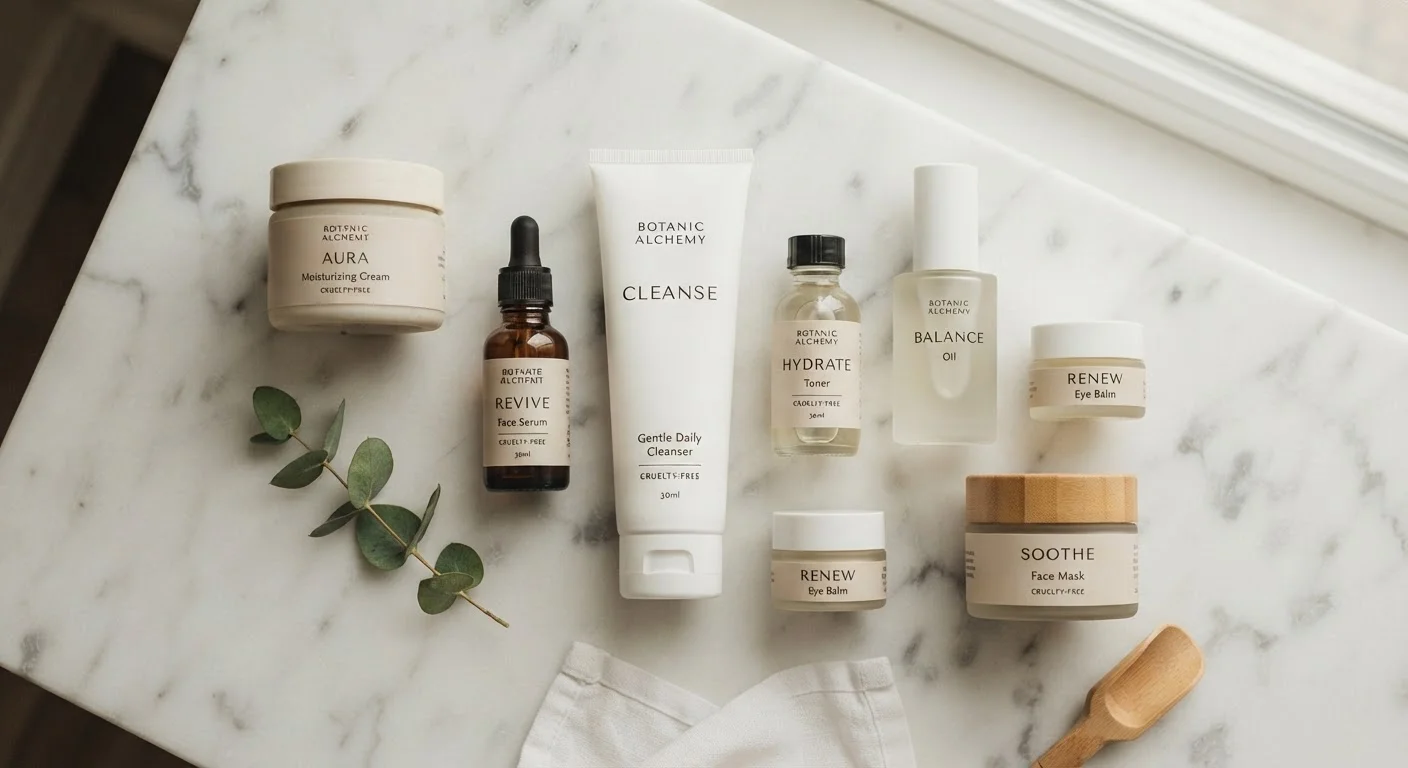
Why Skincare Jargon Feels So Overwhelming
Walk into any beauty aisle or scroll through a skincare forum and you'll encounter a wall of abbreviations, Latin-sounding ingredient names, and competing claims. The terminology isn't actually complicated — it just assumes background knowledge that nobody hands you at the start. This guide fills that gap.
Think of it as a living reference: something to bookmark and return to as you encounter new terms. Each definition below explains not just what a word means, but why it matters in practice. For a deeper look at how ingredients are listed and regulated, see how to read a skincare label.
| AHA solubility | Water-soluble — works on skin surface |
| BHA solubility | Oil-soluble — can reach inside pores |
| Skin's natural pH range | Approximately 4.5–5.5 (slightly acidic) (Dermatology research consensus) |
| Moisturizer trio | Humectant + Emollient + Occlusive |
| Patch test wait time | 24–48 hours before broader use |
| Non-comedogenic regulation | No FDA-defined standard; term is unregulated (U.S. FDA) |
The Core Vocabulary: Definitions Worth Knowing
The terms below come up constantly — in product descriptions, dermatology articles, and ingredient-focused communities. Understanding them makes it easier to evaluate what a product claims to do and whether those claims make sense for your skin.
AHA (Alpha Hydroxy Acid)
A water-soluble chemical exfoliant derived from natural sources such as fruit or milk. AHAs work on the skin's surface to loosen dead skin cells, helping to improve texture and tone over time.
BHA (Beta Hydroxy Acid)
An oil-soluble chemical exfoliant — salicylic acid is the most common example. Because it's oil-soluble, it can penetrate into pores, making it a popular choice for people dealing with congestion or breakouts.
Non-comedogenic
A label indicating a formula is designed not to clog pores. It's a useful starting point for acne-prone skin, though no universal standard governs the claim — individual reactions still vary.
Occlusive
An ingredient or product that creates a physical barrier on the skin's surface to slow water loss. Examples include petrolatum, shea butter, and certain waxes. Occlusives are the 'seal-in' step of moisturizing.
Humectant
A class of ingredient that draws moisture toward the skin, either from the environment or from deeper skin layers. Hyaluronic acid and glycerin are widely used humectants.
Emollient
An ingredient that softens and smooths the skin by filling gaps between surface cells. Emollients sit between humectants (which attract water) and occlusives (which lock it in) in the moisturizing process.
pH
A scale from 0 to 14 measuring acidity or alkalinity. Healthy skin has a slightly acidic pH, and many active ingredients — especially acids — work best within a specific pH range. Product pH matters more than most beginners expect.
Comedone
A blocked hair follicle that can appear as a blackhead (open comedone) or whitehead (closed comedone). Understanding this term helps decode 'comedogenic' and 'non-comedogenic' language on labels.
Retinoid
An umbrella term for vitamin A derivatives used in skincare, ranging from prescription-strength tretinoin to over-the-counter retinol. They are among the most studied ingredients for visible skin aging and acne.
Patch Test
A precautionary method of applying a small amount of a new product to an inconspicuous skin area to check for reactions before using it more broadly. Recommended for anyone trying a new active ingredient.
Actives
Ingredients included in a formula specifically to produce a measurable skin change — examples include vitamin C, niacinamide, AHAs, BHAs, and retinoids. Not all products contain actives; many are support or maintenance formulas.
Broad-Spectrum SPF
A sunscreen rating indicating protection against both UVA rays (linked to aging and deeper skin damage) and UVB rays (the primary cause of sunburn). 'Broad-spectrum' is a regulated term in the US.
A note on actives specifically: more isn't always better. Layering multiple acids or combining retinoids with potent exfoliants without guidance can disrupt the skin barrier. When in doubt, introduce one new active at a time and always patch test first.
Fragrance is another term worth understanding in context — it's neither universally harmful nor entirely benign. A balanced look at fragrance in skincare explains the trade-offs clearly.
These Terms Are a Starting Point, Not a Prescription
Understanding skincare vocabulary helps you read labels and research ingredients with more confidence — but it doesn't replace personalized guidance. If you're dealing with a persistent skin condition, sensitivity, or significant concern, a board-certified dermatologist is the right resource. This article is for general educational purposes only and is not medical advice.
Putting the Terms Together in a Real Routine
Knowing individual terms is useful; understanding how they interact is even more so. A basic moisturizer, for example, works best when it contains all three moisture components — a humectant to attract water, an emollient to smooth, and an occlusive to seal. Products that lean heavily on only one often feel incomplete.
0–14
The pH scale range relevant to skincare
Healthy skin sits around pH 4.5–5.5; disrupting this balance can impair the skin barrier, according to published dermatology literature.
3
Roles in every moisturizer formula
Most effective moisturizers combine humectants, emollients, and occlusives — each serving a distinct function in hydrating and protecting skin.
Similarly, knowing that AHAs and BHAs both exfoliate — but through different mechanisms — helps you understand why a dermatologist might suggest one over the other for your specific concerns. AHAs tend to suit dry or dull skin; BHAs are often preferred for oily or breakout-prone skin. Neither is universally superior.
Product order matters too. For a clear explanation of why layering sequence affects how well ingredients absorb and work, skincare order explained walks through the logic step by step. And if you're still building your foundational routine, what each core skincare step actually does is a practical companion read.
One of the most studied actives — retinol — has its own terminology and learning curve. Retinol explained covers what to expect and who should approach it with extra care.
This article is for general informational and educational purposes only and does not constitute medical or dermatological advice. Consult a qualified healthcare professional for personal skin concerns or conditions.
The content on this site is for informational purposes only and is not a substitute for professional advice. Always consult a qualified professional for guidance specific to your situation.