

The Dress Code Spectrum at a Glance
Dress codes exist on a spectrum from ultra-formal to completely relaxed—and most Americans navigate at least four or five of them in any given year: a job interview, a wedding, a holiday party, a casual Friday. The trouble is that the labels are rarely self-explanatory, and hosts often assume guests already know the rules.
| Most common workplace dress code in the U.S. | Business Casual (Society for Human Resource Management workplace surveys) |
| Dress codes on formal invitations | Usually listed in the bottom-right corner (Standard U.S. etiquette convention) |
| Key differentiator: Business vs. Smart Casual | Denim — generally off-limits for business casual, often acceptable in smart casual |
| Black Tie vs. White Tie | White Tie is the most formal of all dress codes; far rarer than Black Tie |
| "Cocktail Attire" hemline guideline | Knee to midi length (approx. knee to mid-calf) (General U.S. etiquette standard) |
This guide cuts through the confusion with plain-language definitions and practical outfit guidance for each major dress code. Think of it as a quick-reference card you can return to any time an invitation leaves you stumped. For a deeper look at building a wardrobe that covers all these tiers efficiently, see our complete American everyday style guide.
Business Casual and Business Formal: Know the Difference
Business Formal is straightforward: matched suits, ties, and dress shoes for men; tailored suits or formal dresses for women. It's expected at courtrooms, executive presentations, and some traditional industries like law and finance.
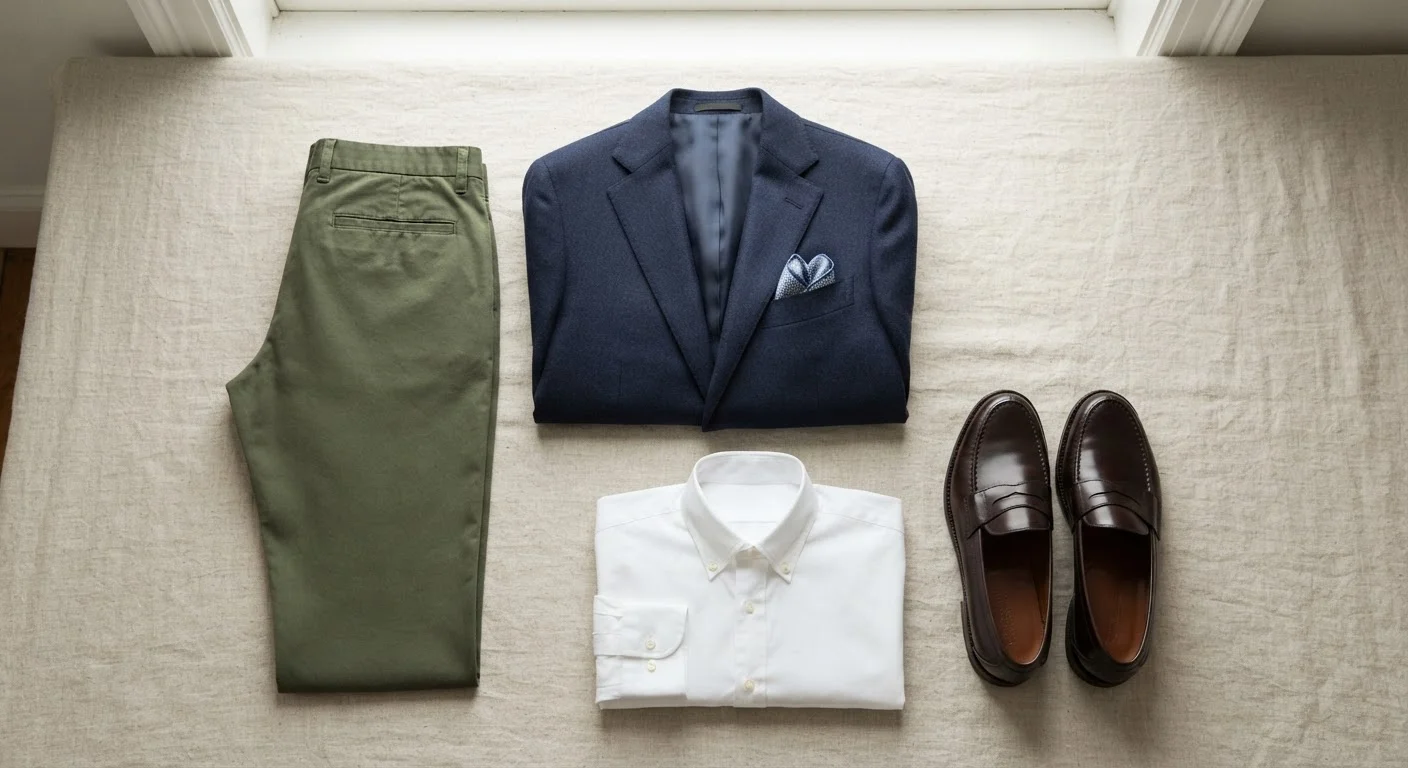
Business Casual is where most modern American workplaces live—and where most confusion happens. The safest business casual formula:
- Tops: Collared shirts, blouses, lightweight sweaters, or polo shirts. Graphic tees generally don't qualify.
- Bottoms: Dress trousers, chinos, or tailored slacks. Dark jeans can work in more relaxed offices, but check the culture first.
- Footwear: Loafers, leather or suede sneakers, low heels, or flats. Athletic sneakers and flip-flops typically fall outside this code.
- Outerwear: A blazer elevates any business casual outfit and is rarely a wrong call.
If you're building a wardrobe that doubles as both work-ready and everyday-versatile, our guide on dressing well for work without a dedicated work wardrobe is worth a read.
Smart Casual, Cocktail, and Evening Dress Codes
Business Formal
The most polished end of professional dressing. Typically means a matched suit, dress shirt, tie, and leather dress shoes for men; a tailored suit, sheath dress, or formal blouse-and-trouser set for women.
Business Casual
A professional but relaxed standard that drops the requirement for a suit and tie. Think dress trousers or chinos, collared shirts, and polished shoes—put-together without being stiff.
Smart Casual
A social dress code that sits between casual and formal. It allows stylish jeans, neat knitwear, and fashionable footwear while still looking intentional and refined.
Cocktail Attire
Semi-formal evening dress typically worn to weddings, galas, or upscale parties. For women, this usually means a knee-to-midi-length dress or dressy separates; for men, a dark suit and tie.
Black Tie
A formal evening dress code calling for a tuxedo (for men) or a floor-length gown or formal cocktail dress (for women). 'Black Tie Optional' gives guests leeway to wear a dark suit instead.
Casual / Resort Casual
Relaxed, comfortable clothing appropriate for everyday wear, vacations, or informal gatherings. Still implies being neat and presentable—not necessarily workout clothes or beachwear.
Smart Casual is the social counterpart to business casual—polished but personal. It's the code for nice restaurants, gallery openings, showers, and casual weddings. Dark or well-fitted jeans are generally acceptable here, paired with a neat blouse, structured top, or button-down. Clean, stylish footwear matters more than formality.
Cocktail Attire steps it up: think knee-to-midi dresses, dressy jumpsuits, or a dark suit with tie. It's the dress code of evening weddings, charity galas, and milestone birthday parties.
Black Tie is the most formal occasion most people encounter: tuxedos for men, floor-length or formal cocktail-length gowns for women. "Black Tie Optional" invitations allow a dark suit as an alternative.
When the Invitation Doesn't Say
If no dress code is listed, use the event's venue and time as your guide. A Saturday evening restaurant dinner usually calls for smart casual; a backyard barbecue is relaxed casual. When in doubt, it's generally safer to be slightly overdressed than obviously underdressed. You can always remove a blazer.
Fit matters across all of these categories. A well-fitting outfit at a lower formality level will almost always look sharper than an ill-fitting one at a higher tier. For guidance on finding silhouettes that work for your proportions, see dressing for your body shape.
Building a Wardrobe That Covers Every Code
57%
of U.S. workers wear business casual regularly
According to SHRM workplace culture research, business casual is the dominant dress code across American offices.
3–5
core versatile pieces to cover most dress codes
Fashion stylists commonly note that a blazer, dark trousers, a quality knit, dark jeans, and leather shoes can bridge most dress-code tiers.
You don't need a separate outfit for every dress code. A handful of versatile anchor pieces can be styled up or down to cover most occasions:
- A well-fitted blazer — transforms smart casual into semi-formal in seconds.
- Dark, straight-leg trousers — work for business casual, smart casual, and even cocktail settings depending on the top.
- A quality knit or blouse — the right top changes the whole read of an outfit.
- Dark, clean-cut jeans — your smart casual workhorse.
- Leather or polished shoes — one pair of versatile dress shoes covers more ground than five pairs of casual ones.
The goal isn't a massive wardrobe—it's a strategic one. Our article on balancing statement pieces with basics can help you figure out what ratio works for your lifestyle and budget.
This article is for general style guidance only. Dress code conventions can vary by region, industry, and individual host—when in doubt, ask the event organizer directly.
The content on this site is for informational purposes only and is not a substitute for professional advice. Always consult a qualified professional for guidance specific to your situation.