

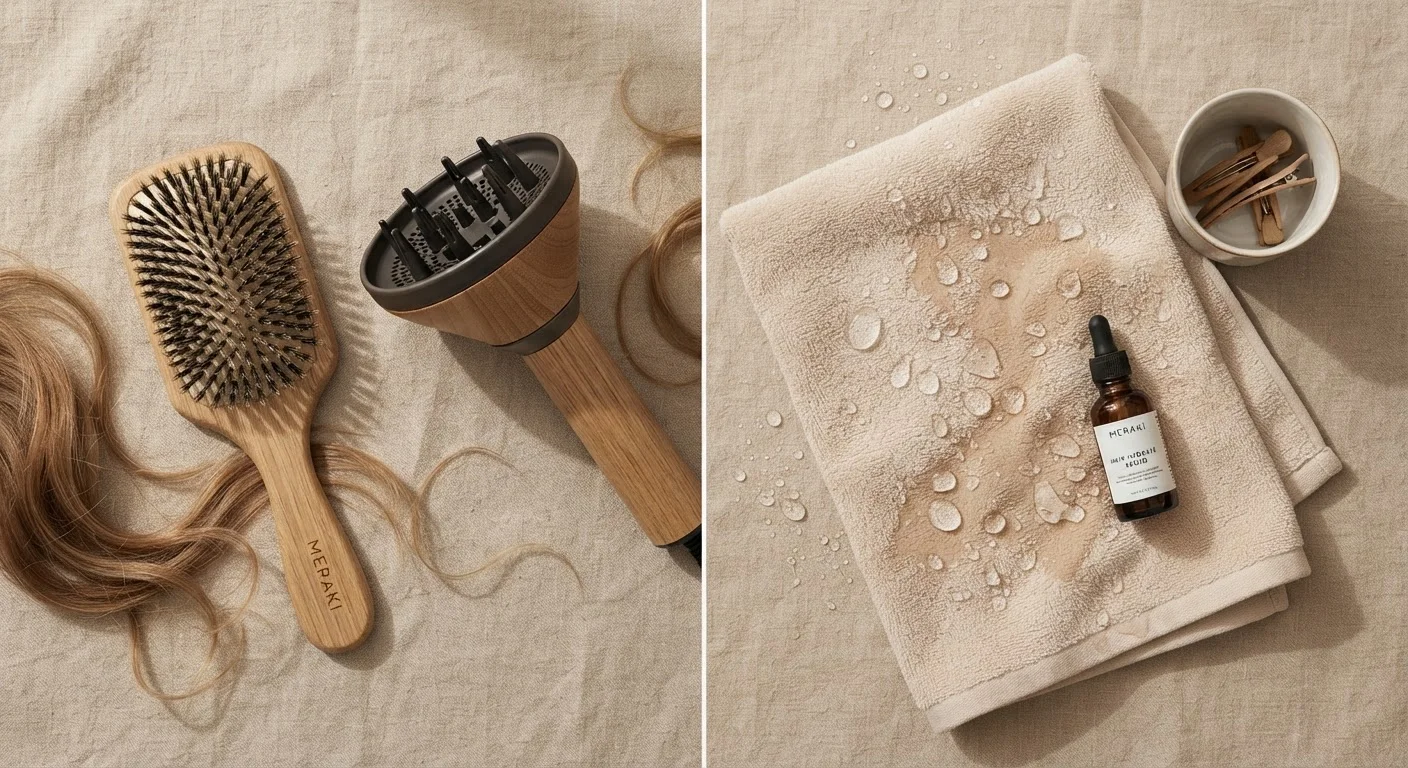
Option A
Air Drying
The hands-off, heat-free approach to drying hair.
Best for: Those with fine, fragile, or chemically treated hair who want to minimize heat exposure and mechanical stress.
Option B
Blow Drying
The quick, controlled method with more styling power.
Best for: Anyone who needs a faster dry time, wants smoother results, or has thick or coarse hair prone to prolonged moisture exposure.
The Science Behind Wet Hair Vulnerability
When hair is wet, its internal structure — made primarily of keratin proteins — is in a temporarily weakened state. Water enters the cortex and causes individual strands to swell, making them more elastic but also far more prone to breakage from friction, tension, and manipulation. This is the foundation of the entire debate: how you dry your hair matters enormously, but so does how long it stays wet.
Research published in the Journal of Cosmetic Science has explored how prolonged water exposure affects the hair's protein bonds, with extended wetting cycles contributing to a form of structural fatigue sometimes called hygral fatigue — particularly in high-porosity hair. Understanding your hair's porosity and elasticity helps clarify why one drying method may serve your specific strands better than another.
The takeaway here isn't that water is bad — it's that wet hair in a vulnerable state benefits from thoughtful handling regardless of which drying method you choose.
| Criterion | Air Drying | Blow Drying |
|---|---|---|
| Heat exposure | None | Moderate to high (technique-dependent) |
| Wet-phase duration | Long (30 min to several hours) | Short (5–15 min) |
| Risk of hygral fatigue | Higher (especially high-porosity hair) | Lower (faster drying reduces wet time) |
| Curl definition | Better preserved | Can disrupt pattern without diffuser |
| Best hair type | Fine, fragile, curly/coily | Thick, coarse, low-porosity |
| Technique dependency | Low | High — distance, heat, motion matter |
| Time investment | Low effort, high wait time | Active effort, faster results |
What Air Drying Actually Does to Your Strands
Air drying has a reputation as the "safe" default, and in some respects that's earned. Removing heat from the equation does eliminate one category of stress on the hair shaft. But the full picture is more nuanced.
The longer hair stays wet, the longer it undergoes that swollen, weakened phase. For people with fine, low-density, or high-porosity hair, prolonged wetness can cause repeated swelling and contracting of the cortex, which stresses the cuticle over time. Additionally, many people unconsciously handle their hair more while waiting for it to dry — twisting, touching, tying back — which adds mechanical friction and tension.
Common grooming habits like scrubbing wet hair with a terry-cloth towel or tying it up in a tight bun while damp can cause more cumulative damage than a well-used blow dryer ever would. If you air dry, the key is to blot gently with a microfiber towel or a soft cotton T-shirt, let hair fall naturally, and resist the urge to manipulate it while it's most vulnerable.
~30%
Reduction in tensile strength when hair is wet
Hair science literature consistently notes that wet hair can lose roughly 30% of its tensile strength compared to dry hair, making handling technique critical.
150°C+
Temperature threshold for significant protein damage
Studies in cosmetic science indicate measurable keratin degradation typically begins at sustained temperatures above 150°C (302°F).
6 inches
Recommended minimum dryer distance from hair
Dermatologists and hair scientists commonly recommend keeping a blow dryer at least 6 inches from the shaft to reduce localized heat concentration.
Blow Drying: The Real Risk Factors
Heat damage is real, but the risk level depends heavily on technique. Holding a dryer six inches away from the hair shaft on a high heat setting in one fixed position for several seconds is very different from keeping a dryer moving at medium heat from a reasonable distance. Most heat damage studies that show significant protein degradation involve temperatures above 150°C (302°F) with direct, sustained exposure — conditions that aren't typical of careful everyday use.
Using a concentrator nozzle or a diffuser attachment improves airflow control and reduces heat concentration on any one section of hair. What the evidence shows about heat styling is that smart technique and appropriate products — particularly leave-in conditioners that coat the cuticle — make a substantial difference in outcomes.
The practical upside of blow drying is speed. Shorter wet time means less time in that structurally vulnerable state, which is especially relevant for thick, coarse, or low-porosity hair types that can take hours to air dry fully.
Finding the Right Method for Your Hair
There's no universal winner. The right approach comes down to your hair's properties, your lifestyle, and how you handle your strands in the process.
If your hair is fine, chemically treated, or already showing signs of breakage, minimizing heat is a reasonable priority — but pair air drying with gentle handling and a microfiber towel. If you have thick, dense, or coarse hair, the extended wet window from air drying may introduce more stress than low-to-medium heat blow drying would.
The hybrid method — blotting excess water, letting hair air dry to about 60–70% dryness, then finishing with a blow dryer on medium heat — threads the needle for many people. It shortens the vulnerable wet phase without loading up on prolonged heat exposure. How frequently you wash your hair also feeds into this equation: the more wash cycles per week, the more cumulative stress your chosen drying routine creates over time.
The Towel Step Is Often the Real Problem
Before you even get to the drying method, how you towel-dry can set the tone for damage. Rubbing wet hair vigorously with a standard terry-cloth towel roughs up the cuticle and causes significant friction breakage. Swapping to a microfiber towel or a soft cotton T-shirt — and blotting rather than rubbing — is one of the simplest, highest-impact changes you can make regardless of whether you air dry or blow dry afterward.
This article is for general informational purposes only and does not constitute professional medical or dermatological advice. If you have concerns about hair loss or scalp conditions, consult a licensed dermatologist or trichologist.
The content on this site is for informational purposes only and is not a substitute for professional advice. Always consult a qualified professional for guidance specific to your situation.