

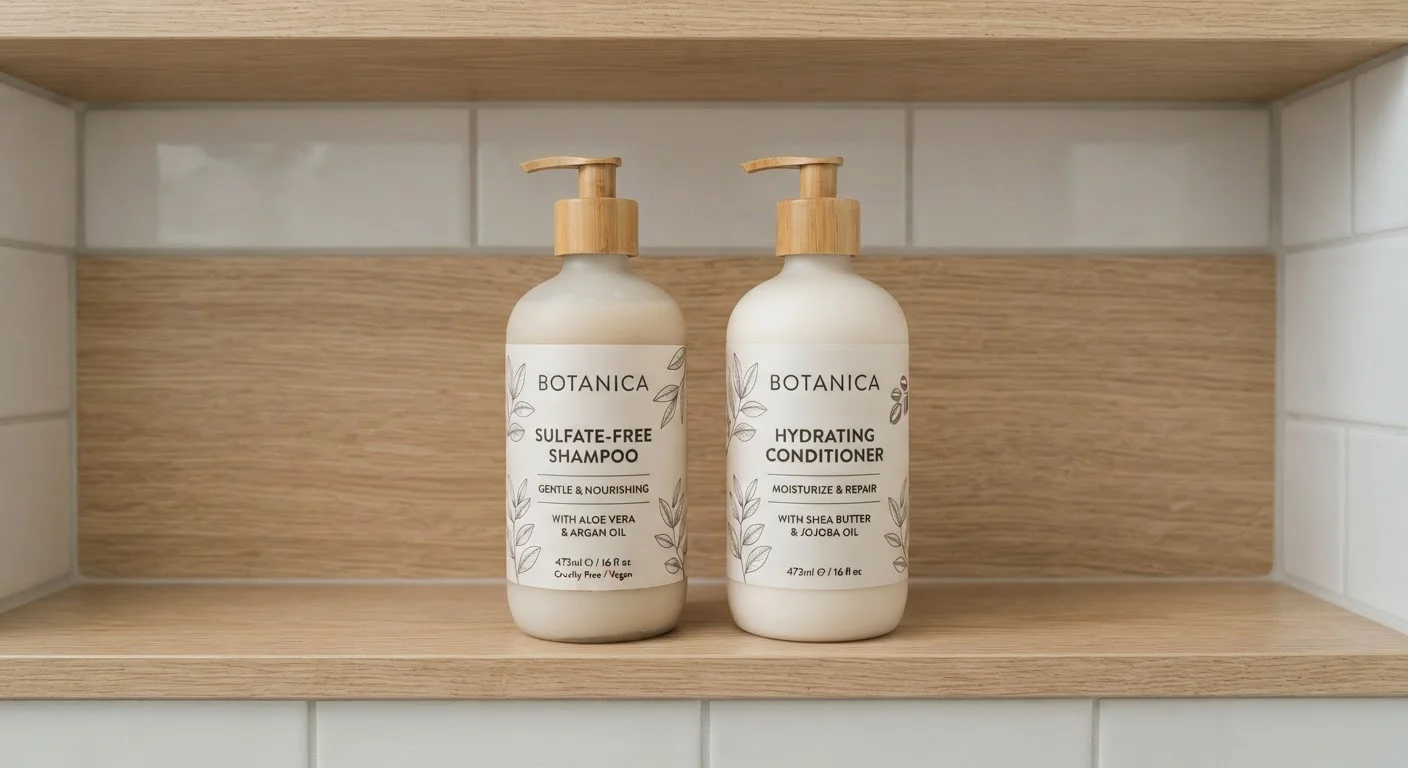
Option A
Regular Shampoo (with Sulfates)
The powerful, deep-cleansing classic.
Best for: Best for oily scalps, fine hair, heavy product buildup, or anyone who needs a thorough weekly reset.
Option B
Sulfate-Free Shampoo
The gentler, moisture-preserving alternative.
Best for: Best for color-treated, curly, coily, dry, or chemically processed hair that benefits from a lighter cleanse.
What Sulfates Actually Do
Sulfates — most commonly sodium lauryl sulfate (SLS) and sodium laureth sulfate (SLES) — are surfactants. A surfactant molecule has one end that attracts water and another that attracts oil, which is exactly what makes them effective cleaners. They grab onto sebum, sweat, and styling product residue, then rinse away with water, taking the grime with them. The lather they produce isn't strictly necessary for cleaning, but it does signal that the surfactant is working.
Regular shampoos rely on these sulfate surfactants as their primary cleansing agent. They're inexpensive to manufacture, highly effective, and stable across a wide range of water conditions. For decades, they were the industry standard — and for many hair types, they still work well.
Sulfate-free shampoos swap those high-powered surfactants for milder alternatives, such as cocamidopropyl betaine, sodium cocoyl isethionate, or decyl glucoside. These still cleanse, but with less stripping action. The trade-off: less lather, more residual moisture left on the strand. If you'd like a broader primer on reading ingredient labels, understanding hair product labels covers exactly how to decode a formula from top to bottom.
Side-by-Side: How They Compare
When it comes to deciding between the two, the differences aren't just about gentleness — they touch cleansing power, lather, scalp impact, and how well color holds. Here's a direct comparison across the criteria that matter most to everyday hair care decisions.
| Criterion | Regular Shampoo | Sulfate-Free Shampoo |
|---|---|---|
| Cleansing strength | High — removes oil and buildup thoroughly | Moderate — gentler, may leave some residue |
| Lather | Rich, abundant foam | Light to minimal lather |
| Moisture impact | Can strip natural oils from strand | Preserves more surface moisture |
| Color retention | May accelerate fade over time | Generally gentler on color-treated hair |
| Scalp irritation risk | Higher for sensitive scalps | Lower irritation potential for most |
| Silicone/heavy buildup removal | Effective | Often insufficient alone |
| Best hair textures | Fine, straight, oily hair types | Curly, coily, dry, color-treated |
One thing neither type changes: the fundamental health of your hair follicle. Shampoo works at the surface. Long-term hair health is much more about your scalp health habits — circulation, sebum balance, and how well your scalp environment supports growth.
When Sulfate-Free Makes a Real Difference
The clearest case for going sulfate-free is chemical or heat-processed hair. Color, bleach, keratin treatments, and relaxers all alter the hair's outer cuticle layer — the protective sheath that lies flat on healthy strands. Disrupted cuticles are more porous, which means they lose moisture and color pigment more readily. Sulfates accelerate that process. If fade speed and moisture retention matter to you, a gentler surfactant is a practical choice, not just a marketing preference.
Curly and coily textures benefit for a related reason. The natural oils produced at the scalp have a harder time traveling down tightly coiled strands, so these hair types tend to run drier. A sulfate-based shampoo may remove what little surface oil exists, leaving strands more prone to frizz and breakage. Sulfate-free formulas cleanse without stripping that moisture baseline.
People with sensitive scalps or conditions like eczema or psoriasis may also find sulfate-free options less irritating — though anyone managing a scalp condition should work with a dermatologist for guidance specific to their situation.
~90%
Color loss attributed to washing
Hair care researchers commonly cite washing as the primary driver of color fade, with shampoo formulation playing a significant role in how quickly pigment is lost.
2–4 weeks
Typical clarifying wash interval
Hair care professionals generally suggest a clarifying shampoo every two to four weeks for those primarily using sulfate-free formulas alongside silicone-based products.
When Regular Shampoo Still Wins
Sulfate-free shampoos have a real limitation: they don't always cut through heavy buildup. If you use silicone-based styling products, dry shampoo, or thick leave-ins frequently, those ingredients can accumulate on the scalp and strand over time. Many of those ingredients — especially silicones — are specifically designed to resist water and are not easily removed by mild surfactants.
This is where a sulfate-based clarifying wash earns its place, even in a mostly sulfate-free routine. Using one every few weeks prevents the kind of buildup that muffles shine, weighs down volume, and can eventually contribute to scalp congestion. Our overview of dry shampoo and scalp trade-offs goes deeper on why buildup management matters.
Fine, straight, or naturally oily hair types are also typically better served by regular shampoo. Sulfate-free formulas can feel coating or heavy on hair that doesn't need extra moisture. And since these hair types tend to show oil faster, a thorough cleanse makes a visible difference in how long a wash lasts. For a practical look at wash frequency, how often to wash your hair breaks down the signals your scalp actually sends.
The Transition Period Is Real
If you switch from regular to sulfate-free shampoo, your hair may feel different for the first two to four weeks. The scalp can temporarily overproduce oil in response to the lighter cleanse — a short adjustment period that typically resolves. It's worth sticking with the switch long enough to see how your hair settles before deciding it isn't working.
The content on this site is for informational purposes only and is not a substitute for professional advice. Always consult a qualified professional for guidance specific to your situation.