

Our Verdict
Full-time RV living is a legitimate and rewarding lifestyle choice for people who prioritize freedom, lower overhead, and experiential living over stability and space. However, the day-to-day realities — from grey water management to mail forwarding to relationship strain in close quarters — are rarely visible in curated social media posts. Going in with clear expectations and thorough preparation makes the difference between a fulfilling adventure and a stressful one.
Best suited to self-directed individuals or couples with flexible remote income, high tolerance for uncertainty, and a willingness to treat logistics as part of the lifestyle rather than obstacles to it.
What Full-Time RV Living Actually Means
Full-timing — the term used by the RV community for living in a rig year-round — means your RV is your primary residence, not a vacation vehicle. That distinction changes everything: insurance classification, mail delivery, vehicle registration, healthcare access, and tax domicile all become variables you must actively manage rather than take for granted.
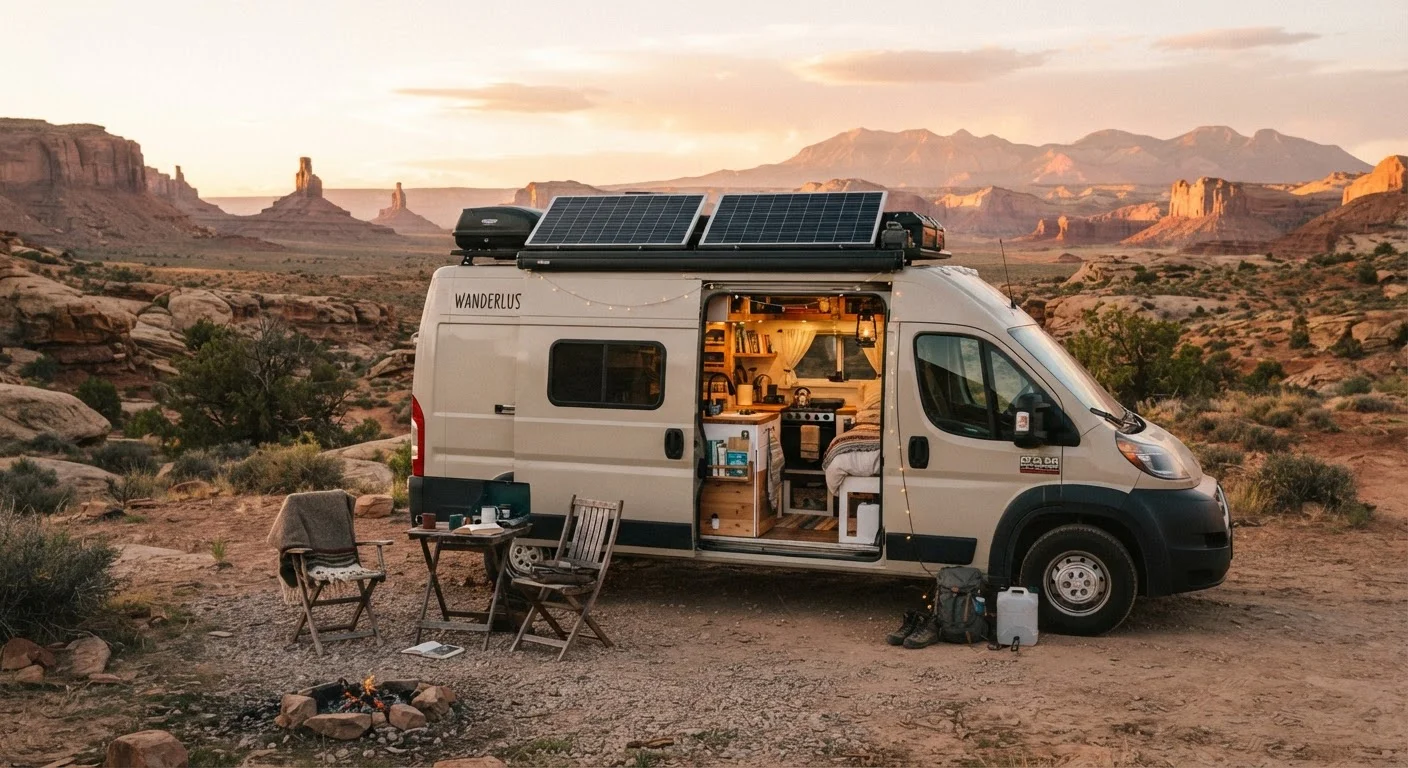
Social media tends to surface the highlights: sunrise views from a canyon rim, a laptop open on a picnic table, the freedom of an open highway. What it rarely shows is the Thursday afternoon when the water pump fails 40 miles from the nearest RV dealer, or the week of rain that makes a 200-square-foot space feel genuinely confining.
For a broader foundation before committing, the complete guide to owning and traveling in an RV covers the end-to-end ownership picture — a useful starting point alongside any lifestyle research.
The Genuine Advantages
The case for full-timing is real and well-documented by the community. Housing is typically the largest line item in an American household budget, and full-timers can reduce that cost substantially by substituting campground fees — which vary widely but often run far less than a mortgage or urban rent payment — for fixed housing expenses.
Significantly reduced housing costs
Campground fees and RV loan payments typically combine to less than median urban rent, though savings vary by region and lifestyle. Eliminating property taxes, HOA fees, and utility infrastructure costs adds to the advantage.
Geographic freedom and flexibility
Full-timers can relocate on their own schedule — following seasonal weather, positioning near family, or exploring regions without time constraints. This flexibility is difficult to replicate in conventional housing.
Simplified, lower-consumption lifestyle
Limited storage space forces deliberate choices about possessions. Many full-timers report that the constraint reduces impulse spending and refocuses priorities toward experiences over accumulation.
Strong, built-in community
Campgrounds, RV clubs, and online communities create dense social networks among full-timers. Many long-term full-timers describe the community aspect as one of the most sustaining parts of the lifestyle.
Lower environmental footprint potential
A smaller living space consumes less energy to heat and cool. Full-timers who rely on solar and boondock frequently can reduce their utility-related environmental impact compared to a conventional home.
Geographic flexibility is the other major draw. Full-timers can follow weather, position themselves near aging parents for months at a time, or relocate for short-term work contracts without the friction of a lease. For remote workers, particularly those in creative or tech fields, the lifestyle enables a kind of continuous novelty that many find creatively sustaining.
The community dimension is also underappreciated. Full-timers tend to develop dense social networks at campgrounds, through RV clubs, and via online forums — connections that can offset the isolation that's common in conventional suburban living.
~1 million
Estimated full-time RV residents in the U.S.
Industry estimates from the RV Industry Association have suggested approximately one million Americans live in RVs full-time, though exact figures are difficult to verify due to the lack of formal census tracking.
10–15%
Annual maintenance budget as share of rig value
Experienced full-timers and RV financial planners commonly cite this range as a realistic maintenance reserve, though actual costs vary widely by rig age, type, and mileage.
The Realities That Don't Make the Feed
The practical friction of full-time RV life is significant and accumulates over time. Space constraints affect every aspect of daily living: cooking, exercise, work, and conflict resolution all happen within the same few hundred square feet. Couples who thrive in the lifestyle typically report strong pre-existing communication habits; those who don't often find the constraints amplifying rather than resolving tension.
Constant, often costly maintenance demands
RVs are homes that travel down highways — every seam, fitting, and system endures road vibration. Experienced full-timers frequently recommend budgeting 10–15% of the rig's value annually for repairs, though this figure varies.
Severe space constraints affect daily wellbeing
Shared living in under 300 square feet is manageable short-term but tests relationships and personal wellbeing over months or years. Rainy or extreme-weather stretches with no usable outdoor space intensify the effect.
Internet connectivity is unreliable in rural areas
Remote workers depend on consistent connectivity, but cell signal varies dramatically by region. Satellite internet options have improved but add monthly cost and aren't equally viable for all rig configurations.
Administrative complexity of mobile residency
Managing domicile, vehicle registration, mail, and multi-state healthcare coverage requires ongoing effort and sometimes professional advice. These logistics are non-trivial and easy to underestimate before departure.
Social isolation from stationary networks
While full-timers build road community, they also gradually disconnect from hometown friends, extended family, and professional networks. This tradeoff becomes more pronounced the longer the lifestyle continues.
Financing and insurance classifications are complex
Lenders and insurers treat full-timers differently from recreational RV users. Full-timer insurance endorsements add cost, and some lenders restrict financing for rigs used as a primary residence.
Maintenance is relentless. An RV combines the mechanical complexity of a vehicle with the infrastructure demands of a home — plumbing, electrical, HVAC, propane, roof seals — and all of it vibrates down the road at highway speed. Full-timers commonly budget between 10% and 15% of the rig's value annually for repairs and upkeep, though individual experiences vary widely.
Fuel economy myths also affect budget planning — manufacturer estimates rarely reflect real-world driving conditions, and full-timers cover enough miles annually for this gap to matter financially.
Logistics: Mail, Domicile, and Healthcare
Three administrative challenges catch many new full-timers off guard: establishing legal domicile, managing mail, and accessing healthcare consistently.
Domicile refers to your legal state of residence for purposes of vehicle registration, driver's licensing, voting, and taxes. Full-timers typically choose a state with no income tax and straightforward residency requirements — South Dakota, Texas, and Florida are commonly cited within the community — though individual situations vary and consulting a tax professional is advisable before making this decision.
Mail forwarding services handle physical correspondence by receiving, scanning, and forwarding mail to wherever you are. Several services cater specifically to full-timers and can also handle package receiving and forwarding, which matters for parts and equipment orders.
Healthcare is the most complex challenge. Full-timers who are not on Medicare or covered through an employer need health insurance that functions across multiple states. Standard HMO plans with narrow regional networks are generally incompatible with a mobile lifestyle; PPO or short-term options with broader networks are more workable, though coverage, cost, and suitability vary significantly by individual circumstances.
Healthcare Planning Deserves Early Attention
Healthcare access is widely cited as the most underestimated challenge of full-time RV living. Coverage options, networks, and costs differ substantially by plan type and individual situation. It is worth researching health insurance options that work across state lines — and consulting a licensed insurance broker familiar with mobile lifestyles — well before selling a conventional home or leaving an employer-sponsored plan.
Making an Informed Decision
Many people who ultimately thrive as full-timers started with a trial run: renting an RV for several weeks or purchasing a used rig for a shorter commitment before selling a home. Renting versus owning is a meaningful decision in its own right, especially before committing to full-time living.
Choosing the right rig matters as much as deciding to full-time. A motorhome versus a towable setup involves different trade-offs in drivability, cost, and campsite flexibility — trade-offs that are amplified when the vehicle is your permanent home rather than a weekend getaway.
Those new to the broader RV experience should also read what every new owner should know before leaving the driveway before making any large commitments. The fundamentals of hookups, driving, and campground etiquette are non-trivial when you're learning them in a vehicle that's also your only home.
The full-time lifestyle rewards preparation and penalizes improvisation. Approached honestly — with clear financial modeling, a plan for the administrative details, and realistic expectations about space — it can be a genuinely enriching way to live. Approached as an escape from problems rather than a deliberate lifestyle choice, it tends to transport those problems down the road at 55 miles per hour.
The content on this site is for informational purposes only and is not a substitute for professional advice. Always consult a qualified professional for guidance specific to your situation.