

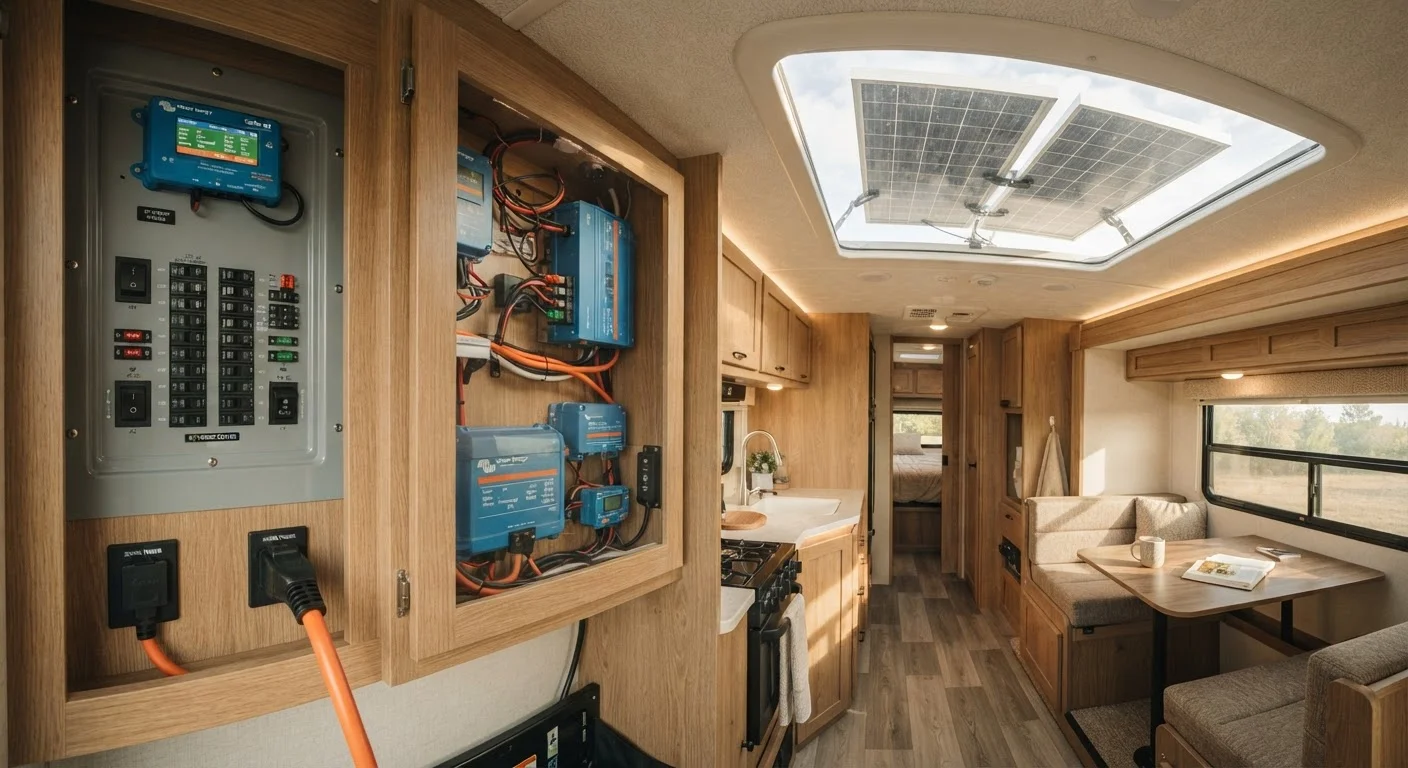
The Two Circuits Inside Every RV
Before exploring power sources, it helps to understand that virtually every RV operates on two separate electrical circuits running in parallel. The 12-volt DC system powers low-draw equipment: interior lighting, exhaust fans, the water pump, slide-out motors, and the control boards on propane appliances. This circuit draws from the coach batteries and works even when you're completely disconnected from external power.
The 120-volt AC system handles high-demand appliances — the air conditioner, microwave, residential refrigerator, and outlets for electronics. This circuit requires an external power source: shore power, a running generator, or an inverter pulling from your battery bank. The two systems are linked by a converter/charger, which takes incoming AC power and uses it to keep your 12V batteries charged, and an inverter, which does the reverse when you're running off stored battery power alone.
If you're new to RV travel, the guide for first-time RV owners offers a practical overview of hookups and campground basics that complements this deeper look at electrical systems.
Shore Power: The Campground Connection
Shore power refers to plugging your RV directly into a campground electrical pedestal — the same concept as plugging an appliance into a wall outlet, just at a much larger scale. It is the most reliable and convenient power source for running all your appliances without worrying about fuel or battery capacity.
Campgrounds typically offer two service levels. 30-amp service uses a three-prong connector and provides up to 3,600 watts on a single 120V leg — enough for most smaller RVs running one air conditioner and typical appliances, but not both simultaneously. 50-amp service uses a four-prong connector and delivers two separate 120V legs, providing up to 12,000 watts total. Larger Class A motorhomes and fifth wheels with multiple air conditioners almost always require 50-amp service.
30A vs 50A
Two standard campground service levels
Most campgrounds in the U.S. offer 30-amp and 50-amp pedestals; larger rigs typically require 50-amp service to run multiple high-draw appliances.
~80–100%
Usable capacity of lithium batteries
Lithium iron phosphate batteries offer significantly more usable capacity than lead-acid alternatives, which are typically limited to around 50% depth of discharge.
CO Risk
Carbon monoxide hazard from generators
The U.S. Consumer Product Safety Commission identifies generator-related carbon monoxide poisoning as a leading cause of non-fire CO deaths — always run generators outdoors.
One important accessory: a surge protector or power management system (EMS). Campground pedestals can deliver low voltage, power surges, or even miswired connections that damage sensitive electronics and appliances. A quality EMS monitors incoming power quality and shuts off the connection if it detects a problem.
Generators: On-Demand Power Anywhere
When shore power isn't available, a generator produces 120V AC electricity on demand. RV generators fall into two broad categories: built-in (integrated) generators mounted inside a dedicated compartment and fueled from the RV's main fuel tank, and portable generators that can be carried and set up outside the rig.
Integrated generators are common in motorhomes and offer convenience — they start with the push of a button. Portable units give towable RV owners a similar capability without the built-in infrastructure. Either way, output is measured in watts, and matching generator capacity to your actual load is important: running a generator at very low load for extended periods can cause wet-stacking (carbon buildup) in diesel units, while overloading a generator damages both the unit and connected appliances.
Match Generator Size to Your Actual Load
Before selecting a generator, add up the wattage of the appliances you plan to run simultaneously — particularly the startup surge of your air conditioner, which can be two to three times its running wattage. Choosing a generator with adequate headroom prevents overloads and extends the unit's service life. When in doubt, consult a qualified RV technician for a load assessment.
Noise and exhaust are real considerations. Many campgrounds enforce quiet hours and prohibit generator use during certain windows. Always operate generators outdoors in well-ventilated areas and never inside an enclosed space — carbon monoxide poisoning is a serious hazard. For those planning frequent off-grid stays, the article on dry camping resource management covers how experienced RVers balance generator use with other power strategies.
Solar Power: Harvesting Energy on the Road
Solar panels convert sunlight into DC electricity that charges your coach battery bank. Unlike shore power or generators, solar produces power silently and without fuel — making it especially appealing for boondocking (camping without hookups in remote locations).
A basic solar setup consists of panels mounted on the roof, a charge controller that regulates the flow of power into the batteries to prevent overcharging, and the battery bank itself. The charge controller type matters: older PWM (pulse-width modulation) controllers are adequate for small systems, while MPPT (maximum power point tracking) controllers extract significantly more energy from the same panels, particularly in variable light conditions.
Battery technology is equally important. Traditional flooded lead-acid batteries are inexpensive but require maintenance and deliver only about 50% of their rated capacity safely. AGM (absorbed glass mat) batteries are sealed and maintenance-free. Lithium iron phosphate (LiFePO4) batteries have become increasingly popular among serious RVers because they offer roughly 80–100% usable capacity, longer cycle life, and lighter weight — though they carry a higher upfront cost.
Solar works best as a supplement or primary source for low-to-moderate loads. Understanding your system's limits helps you plan realistically. For a broader view of how these decisions fit into overall RV ownership, the complete RV ownership guide provides end-to-end context.
How the Three Sources Work Together
Experienced RVers rarely rely on a single power source. The most capable setups integrate all three: solar charging the batteries during daylight hours, a generator available for extended cloudy periods or high-demand situations, and shore power used whenever a full-hookup campsite is available.
An automatic transfer switch (ATS) ensures your RV seamlessly transitions between shore power and a generator without manually switching connections. Some advanced systems include a battery management system (BMS) — particularly with lithium batteries — that monitors cell health, temperature, and charge state to protect battery longevity.
Inverter vs. Inverter/Charger: Know the Difference
A standalone inverter only converts DC battery power to AC. An inverter/charger does both — it inverts battery power to AC when off-grid and acts as a charger when shore power or a generator is connected. Many modern RV upgrades replace a separate converter and inverter with a single inverter/charger unit for simplicity and efficiency. If you're planning an upgrade, have a licensed RV electrician evaluate your existing wiring before installation.
When choosing or upgrading an RV, understanding the electrical system is as important as evaluating floorplan or towing capacity. Whether you're deciding between a motorhome and a towable rig, the motorhome vs. towable comparison can help you think through how power infrastructure varies between rig types. For those still deciding whether ownership makes sense at all, renting vs. owning an RV offers a grounded look at both paths.
This article is for general informational purposes. Electrical work on an RV should be performed or verified by a qualified technician. Always follow manufacturer guidelines and applicable safety codes when modifying or maintaining your vehicle's electrical system.
Frequently Asked Questions
A 30-amp service delivers up to 3,600 watts on a single leg and is common in smaller RVs and older campgrounds. A 50-amp service provides two 120-volt legs for up to 12,000 watts total, allowing larger rigs to run multiple high-draw appliances simultaneously. Adapters let you connect a 50-amp RV to a 30-amp pedestal, though power will be limited.
Running a standard rooftop AC unit on solar alone is difficult without a very large battery bank and solar array, because air conditioners draw significant power continuously. Some newer high-efficiency DC-powered AC units are more solar-compatible, but for most setups, an AC unit is best powered by shore power or a generator.
Battery runtime depends on battery capacity (amp-hours), battery type, and how much power you're drawing. A pair of standard 100Ah lead-acid batteries might power lights, a water pump, and a fan for one to two days. Lithium batteries of the same rating store more usable capacity and can extend that timeline considerably.
Yes, with proper equipment it is generally safe. Modern RVs have converter/chargers that switch to a maintenance mode once batteries are full. However, poor-quality power pedestals or faulty surge protection can cause damage; a surge protector or power management system is widely considered a worthwhile precaution.
System size depends entirely on your power consumption habits. A modest setup of 200–400 watts of panels with a 100–200Ah lithium battery bank suits weekend campers running lights, a fan, phone charging, and a small refrigerator. Full-timers or those running larger loads typically need 600 watts or more with a larger battery bank.
The content on this site is for informational purposes only and is not a substitute for professional advice. Always consult a qualified professional for guidance specific to your situation.