

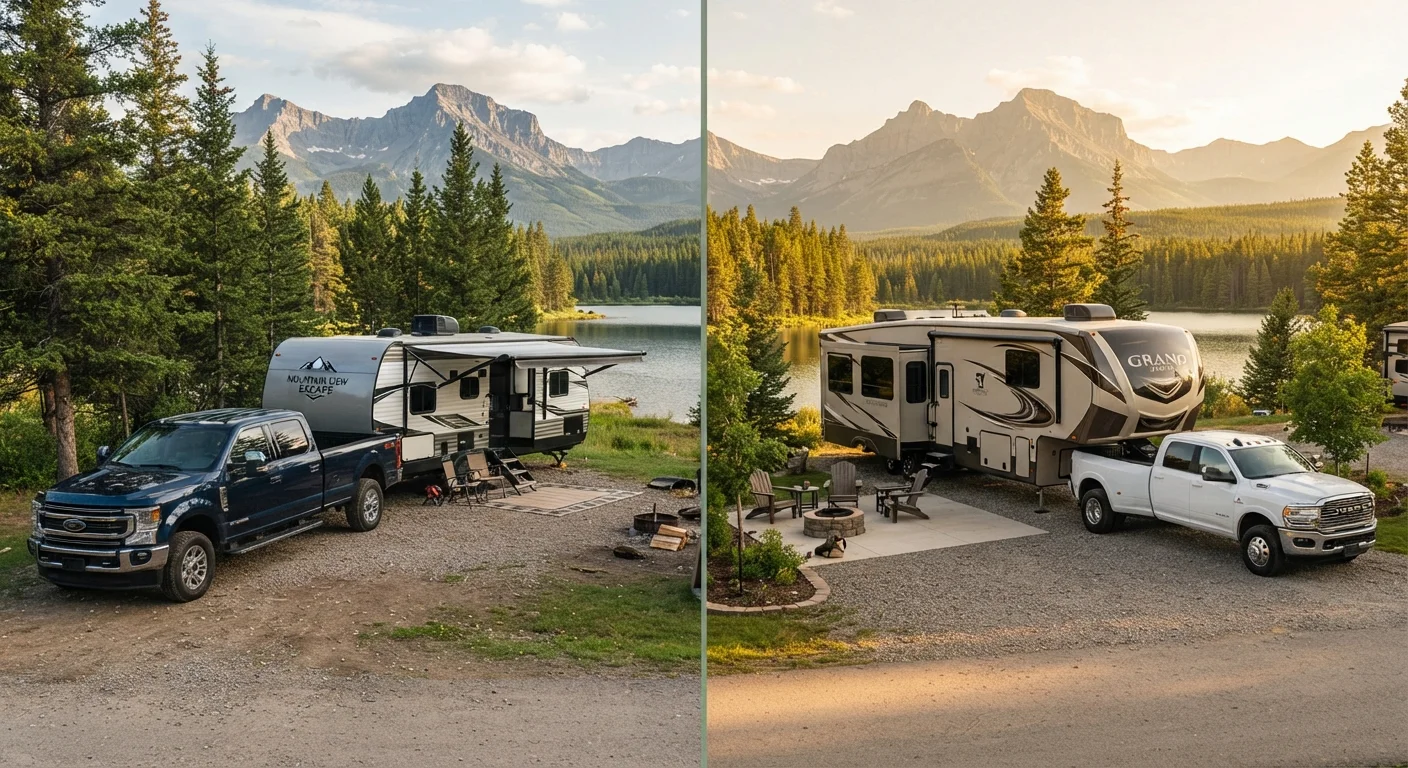
Option A
Travel Trailer
The versatile, widely compatible towable.
Best for: Campers who want flexibility in tow vehicles and a wide range of floor plans at various price points.
Option B
Fifth Wheel
The stable, spacious choice for serious RVers.
Best for: Owners with a pickup truck who prioritize towing stability, interior height, and larger living spaces.
How Each One Hitches to Your Vehicle
The most fundamental difference between these two RV types is how they connect to the tow vehicle — and that connection shapes everything from which vehicle you need to how the rig handles on the road.
A travel trailer uses a ball-and-coupler hitch: a receiver hitch mounted to the tow vehicle's frame accepts a ball mount, and the trailer's coupler drops over it. Weight-distributing hitch systems and sway control bars are commonly added to improve stability, particularly on heavier trailers. This setup can be used on full-size trucks, midsize trucks, and capable SUVs, depending on the trailer's weight.
A fifth wheel uses a completely different mechanism: a horseshoe-shaped kingpin hitch (sometimes called a fifth-wheel hitch) mounted directly in the bed of a pickup truck. The trailer's kingpin locks into this hitch over the rear axle. Because the connection point sits above the truck's rear axle rather than behind it, the physics of towing change considerably. This arrangement is why fifth wheels are limited to pickup trucks — there must be a usable truck bed.
| Criterion | Travel Trailer | Fifth Wheel |
|---|---|---|
| Hitch Type | Ball-and-coupler (receiver hitch) | Kingpin hitch (in truck bed) |
| Compatible Tow Vehicles | Trucks, SUVs, some crossovers | Full-size pickup trucks only |
| Towing Stability | Good with sway control added | Excellent; over-axle connection |
| Interior Height | Typically 6.5–7 ft | Often 7–8 ft |
| Truck Bed Access | Full access when unhitched | Partially obstructed by hitch hardware |
| Price Range | Generally lower entry point | Typically higher purchase price |
| Backing & Maneuvering | Longer learning curve for reversing | More predictable pivot when backing |
Understanding hitch type is just the start. For a broader look at how towable rigs fit into the RV landscape, see our comparison of motorhomes and towable RVs.
Towing Stability and Road Handling
Ask experienced RVers about the biggest practical difference and the answer is usually stability. Fifth wheels have a clear mechanical advantage here. Because the hitch point sits directly over the truck's rear axle, weight is distributed more efficiently, and the leverage that causes trailer sway is significantly reduced. Long highway stretches, crosswinds, and mountain grades feel more controlled with a fifth wheel for most drivers.
Travel trailers, hitched behind the vehicle's rear axle, can be more prone to trailer sway — a side-to-side oscillation that builds momentum if not corrected. Modern weight-distributing hitches with integrated sway control mitigate this substantially, and many experienced towers handle large travel trailers without incident. Still, the physics favor the fifth wheel on pure stability.
~40%
Share of RV shipments that are travel trailers
Travel trailers consistently represent the largest single segment of RV shipments in the U.S., according to RVIA industry data.
1,500–2,000 lbs
Typical fifth wheel tongue weight range
Fifth wheels impose significantly higher pin weights on the tow vehicle than most travel trailers, making proper payload management critical.
Driver experience matters too. Fifth wheels can feel easier to back into a campsite for some, thanks to the predictable kingpin pivot. Travel trailers, because of their longer lever arm, require more deliberate input when reversing. Neither is technically difficult once practiced, but the learning curve differs.
Before selecting either option, verify that your tow vehicle's ratings are appropriate. Our guide on RV weight ratings including GVWR and GCWR explains exactly what those numbers mean and why exceeding them is dangerous.
Living Space, Layout, and Practical Trade-offs
Fifth wheels tend to have a raised front section — typically a bedroom or lounge area — that sits over the truck bed. This bi-level layout adds interior volume without adding overall road length, which is why fifth wheels often feel more spacious than a travel trailer of the same exterior length. Ceiling heights in fifth wheels are commonly 7 to 8 feet, versus 6.5 to 7 feet in many travel trailers.
Travel trailers sacrifice none of the truck bed, but they also don't benefit from it. Their single-level layouts are generally more straightforward and easier to furnish in familiar configurations. Toy hauler variants — which include a rear garage for motorcycles, ATVs, or bikes — are available in both categories, though the fifth-wheel version tends to offer more garage space.
One often-overlooked trade-off with fifth wheels: the truck bed is partially occupied by the hitch hardware. Even when not towing, removing and reinstalling a fifth-wheel hitch is time-consuming. Some owners keep a dedicated tow truck, while others accept reduced cargo access. Travel trailer owners retain full bed utility when the trailer is unhitched.
Campsite Length Limits Matter
Many state and national park campsites have maximum combined length restrictions — often 40 feet. A large fifth wheel paired with a long-bed pickup can push past that threshold quickly. Before purchasing, check the length specifications against campgrounds you plan to use most frequently. Some premium sites have more accommodating limits, but smaller or older parks may not.
If you're still evaluating whether RV ownership is the right path altogether, renting versus owning an RV covers the long-term financial and lifestyle considerations worth weighing before committing. And if you're newer to RV types in general, understanding motorhome class designations provides useful context on the broader RV market.
The content on this site is for informational purposes only and is not a substitute for professional advice. Always consult a qualified professional for guidance specific to your situation.