

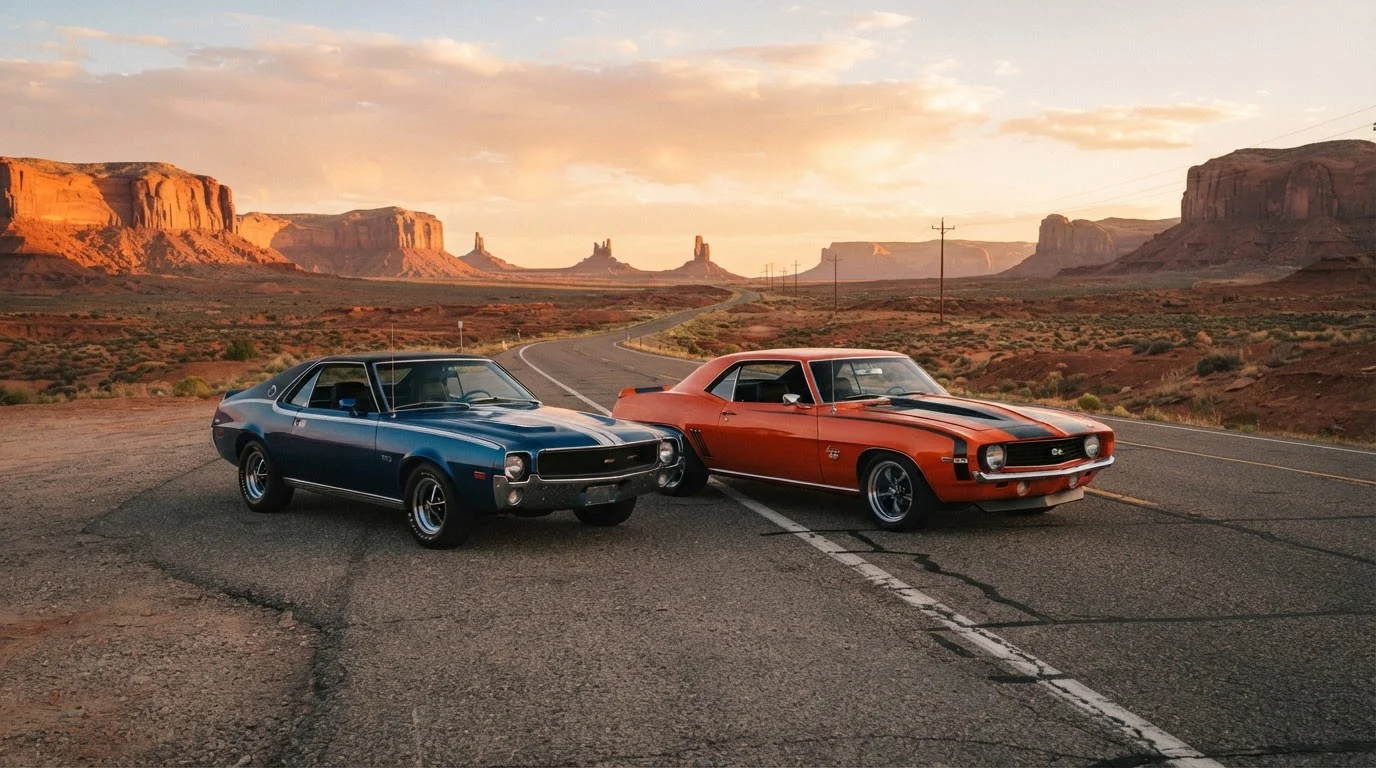
Option A
Muscle Car
The brute-force, full-size performance icon.
Best for: Enthusiasts who prioritize raw straight-line power and large-displacement V8 engines in a mid-size or full-size body.
Option B
Pony Car
The nimble, affordable, youth-market sports coupe.
Best for: Drivers who want a sporty, stylish, compact coupe with accessible pricing and versatile engine options.
Where the Terms Come From
The two labels get swapped constantly in casual conversation, but they emerged from genuinely different moments in American automotive history. Getting them right matters — especially for collectors and anyone shopping the classic car market.
The muscle car concept is generally traced to the 1949 Oldsmobile Rocket 88, which dropped a high-displacement overhead-valve V8 into a lighter mid-size body. The formula was simple: take a large engine, put it in a car that didn't expect to carry it, and sell the result at a price ordinary buyers could reach. By the early 1960s, the GTO, the 442, and the Super Sport variants had codified the segment. Power was the product.
The pony car is a distinct category with a specific birth date: April 17, 1964, when Ford introduced the Mustang at the New York World's Fair. The Mustang was compact, had a long hood and short rear deck, offered a wide range of engines (including a base six-cylinder), and was priced to attract young buyers. Its success immediately prompted competitors — the Camaro, Firebird, Barracuda, and Javelin all followed. The term "pony car" derives directly from the Mustang's name.
Both segments share the 1960s muscle era, which is why the confusion persists. But one category was defined by its engine; the other was defined by its proportions and price. That is the core distinction.
Key Differences: Proportions, Purpose, and Price
| Criterion | Muscle Car | Pony Car |
|---|---|---|
| Defining characteristic | Maximum engine displacement | Compact proportions and styling |
| Typical platform | Mid-size body (e.g., A-body GM) | Compact, shorter wheelbase |
| Original price intent | Performance premium | Accessible to young buyers |
| Base engine options | V8 standard or strongly expected | Six-cylinder often standard |
| Segment origin | Late 1940s–early 1960s | 1964 (Ford Mustang launch) |
| Primary design goal | Straight-line speed | Sporty appearance and versatility |
| Classic examples | GTO, 442, Super Sport, Road Runner | Mustang, Camaro, Firebird, Barracuda |
The comparison above captures the structural differences, but context adds nuance. A muscle car was typically built on a mid-size platform — think the A-body GM cars or the Ford Torino/Fairlane — with a big-block V8 as the point of the exercise. Handling was often secondary. Fuel economy was irrelevant. The car existed to go fast in a straight line.
Pony cars were lighter, shorter in wheelbase, and explicitly designed to appeal to a broader market. Ford's internal research before the Mustang's launch famously targeted buyers who wanted something that looked sporty even if they never ordered a performance engine. This is why base Mustangs shipped with inline-six engines — that was intentional market strategy, not compromise.
The overlap that confuses enthusiasts: Ford, GM, and Chrysler all offered high-output V8 engines in their pony cars. A 1969 Mustang Boss 429 or a Camaro Z/28 has genuine muscle car-level performance, but it still lives in a pony car body. These cars straddle both definitions, and reasonable people debate where they belong. What they are not is evidence that the two categories mean the same thing. See our guide to passenger car body styles for more context on how body architecture shapes vehicle identity.
418,812
First-year Mustang units sold
Ford sold over 418,000 Mustangs in the 1965 model year — a record at the time that validated the pony car formula immediately.
1964
Year the pony car segment was born
The Ford Mustang debuted at the New York World's Fair on April 17, 1964, creating an entirely new vehicle category.
6
Competing pony cars launched by 1970
The Mustang's success prompted Chevrolet, Pontiac, Plymouth, AMC, and Dodge to introduce pony car competitors within six years.
Why the Debate Still Matters for Buyers and Collectors
For anyone buying or restoring a classic, these distinctions carry real consequences. Muscle cars with documented, numbers-matching high-output engines tend to sit at the top of the collector market. Understanding what you're looking at — and what the seller is claiming — requires knowing the terminology accurately. Our editorial piece on matching numbers myths covers how originality claims are evaluated and sometimes misrepresented.
Insurance, registration, and restoration sourcing can also differ. A true high-displacement muscle car may face different actuarial treatment than a base pony car, and parts ecosystems vary considerably between a big-block intermediate and a compact sporty coupe.
For drivers considering a classic as something they'll actually use, the pony car format is often more practical — lighter, easier to park, and more adaptable to modern driving conditions. The trade-offs of driving a classic daily versus showing it apply to both categories, but the pony car's smaller footprint gives it a practical edge on public roads.
When a Pony Car Becomes a Muscle Car Debate
High-performance pony car variants — such as the Mustang Boss 429, Shelby GT500, or Camaro SS 396 — sit at the intersection of both categories. Enthusiast communities genuinely disagree on classification, and both sides make reasonable arguments. The most defensible approach is to acknowledge the body/platform as pony car and the engine specification as muscle car territory. Context and documentation matter more than a single label.
The muscle car vs. pony car debate is a good entry point into a broader habit of thinking carefully about vehicle categories — one that applies just as well to modern vehicles. Just as SUVs and crossovers are often conflated despite meaningful structural differences, classic performance car labels carry real distinctions that affect how vehicles are valued and understood. See why the SUV vs. crossover distinction matters for a parallel example from today's market.
The content on this site is for informational purposes only and is not a substitute for professional advice. Always consult a qualified professional for guidance specific to your situation.