

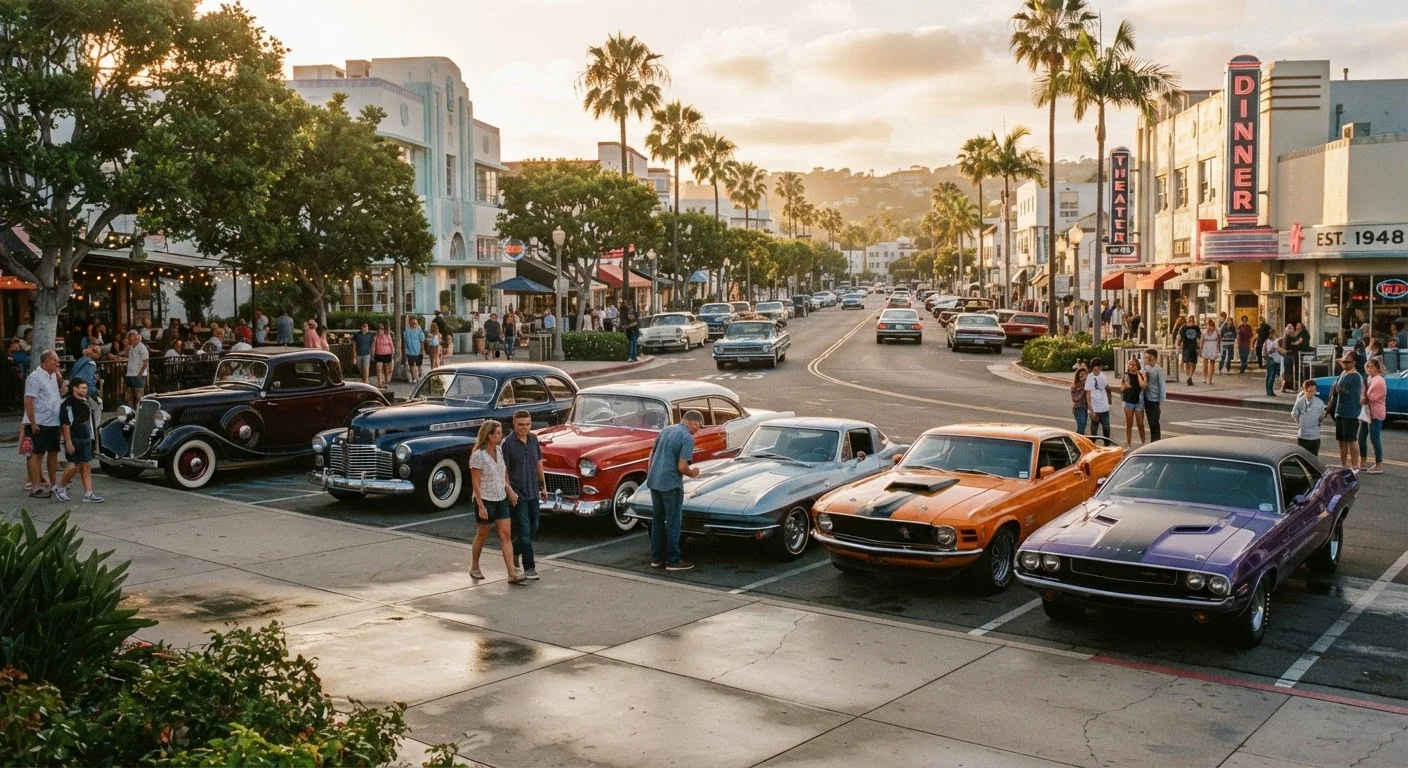
Why Eras Matter in the Classic Car World
American classic cars aren't a monolith. A 1936 roadster, a 1957 hardtop, and a 1970 muscle car all carry the "classic" label, yet they represent entirely different engineering philosophies, material choices, and cultural moments. Understanding which era a vehicle belongs to shapes everything from how you source parts to how you interpret its historical value.
If you're new to the hobby, our comprehensive collector's starting point covers how eras, terminology, and ownership culture all connect. For a deeper look at how "classic" is formally defined — by states, insurers, and registries — see what makes a car classic. The decade-by-decade breakdown below gives you the historical foundation to make sense of it all.
The Prewar Era (1920s–1930s): Coachbuilt Craftsmanship
Before World War II, American automobiles were heavily influenced by European coachbuilding traditions. Bodies were often crafted by independent coachbuilders working with bare chassis supplied by manufacturers. Long hoods, sweeping fenders, running boards, and convertible roadster profiles defined the aesthetic. Straight-eight and V12 engines were marks of prestige in this segment.
Mechanically, these cars relied on drum brakes, manual transmissions with non-synchronized gears, and six-volt electrical systems — features that require period-specific knowledge to restore and maintain correctly. Surviving examples are rare and command considerable attention at auction events and concours shows.
Prewar American cars were often hand-fitted by coachbuilders, making every surviving example historically unique.
The Postwar Boom (1946–1954): Resuming Production
Automakers emerged from wartime production contracts and quickly retooled for civilian buyers. Early postwar models were largely carryovers from prewar designs, but by the early 1950s, manufacturers were introducing new overhead-valve V8 engines, unit-body construction experiments, and the beginnings of the styling arms race that would define the decade's end.
Hydraulic brakes became standard, six-volt electrical systems were still common but twelve-volt systems began appearing, and automatic transmissions — then a genuine novelty — grew in availability. This era produced workhorses and early luxury cruisers that are now appreciated for their relative mechanical simplicity.
The early 1950s introduced overhead-valve V8 engines that set the template for American performance for decades.
The Golden Age (1955–1964): Chrome, Fins, and V8 Power
Often called the golden age of American automotive design, this era delivered the high-tailfin, two-tone paint, wraparound-windshield styling that most people picture when they hear "classic American car." Twelve-volt electrical systems became standard industry-wide during this period, and power-assist features — brakes, steering, windows — rolled out across model lines.
Small-block and big-block V8 engines proliferated, giving buyers meaningful performance choices. Hardtop body styles (no B-pillar, full glass all around when windows are down) reached their styling peak here. Corrosion in body cavities and rocker panels is a common challenge for restorers working on these models today.
Wraparound windshields, tailfins, and abundant chrome made the late 1950s the most visually extravagant period in American car design.
The Muscle Car Era (1964–1971): Displacement and Quarter-Miles
The introduction of high-displacement V8 engines in intermediate-size body platforms — widely traced to the 1964 model year — launched the muscle car era. Automakers competed openly on horsepower ratings, with some engines exceeding 400 cubic inches of displacement. Four-speed manual transmissions, wide-oval tires, and functional hood scoops became period markers.
Collector interest in documented, numbers-matching muscle cars (meaning the engine, transmission, and rear axle carry factory-correct codes matching the build sheet) remains extremely strong. Reproductions and engine swaps are common, so buyers should verify component authenticity carefully. The era ended as insurance surcharges on high-performance vehicles and tightening federal emissions standards made these configurations economically impractical for automakers to continue.
Numbers-matching muscle cars — with original factory-coded drivetrains intact — carry significant premiums in the collector market.
The Malaise Era (1972–1979): Regulation and Adaptation
The combination of new federal emissions regulations, the 1973 oil embargo, and safety mandates transformed American automotive output dramatically. Compression ratios dropped to accommodate unleaded fuel, and horsepower figures fell sharply — often 30 to 50 percent compared with equivalent late-1960s engines. Large rubber bumpers and reduced performance became the era's visual and mechanical signatures.
Once dismissed by collectors, malaise-era vehicles have gained renewed appreciation. Survivors in good condition are increasingly uncommon, and certain models — pony cars, full-size wagons, and early downsized luxury vehicles — now draw genuine hobbyist interest. Their emissions systems and early electronic controls require familiarity with period-specific diagnostic approaches.
Once overlooked, malaise-era American cars are gaining collector appreciation as well-preserved examples become increasingly scarce.
From History to the Garage
Each era left behind vehicles with distinct strengths, weaknesses, and restoration challenges. Prewar cars demand coachbuilding knowledge; postwar chrome-laden cruisers need careful rust assessment; muscle cars often require sourcing correct-date-coded drivetrain components; and malaise-era survivors may need emissions-system expertise.
Match Your Research to the Era
Parts availability, restoration techniques, and community resources vary significantly by decade. A marque club focused on 1950s models will have different technical libraries and supplier networks than one centered on 1960s muscle cars. Identifying your vehicle's era before beginning a restoration helps you find the right expertise from the start. Many era-specific clubs also maintain factory documentation archives that can be invaluable for authenticity verification.
Whether you plan to drive your classic daily or preserve it for shows — two very different approaches covered in daily driver vs. show car ownership — knowing your vehicle's era anchors every decision you make. For the full lifecycle of ownership from title to storage, everything classic car ownership actually involves is an essential read. And when you're ready to connect with fellow enthusiasts, joining the classic car community will point you toward clubs, shows, and resources organized around these very eras.
The content on this site is for informational purposes only and is not a substitute for professional advice. Always consult a qualified professional for guidance specific to your situation.