

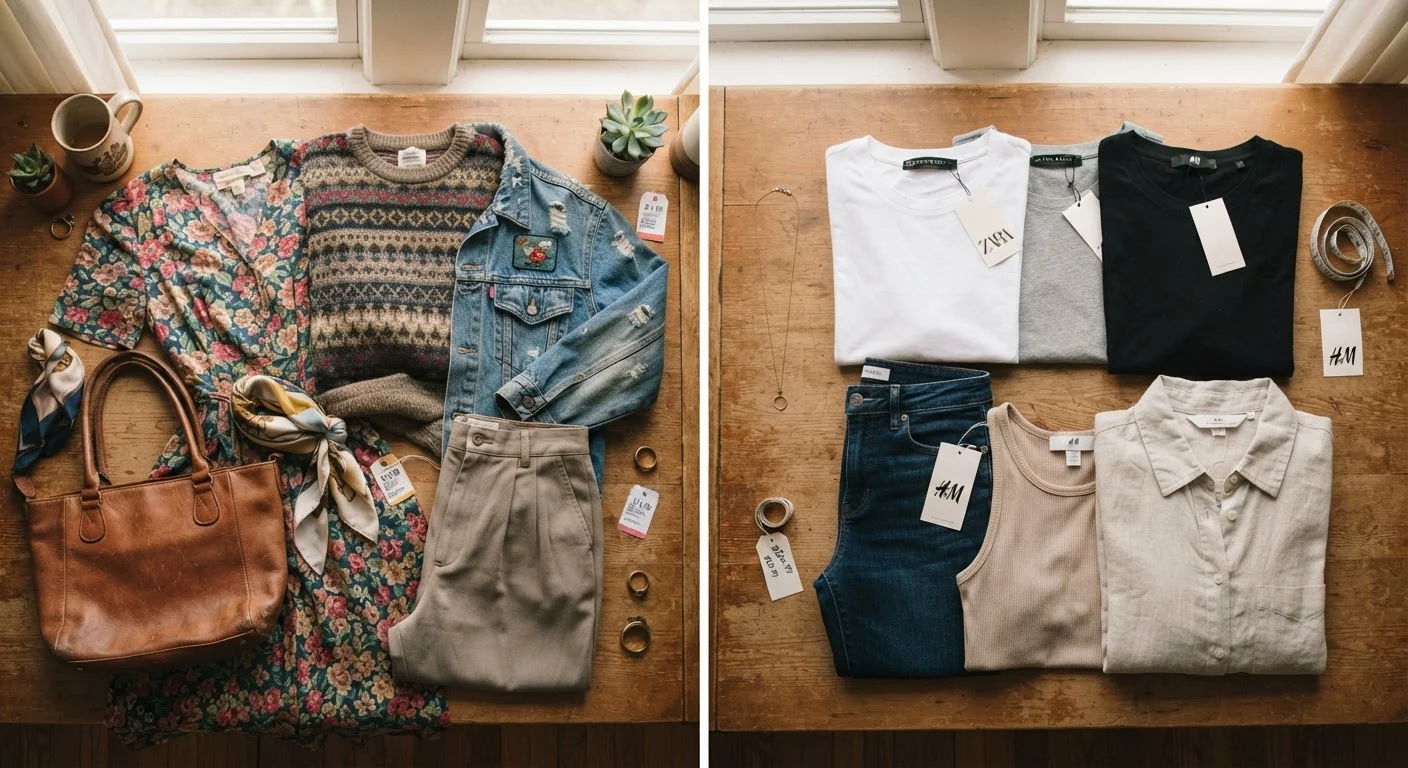
Option A
Thrift Store Shopping
The patient hunter's path to unique, durable pieces at a fraction of retail.
Best for: Budget-conscious shoppers who have flexibility in timing and enjoy the search process.
Option B
Fast Fashion
The instantly accessible, trend-forward option with a hidden long-term price tag.
Best for: Shoppers who need specific items quickly and prioritize convenience over longevity.
The Real Price Tag: Cost Per Wear
A $12 thrifted blazer sounds like a clear win over a $40 fast fashion version — until you factor in how long each actually lasts. Cost per wear (the price of an item divided by how many times you'll realistically wear it) is the more honest number to track.
Fast fashion garments are often made with thinner fabrics, lighter stitching, and finishes that fade or pill after a dozen washes. If that $40 blazer only survives one season before looking tired, your cost per wear climbs quickly. A thrifted piece made in an earlier era of manufacturing — when fabric weights were generally heavier — can hold its shape for years if cared for properly.
That said, not every thrift find is a gem. Condition varies wildly, and a heavily worn item is still a heavily worn item regardless of what it originally cost. Inspect seams, zippers, and fabric carefully before buying. For a practical approach to evaluating what's worth adding to your closet, see our guide to building a wardrobe from scratch.
| Criterion | Thrift Store Shopping | Fast Fashion |
|---|---|---|
| Average item price | Generally lower ($2–$20) | Low to mid ($5–$50) |
| Cost per wear (typical) | Often lower over time | Often higher due to shorter lifespan |
| Fabric quality | Varies; older pieces often heavier | Typically lighter, synthetic blends |
| Size & style availability | Unpredictable, hunt required | Consistent and reliable |
| Convenience | Time-intensive | Fast, including online options |
| Environmental footprint | Generally lower (extends garment life) | Generally higher (new production, waste) |
| Trend alignment | Hit-or-miss | Consistently current |
Quality and Longevity: What the Fabric Tells You
Fabric composition is one of the most reliable indicators of how long a garment will last — and it's where the two shopping models diverge most visibly. Many fast fashion items lean heavily on polyester blends that resist wrinkling but trap heat, pill over time, and don't breathe well. Higher natural fiber content (cotton, wool, linen) generally signals better durability and comfort.
Thrift stores often carry pieces from decades when natural fibers were more standard in everyday clothing. A 100% cotton Oxford shirt from a thrift rack may genuinely outlast multiple fast fashion equivalents. The tradeoff? You have to do more legwork — checking labels, feeling the weight of fabric, and skipping anything that's already pilling.
Whichever route you use, how you care for clothes matters enormously. Our fabric-by-fabric care guide breaks down washing and storage best practices that apply to any garment in your closet.
~$1,700
Average annual U.S. household clothing spend
According to the U.S. Bureau of Labor Statistics Consumer Expenditure Survey, American households spend roughly this amount on apparel and services each year.
3×
How much longer natural fibers can last vs. many synthetics
Textile durability research generally finds that higher natural fiber content correlates with significantly longer usable garment life under regular washing conditions.
~70%
Of thrift shoppers cite saving money as primary motivation
Consumer surveys on secondhand shopping consistently find cost savings as the leading driver, followed by environmental concern and finding unique items.
Availability and Convenience: The Honest Comparison
Fast fashion's biggest genuine advantage is predictability. You can walk in — or shop online — knowing you'll find your size, a specific color, and a consistent fit. That's not a small thing when you need work pants before Monday or a specific dress for an upcoming event.
Thrift shopping, by contrast, rewards patience and flexibility. Inventory rotates constantly and unpredictably, which means you might score an incredible wool coat or leave empty-handed three visits in a row. It's not an ideal strategy when you have a precise wardrobe gap to fill on a deadline.
A hybrid approach works well for most people: use thrift stores to build out the volume of your wardrobe (basics, layering pieces, blazers, jeans) and lean on fast fashion selectively when you need something specific and timely. This is especially useful during seasonal wardrobe transitions when you may need to fill a gap quickly.
Thrift Shopping Takes Practice
If your first few thrift store visits feel overwhelming or unproductive, that's normal. Most experienced thrift shoppers develop a consistent routine — visiting the same stores on restock days (often mid-week) and focusing on specific sections. The payoff in both price and quality tends to improve significantly once you know what to look for and where.
The Bigger Picture: Spending Patterns Over Time
Neither thrift shopping nor fast fashion is automatically the frugal choice. Fast fashion's low per-item prices can make it easy to buy more frequently and impulsively — a pattern that adds up faster than most people expect. Research on consumer spending consistently shows that small recurring purchases erode savings more effectively than occasional larger ones. For a broader look at how clothing habits fit into your financial picture, lifestyle choices that quietly drain savings is worth a read.
Thrift shopping isn't immune to this either. The thrill of a low price can drive over-purchasing — buying things simply because they're cheap rather than because you'll actually wear them. A deliberate, needs-first mindset matters regardless of where you shop.
As for environmental impact: buying secondhand generally extends a garment's useful life and reduces new production demand. Fast fashion's high-volume, low-cost model is associated with significant textile waste, though the full picture is complex and includes factors like shipping, dyes, and consumer behavior. The most sustainable garment, by most measures, is one you already own and actually wear — which is also the most budget-friendly one. And as fit consistently outperforms brand name, a well-fitting thrift find can look just as polished as anything new.
The content on this site is for informational purposes only and is not a substitute for professional advice. Always consult a qualified professional for guidance specific to your situation.